Juno Snaps Rare Close-Up of Jupiter’s Shadowy Moon Thebe


NASA’s Juno spacecraft captured a new view of the irregular moon Thebe during a flyby on May 1, revealing the battered world just 5,000 km away.
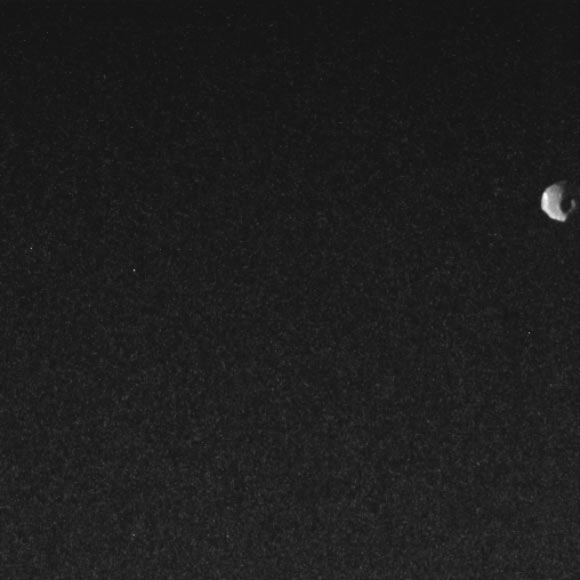
Juno captured this view of Thebe during a close flyby on May 1, 2026. Image credit: NASA / JPL-Caltech.
Thebe is a small, irregularly shaped moon, measuring approximately 116 x 98 x 84 km and an average radius of approximately 49 km.
It is the second largest inner moon of Jupiter and the seventh largest moon in the Jovian system.
Thebe was discovered in 1979 by astronomer Stephen Synnott using images from NASA’s Voyager 1 spacecraft.
It orbits Jupiter at an average distance of about 221,900 km, well within the orbit of Io, Jupiter’s innermost Galilean moon. One orbit takes approximately 16.1 hours.
Like many inner moons, it is tidally locked, meaning the same face always points toward Jupiter.
Thebe has a dark reddish, heavily cratered surface. Its most prominent feature is the large impact crater Zethus, named after Thebe’s mythological twin brother.
One of Thebe’s most notable contributions is that the Moon is the primary source of material for Jupiter’s Spider Ring, one of the faintest outer rings of Jupiter’s ring system. Micrometeorite impacts push dust from the Moon’s surface, which then spreads in a diffuse ring along Thebe’s orbital path.
“Thebe resides at the outer edge of Jupiter’s weak ring system and is thought to play a role in the formation of the planet’s ‘spider’ ring through the shedding of dust,” NASA scientists said in a statement.
The new image of Thebe was captured with the Stellar Reference Unit (SRU) on board the Juno spacecraft at a distance of about 5,000 km.
“Although the primary function of the SRU is to image star fields for navigation, its high sensitivity in low-light conditions makes it a powerful secondary scientific instrument,” the researchers said.
“The SRU has already been used to discover ‘shallow flashes’ in Jupiter’s atmosphere and to image the planet’s ring system.”