Hyper’s TrackPad Pro wants to make your mouse obsolete… but I hate it


Consider this an apology to Hyper and his parent, Targus. I don’t want to use HyperSpace’s standalone TrackPad Pro haptic trackpad and I’ve probably wasted your time, Hyper’s time, and mine. Perhaps, dear reader, you will feel differently. Me? I just can’t stand it.
Hyper’s $150 Haptic Trackpad Pro (or $109 on Kickstarter) taught me that I’m a mouse enthusiast first and foremost and that I absolutely don’t need the advanced capabilities the trackpad offers, such as deep clicking and various “zones” in which clicks trigger different actions. I don’t want anything to do with them.
When I saw the TrackPad Pro at CES 2025, I liked the concept but was less than impressed with the execution. It just didn’t really work. This is the case now. Still, my time with Hyper’s TrackPad Pro has taught me that this touchpad peripheral is a device for typing and trackpad nerds. And I’m neither.
A haptic touchpad is worth your time, though. Simply put, haptics are like OLED in touchpads. They are a step forward, because they are clickable across the entire width of their surface. Apple Macs and some Microsoft Surface devices use a touchpad or haptic trackpad, and they’re efficient and futuristic, all in one. Some have compared Hyper’s TrackPad Pro to Apple’s Magic Trackpad and that comparison seems fair.
In all honesty, the signs were there from the start. Hyper sent me a TrackPad Pro for review, and I received it just before leaving on a two-week business trip, along with a laptop and mouse.
Why am I a fan of mice? I’m left-handed and have steadfastly held on to a left-handed Razer DeathAdder mouse that I bought years ago. Lefties are forced to make all sorts of accommodations in their lives, like learning to use right-handed scissors or reluctantly accepting that the WASD setup on a computer keyboard isn’t for them. (I rather prefer the top numpad layout.) As a result, I use a left-handed mouse, but I’ve been trained to left-click with my middle finger rather than my index finger. Chaos! This is the trauma imposed by the right-wing world.
Mark Hachman / Foundry
As a result, touchpads usually mess with my head. I’m supposed to click which corner of the touchpad to right click? (Bottom left.) And while Windows lets you tap with two fingers to right-click, the Hyper touchpad doesn’t. Ugh.
It’s not entirely my fault
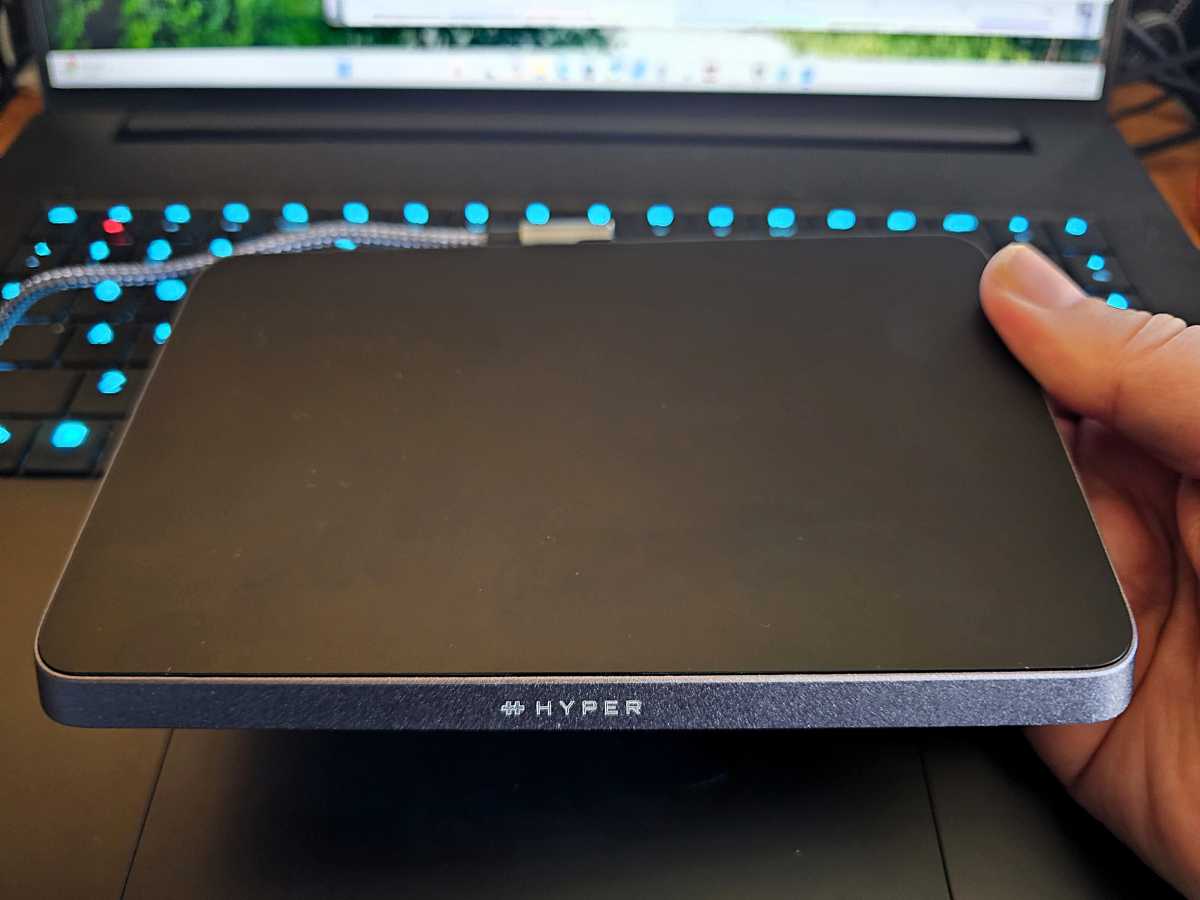
In my defense, though, I think it’s fair to say that Hyper’s setup experience is bad. The device itself is fine: the TrackPad Pro measures 3.85 inches x 6.29 inches (98mm x 160mm) and maybe half an inch thick, which connects to your PC via a braided USB-C cable.
Physically, the device works well. The surface is metallic and smooth, with a report rate of 240 Hz. All this means that the trackpad feels extremely smooth and responsive, without any hitches or stutters.
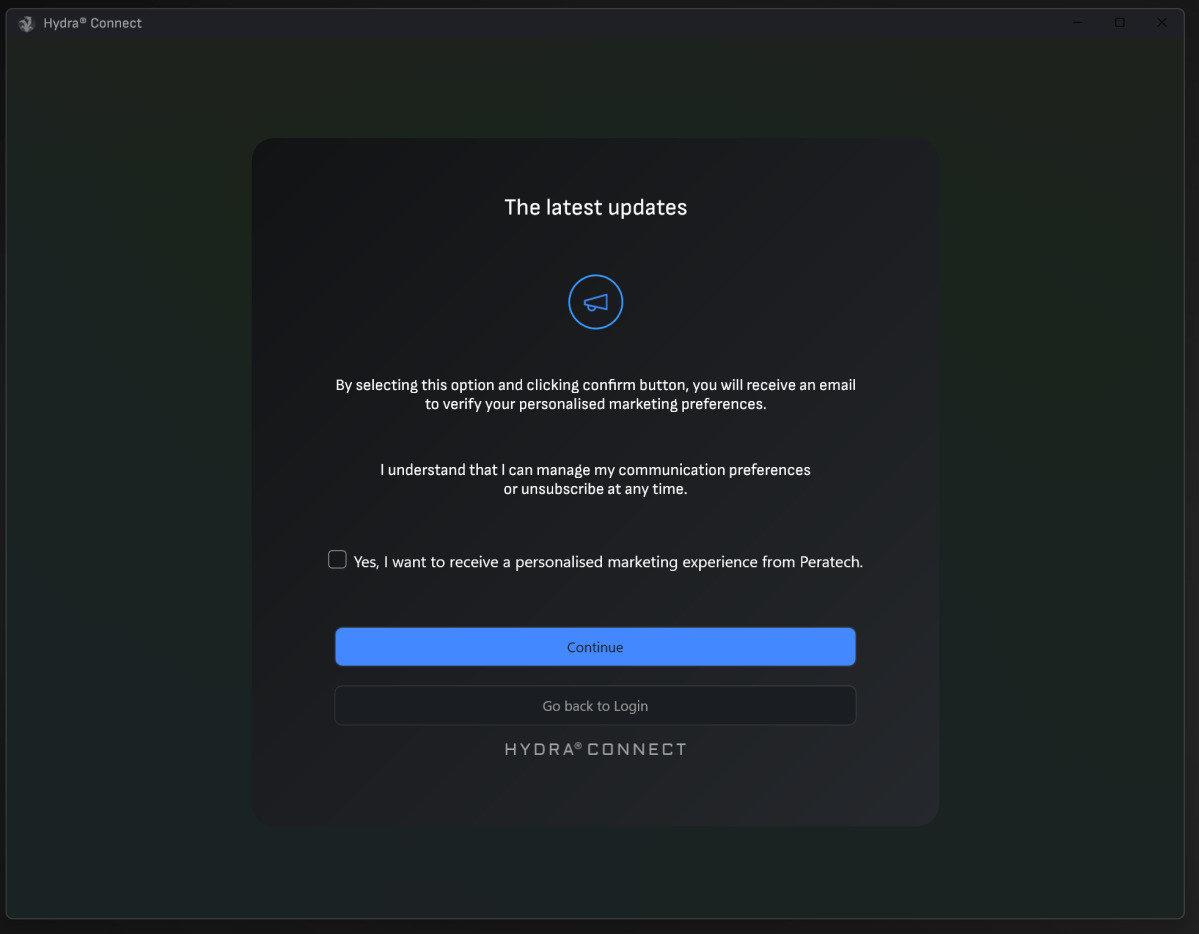
However, to enable full functionality, you need to download a Hydra Connect app. First, Hydra enforces the need for an account and password, which instantly makes me suspect something nefarious is going on behind the scenes. Second, the software immediately asks you if it can send you marketing emails – I don’t think so. Third, although the software attempts to guide you through its features, the accompanying text windows are too small to contain the entire explanation, which seems amateurish. Fourth, why dedicate an entire app tab to Hydra Connect, a feature listed as “coming soon”?
Mark Hachman / Foundry
Finally, did anyone in the Marvel era really think “Hydra” would be viewed positively? Especially after asking to spam you? Come on.
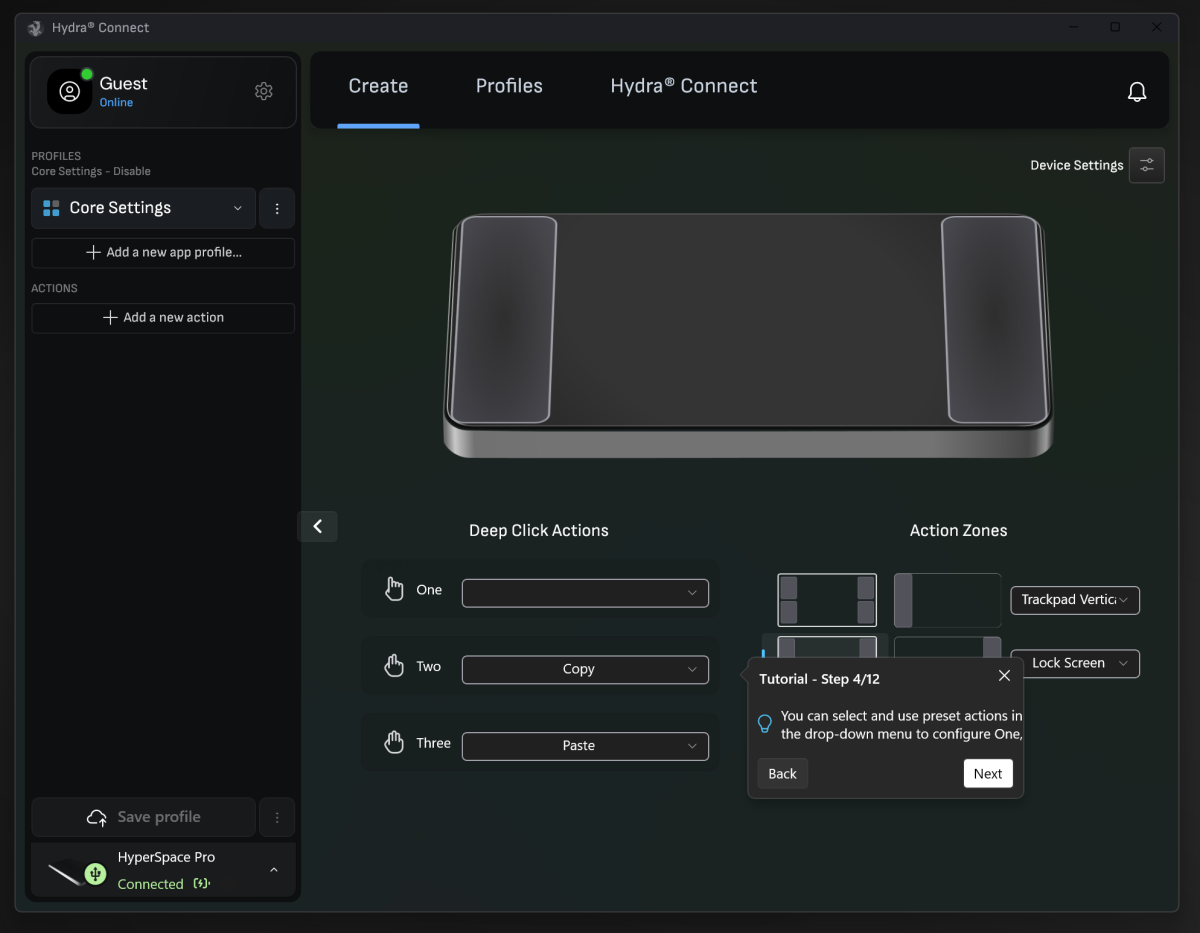
The Hydra app, to its credit (?), is extremely detailed. You can define areas on the trackpad surface, where specific clicks will have specific actions defined. Unfortunately, I kept coming across an area where clicking would freeze my laptop – this got old quickly. You can set profiles for various applications like Photoshop, where specific types of clicks have various functions. Interestingly, even though the TrackPad Pro seemed large enough to use as a graphics tablet, this feature didn’t seem to be enabled.
I’ll be honest: I tried to test the TrackPad Pro. But I knew from the start that I wouldn’t like it, so I didn’t give it more than a few hours. In the spirit of fair play, I will direct you to a competitor, Wiredwhose handling of the Hyper TrackPad seems more objective.
Mark Hachman / Foundry
The TrackPad Pro has a nice feature: a “deep click”. Simply touching the tablet is one input, pressing it enough that it clicks is another. But you can press it even harder so it registers a “deep click,” which could signal something else entirely. Detecting how far you’ve pressed the trackpad is a bit iffy even at the best of times, and you really shouldn’t set a single command to trigger at different pressure levels.
(I once found a way to configure these deep clicks, then apparently lost that ability forever in the Hydra’s stomach.)
In any case, if you’re the kind of person who likes to configure a trackpad in a precise way, with specific functions defined, the Hyper TrackPad Pro might be for you when it ships in early 2026. If I’d realized I really had no use for it, I would have politely declined a review copy. But I learned something! While I still think a haptic touchpad is probably the future of laptop typing, Hyper’s dedicated touchpad just isn’t for me.