
You might have heard mixed things about the safety of breathing the same air as your 3D printer. While the smell of melted plastic isn’t exactly pleasant, I was curious about what effects the average 3D print had on the air around me, and how it compared to my usual daily routine.
How I did this
I want to preface this by acknowledging the limitations. I monitored a single print, using a household air quality monitor I bought from IKEA. The monitor, a Vindstyrka, only measures the volatile organic compound (VOC) index and presence of one type of particulate matter (PM2.5). It’s usually in my living room so I can glance at the temperature and humidity.
For the setup, I put the air quality right next to the vent on the back of my Bambu Lab P2S, an enclosed printer that includes an activated carbon filter as stock. The printer is in a small bedroom, which we use whenever guests stay. The print bed gets way more use than the sofa bed, put it that way.
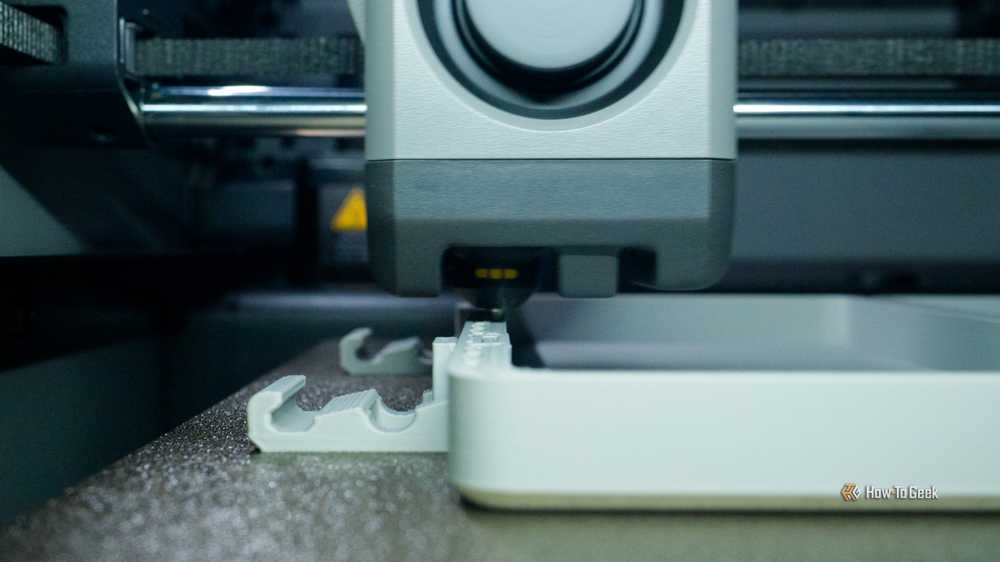
While I normally switch the ceiling fan on and open a window whenever I send a job to the printer, I wanted to really saturate the air for the purposes of this test, so I did neither of these things. Though the P2S is an enclosed 3D printer, it doesn’t (yet) have any extraction fan or filter fitted to it. There’s only an intake fan on the unit, and the enclosure isn’t exactly airtight.
So far, I’ve only printed PLA, which is widely considered the most versatile print material for home users. This is a biodegradable filament that’s essentially made from plants. Many consider it to be “safe,” but there is evidence to suggest that PLA can contain contaminants that are released into the air when it is heated to melting temperature.
The print, a toolbox in which to store the various tools that come with the P2S, took just over four hours and consumed around 175g of filament.
Here’s what I observed
Though the air quality monitor I used leaves much to be desired, it seems to work pretty well for everyday use. I notice the VOC levels spiking when I cook in the next room (on a gas stove), and the PM 2.5 levels shoot up dramatically whenever there’s a bush fire or controlled burn happening nearby.
One of the most interesting things I’ve noticed is the VOC index spiking whenever my partner sprays perfume in the living room before getting ready for work, and how a similar thing happens when I’m using cleaning products or furniture polish. At the same time, the PM 2.5 levels barely rise above 5 µg/m³ on a daily basis, normally coinciding with rush hour traffic.
So here’s the VOC graph in the four or so hours following my starting the print just after 9 am:

And here’s the PM 2.5 graph from the same period:

Based on these results, we can conclude that the effect on PM2.5 is non-existent (unsurprising). For VOC, there is a measurable uptick during the print, with the index peaking at 248. The level then appeared to drop, hovering around the 150 mark.
This persisted until I opened the window and turned the fan on, sharply dropping off thereafter:

So how bad is this effect, really? Ultimately, this depends on precisely which VOCs are being released. But for comparison, here’s a graph of my VOC index readings over the past week:

The highest peaks that you see (highlighted in red) correspond with me cooking using the stove. The slightly lower peaks correspond with me using the stove to boil water for coffee. The period that was monitored during a 3D print (right next to the printer) is highlighted in yellow.
Is there a takeaway here?
Perhaps the most important conclusion here is that enclosed printers like the P2S still cause VOC levels to spike during printing. This would likely be more pronounced on a “bedslinger” like the A1. The other obvious takeaway is that ventilation is good for your home (a surprise to nobody). Whether you’re cooking, 3D printing, or cleaning the house, you’re introducing potentially harmful airborne contaminants into your home. Opening the window rapidly dissipates these.
My intent is to always ventilate the room when I’m printing, and I’m going to stick to that. I feel vindicated in my decision to put the printer in a room that I can shut off from the rest of the house, rather than having it in a central position. I’m also going to get Bambu Lab’s fan attachment so I can direct the fumes out of a nearby window.
If you’re wondering where your printer should go, take my results with a pinch of salt. One thing I will say is that even when ventilating the room, the smell of melting PLA is often present, and it’s not exactly something I personally enjoy the smell of. This even happens when I’m drying PLA at the recommended 45ºc.
Looking for more 3D printing health tips? Learn why there’s no such thing as a food safe 3D print.


:max_bytes(150000):strip_icc()/Health-GettyImages-FoodsThatAgeYou-75532ebe037f493896a7a46d100b14c5.jpg?w=390&resize=390,220&ssl=1 "5 Foods That Could Be Aging You Prematurely, According to Experts")
