‘I never thought I’d make it to this age’



 BBC
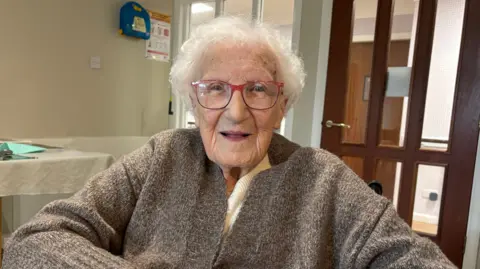
BBC“I never thought I could reach this age,” says 100-year-old May O’Shea. “I thought I would be dead by now.”
The May milestone remains a milestone achieved by very few people, even though the number of centenarians in the UK has doubled in the last 20 years.
Latest figures from the Office of National Statistics (ONS) show that around 16,650 people aged 100 or over were living in the UK in 2024, a record high.
In Scotland, where May lives, there were 1,000 centenarians for the first time, but this is still an age reached by only one in 5,000 people.
May, born in Port Glasgow in 1925, said: “I don’t feel like I’m 100 years old, I feel a lot younger. I look at my hands and I’m shocked.”
Looking back on her long life, she remembers surviving a German blitz on Port Glasgow during World War II, which destroyed her neighbors’ homes.
“We could see all the flames in the sky, it looked like a sunset,” she remembers.
May moved to London after the war and became a housekeeper, spending three years working for iconic 80s band Depeche Mode.
She had her son Jim, who is now 70, before returning to Scotland later in life where she became grandmother to her three grandchildren and seven great-grandchildren.
The centenarian says she reads two newspapers every day, which are delivered by Jim, who she credits with keeping her alert.
When asked if there’s a secret to such a long life, she cites the fact that she “never smoked or drank,” and advises those who want to follow in her footsteps to “take care of themselves and don’t overdo it!”
Paul Shiels, professor of geroscience at the University of Glasgow, says the increase in people living to 100 can be explained by improved living conditions, better diets and general improvements in public health.
He said: “Over the last century we have seen advances in medicine, better detection of disease, better treatment of disease, more widespread use of vaccines and the advent of antibiotics.
“It really allows people who would have died younger to live longer.”
ONS statistics show that women make up more than 80% of those who reach 100.
However, the number of men living to a very old age is increasing rapidly.
Twenty years ago, men represented 10.9% of people aged 100 and over, but today they represent 18.4%, or almost one in five.
“Women age better than men,” explains Professor Shiels.
“They handle psychosocial stress much better and tend to be more social.
“There is no clear answer as to why the rate of men reaching 100 is increasing faster than that of women. I think it could be that the number of women has plateaued and men are catching up.
“We may see another slight increase in the number of people reaching 100 over the next few decades, but I don’t think it will be dramatic.”
 Murrayside Retirement Home
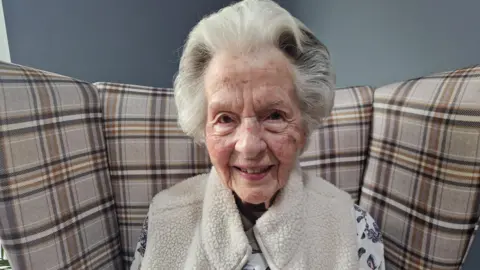
For Mary Smith, 104, good genes are the key to a long life.
Mary was born in Korea in 1921 to British parents, before traveling the world with the Navy.
She was 23 at the end of World War II, a day she still describes as her “favorite memory.”
“I was posted to America when the end of the war in Europe was announced,” she remembers.
“I was in a boat, halfway across the Atlantic Ocean, and we were able to turn the lights on for the first time.”
While in Washington, D.C., she married her husband, a British army officer, and had two sons.
She attributes her longevity to her “tough ancestors.”
“My ancestors always remained sharp, both mentally and physically, and all remained very active into old age,” she says.
Her carers at Murrayside Care Home in Edinburgh also add that she “never misses a gym class”.
“They keep me fit and keep me moving, keep me from getting stiff. I’m very determined, I won’t give up,” she says.
The best ways to reach 100
Professor Shiels says that although genes play a role in longevity, they are not the main factor in determining whether you will live to be 100.
He says: “We still know a lot more about what actually causes us to age, and the big surprise is that your environment probably has more influence on your age and age-related health than your genetics. »
Instead, he says, environmental stressors such as whether or not you eat a balanced diet; if you smoke or drink alcohol; oral health and the amount of exercise you do play the most important role.
“There are unique aspects of aging, but the overall picture is relatively uniform,” says Professor Shiels.
“If more of us want to live to be 100, we need to change our environment and change our lifestyle.
“Many influential scientists now claim they can make you younger, but I am very skeptical.
“In the real world, you need balance. Reducing stress, doing things in moderation and being social: these are the best ways to approach 100.”
 Stephanie Bell
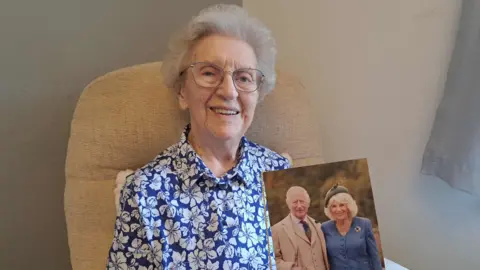
Jean Aitken, a former teacher also from Port Glasgow, gives some additional advice which she says helped her reach her 100th birthday.
“Everyone always wants to know the secret.” she said.
“I’ve never been sporty, but all my life I’ve always done a lot of Scottish country dancing,” she says.
“Another thing is I don’t drink milk and I never have – I never liked it.”
Jean lived with her twin sister Margaret, who died at age 92, before moving to a care home at age 99.
She took classes on using an iPad, which she uses to order groceries and share photos and videos with her family.
Her great-niece, Stephanie Bell, describes her as a very positive person who “always lives life to the fullest.”
For Jean, the advice for living to be a hundred is simple.
She says, “Keep going, you just have to keep going.” »