I optimized Windows Search to find any PC file in a flash. Here’s how


Have you ever looked for a file in Windows and are you empty? Or expected for too long for the results? You are not alone. Many users find that Windows Search frustrating and really sum up its default settings.
By default, Windows only indexes certain locations such as office and musical documents, images and libraries under “my documents”. If you organize your files differently, you could be left pending or find nothing at all.
Another Windows oddity is that search results may vary depending on where you start search. Whether you use the Start menu, the file explorer or the taskbar, everyone can produce different results.
In this guide, we will show you how to adjust the integrated research settings of Windows so that you can quickly find what you really look for.
How to perfectly configure office search
It is perfectly logical that Windows does not indicate the set of hard drive by default and is also limited to certain file types. Otherwise, indexing would consume many more resources. The search also returns all kinds of system files. You will then have to carefully pass these results to find the files you really need.
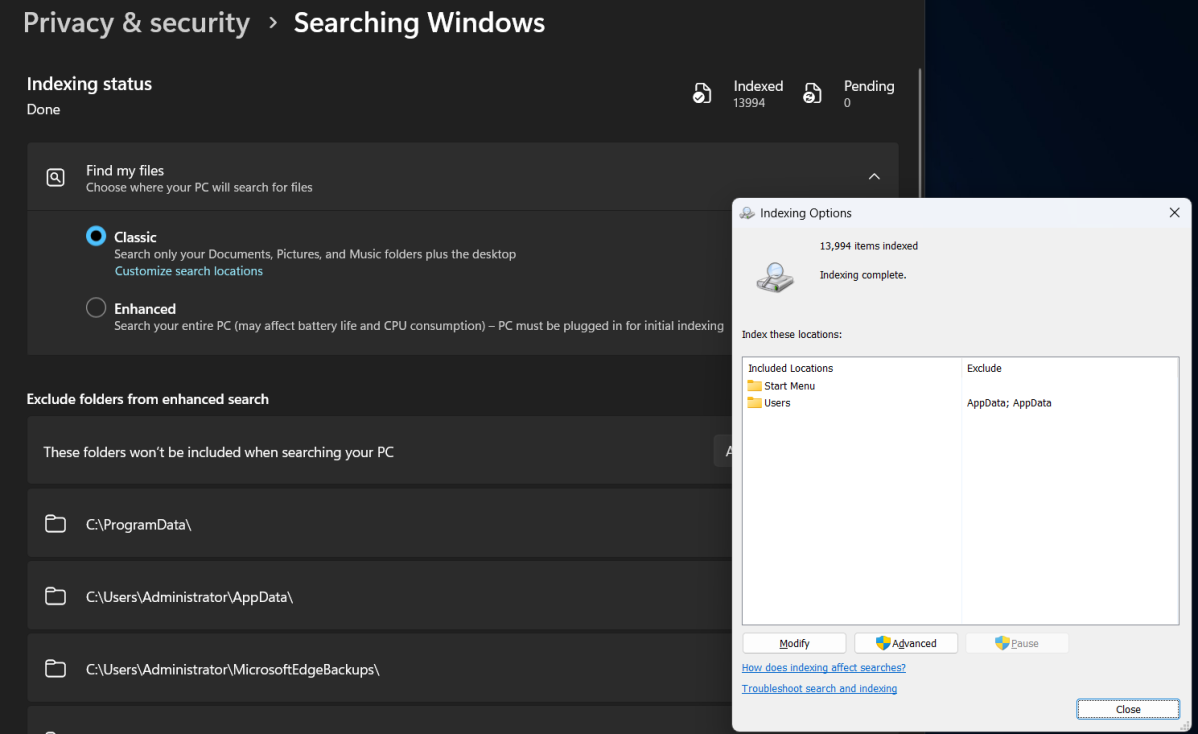
Unfortunately, this is exactly what can happen if you carefully activate the “improved” option displayed in the image above and neglect the “searching everything” notice in the small impression below.
This is why, in the following steps, we will show you how to adjust the default search parameters appropriately. The stages described apply to Windows 11, but they only differ slightly by Windows 10.
Here’s how it works: To customize indexed hard drive directories, open the Windows Settings application, click on “Confidentiality and security” on the left, then click the Blue link “Customize search locations – Load” under “Classic” on the right.
This opens a window where you can use the drop -down arrows at the top to select the directories that Windows should include in the desktop search.
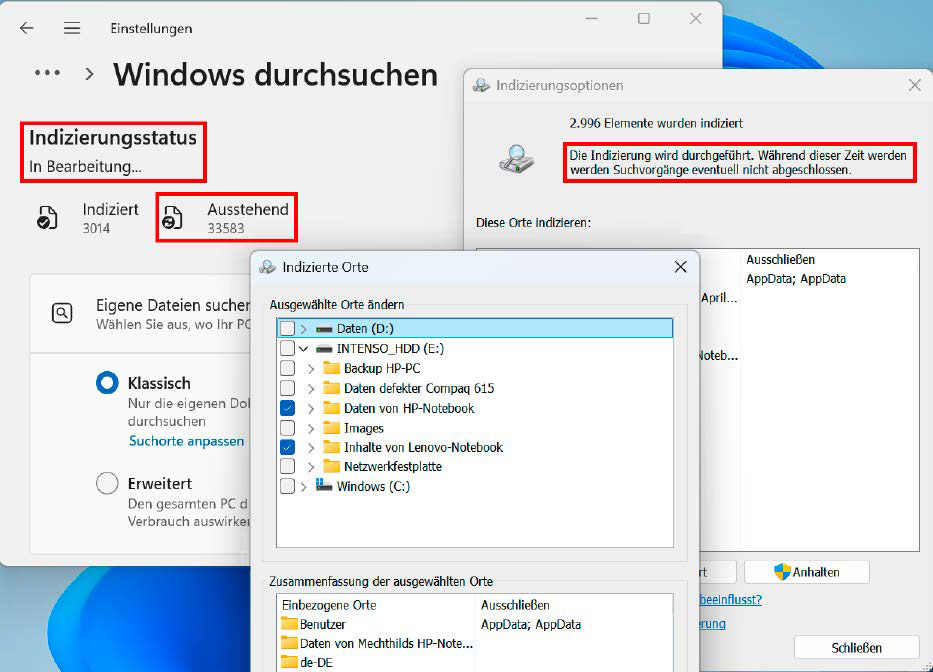
Confirm your selection with “OK”. Depending on the size and content of the additional files, the reindexing can take up to several hours.
Meanwhile, you can continue to use your PC as usual, but search results may not work properly as long as the index is fully rebuilt.
Once the indexing is complete, all the files or folders you add or modify later will be automatically (and almost immediately) added to the search index.
IDG
Network players and external hard drives can also be included in Windows research in the same way. However, it is important to note two things: first, the discs must remain on or connected until the message “indexing is finished” appears.
Second, the research feature for external readers only works until the reader’s letter does not change. If necessary, use the USB Drive information tool to avoid problems.
Additional settings are available via the “Advanced” button next to “Modify”. Here you can choose to index encrypted files, rebuild the search index if problems arise or modify the location where the index is stored.
For example, you can move it to another score if space on the Windows partition is exhausted. Indeed, the search index occupies ten percent of the space required by indexed files.
Using File Explorer for more reliable searches
Once you have configured the desktop search, using it should (in theory) be simple and effective. Unfortunately, this is not always the case.
On the one hand, Microsoft offers two different entry points: the search field in the taskbar (or in the start menu) and that of File Explorer. These behave very differently.
Although the search for bar or start -up menu is fast, it often does not return the desired result. For example, even if the search term is part of the file name, Windows will only display it if the file storage location is included in the index.
The categories indicated in the Start menu – applications, documents, settings, folders and photos – are also not very useful. Indeed, contrary to what Microsoft claims, they do not filter with the type of file, but by its storage location.
So, if you are looking for a recorded document outside the default locations, click on “documents” will not help you. In the end, this research option is often struggling to display the results in a clear and structured manner.
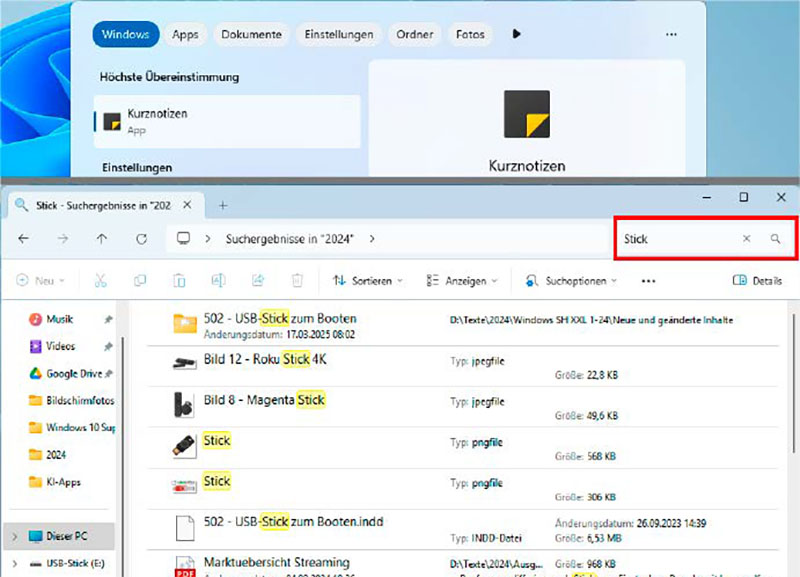
Although Windows search via the start menu does not often lead to the target (above), classic search via file explorer generally finds the desired files quickly and reliably.
IDG
Research in File Explorer offers more control, which in turn gives best results. As long as the open folder has been indexed to search for office, Windows lists very quickly, correctly and completely.
It also works when two or more keywords have entered. Even with hundreds of success, you can easily reduce things and find what you’re looking for. To do this, click on “Trier” or “Search options” in the menu bar at the top of the file explorer.
It can also help deactivate the “file content” option here.
Advice: Because search in the Explorer window always applies to the currently open folder and all its sub-folders, be sure to select the correct level in the folder system of your hard drive before starting your search.
Find photos by subject and people
Image analysis by subject and content is much more advanced than office search for text -based content.
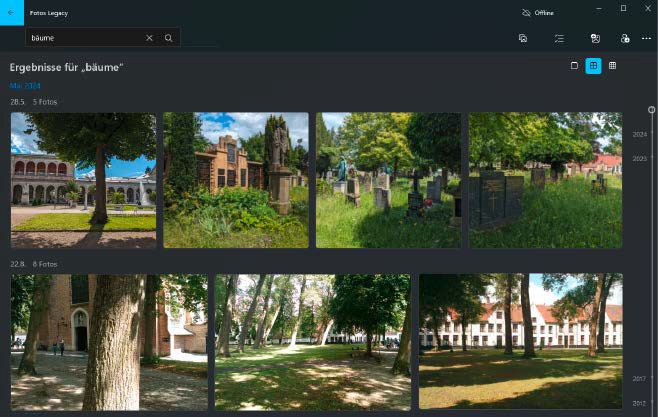
To use it, download Microsoft Photos Legacy from the Microsoft Store. This old inherited application displays and organizes your images like the new Windows photo viewer, but it can do even more.
You can find a description of key features on the Microsoft website.
IDG
The Legacy app automatically analyzes and marks your photos in the background. Without needing to manually attribute tags, you can simply “search for people, places and things” using the central search bar at the top. Overall, the image analysis and the automatic search function work quite well, even if the marking of keywords is not always exact.
In addition, the Legacy application offers facial recognition and OCR recognition for text in images. The text search also finds corresponding recordings and screenshots with corresponding content.
Best alternatives to Windows Search
Regarding alternatives to Windows research, everything is one of the best. This light tool is easy to use, offers a practical interface for advanced research and supports a wide range of search operators.
Everything is also very fast: as soon as you type the first letters in the input line, the corresponding results appear.
After installation, the everything appears in the lower right corner of the taskbar. You can launch and use the search quickly from there.
The “Advanced Research” option (under “research”) is particularly useful. It allows you to limit your search term to whole words, to search for exact sentence, to use logic or logic and exclude certain words, among others.
Important: The yellow exclamation mark indicates that the tool does not seek in the content of the file. So, everything is not a complete replacement for the Windows desktop search, but rather an extremely fast and powerful supplement to find files of all types.
Advice: You can bind the search field of the taskbar directly to everything, by replacing Windows search for the discovery of faster files.
Ultrasearch Free is also fast and, like everything, uses the existing MFT data of Windows (Master File Table).
This table contains all file information, including storage locations, file size, access rights, sharing, writing protection, archiving, file type, horodatages, etc.
Ultrasearch can also search for text content of documents on request (via the entry line “search for file content” on the right), but it does not use index for this. To prevent the search for tasks for too long, it is better to limit the directories in the field below the “suggested paths” as appropriate as possible.
We also recommend two other programs for file research: Docfetcher and search for my files.
Alldup specializes in searching for double files, helping you to release an additional storage space.
Finally, PowerToys Run (part of Microsoft’s Powertoys collection) allows you to search for applications, folders and files.
Challenges with recall search
The recall, as a brief reminder, was supposed to be the central characteristic of Windows 11 24H2 on new Copilot + laptops launched last summer.
The tool is designed to make everything you edited, wanted or open to your quickly recoverable PC. To do this, remember continuously takes screenshots, analysis and indexes.
However, as Microsoft initially paid far too little attention to data protection, the recall was removed before its launch.
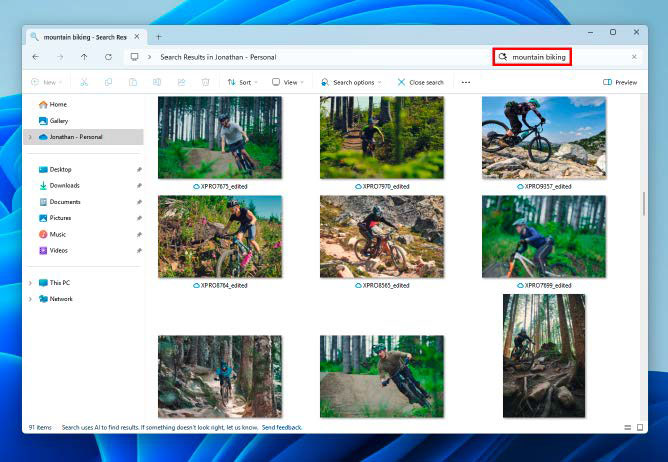
Microsoft works on a new research supported by AI on Copilot + PCS, which is designed to recognize photos according to their subjects, among others. There is still only a pre-liberation version in Windows initiate constructions.
IDG
In the meantime, Microsoft has improved data confidentiality and has joined the “new” recall in Windows 11 via an update.
In practical tests, the new version leaves a good but somewhat ambivalent impression: research works well, but also reveals important shortcomings.
Indeed, the screenshots taken at rigid 30 -second intervals do not capture what is happening between the two. A more dynamic analysis of the activity could help to grasp all the important moments.
In addition, the new Windows Sematic research (which includes requests in natural language) is limited to Copilot +devices.
This article originally appeared on our PC-Welt sister publication and was translated and located in German.


