I promise AI didn’t write this column, and if it’s after my job, it’ll be over my dead body

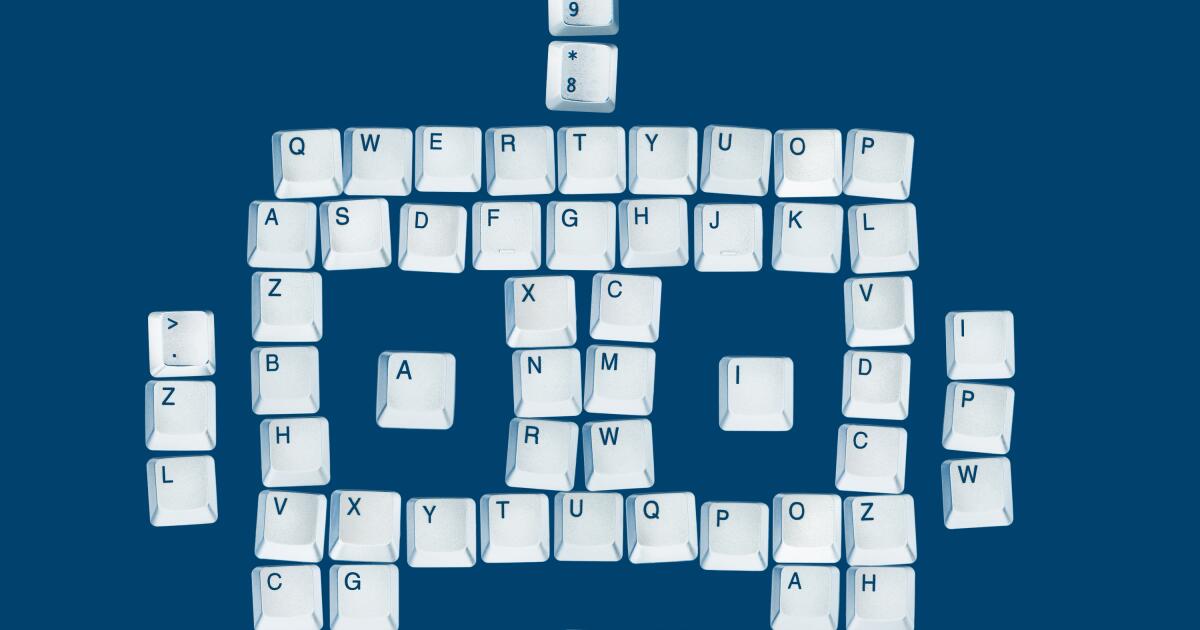

For quite a while now, someone has been living on my computer and writing emails for me.
I don’t remember signing up for this AI feature, which is like having a valet. It’s also in my phone, which offers three helpful but impersonal responses I can send to someone who just sent me an email telling a story or asking if I want to meet for coffee.
“I’d like to have coffee,” was one of the suggested responses to a recent email. “Let me come back to the timing soon.”
One argument for these features is that they can save me time and free me up for more important tasks. But it takes me longer to read the three manufactured email options than it does to write my own response.
I find this really irritating for about 150 reasons, one of which is that, in an increasingly automated world, it’s another nail in the coffin of human interaction. And yes, there are at least 150 reasons. I know this because I asked the AI and it spit them out in about three seconds. #148: “It looks like it was written by committee.” »
A lot of the nasty comments end up in my mailbox, so I wondered if the auto-reply tool might be useful. But the robot is not salty enough to be of service. “Thanks for reading” was the suggested response to someone who called me a desperate fool and another guy who wondered why anyone would read my “stupid column.”
On reflection, perhaps a calm and dismissive response is the way to go. But the bigger concern is what happens to human intelligence, as artificial intelligence takes more care of our writing, research, communication and thinking.
If a middle school, high school or college student can easily use a computer tool to write a reading report or an essay, what is the impact on vocabulary, grammar, reading, critical thinking, originality, intellectual curiosity?
On learning?
“There’s no nose like an English teacher’s,” said Mike Finn, a recently retired Los Angeles instructor, who said teachers can tell whether a student’s work is original or not and try to steer him away from shortcuts and plagiarism.
But it’s easier than ever for a student to become lazy. In a New Yorker article Last year, a university professor described AI-based cheating as a widespread and ingenious way for students to avoid wasting time on material they weren’t interested in. “I try to do as little work as possible,” one student said.
My son, a university librarian, has witnessed this phenomenon as well as a general erosion of research skills and decision-making ability among some students.
“They can’t choose a book from thousands of books for a research project and don’t even want to because they think they can get the information more easily from a computer,” he said.
Jenn Wolfe, a secondary education professor at Cal State Northridge, said the use of AI is “a very hot topic right now” and that in high schools and middle schools, some teachers are “going back to pen and paper, from what I’m seeing and hearing.”
I met Wolfe in 2013while she was a teacher at LA Unified High School, getting used to the introduction of iPads into classrooms.
“It’s not a teacher or a student either,” she wisely said at the time about the iPad. “It’s a tool.”
Professor Sarah W. Beck, chair of NYU’s Department of Teaching and Learning, echoed this idea of adapting to changing technology.
“I think denial or refusal of AI is not a useful position because it is here to stay,” Beck said, so the key is to understand the benefits and reduce the risks.
She told me she had just come out of an education class in which the prospective teachers “are mostly quite skeptical of AI. They’re not rejecting AI, but they’re very sensitive to its limitations and really appreciate the human dialogue around writing.”
There is no denying that AI can be useful as a research tool, for exploring themes and helping writers formulate their thoughts. It’s also useful in areas beyond writing. This helped me replace a toilet tank flush valve a few weeks ago, for example. And I just had a tooth extracted and I was wondering about the pros and cons of getting an implant. The AI provided me with a wealth of information about the pros and cons.
For writing, Beck said, it can organize your notes or perform “formula writing” tasks.
“We need to learn how to use these tools in a way that gives us more time to spend on the parts of writing that really matter,” she said.
We must also be careful.
When we are faced with instructions, analyses, canned emails, ready-made manuscripts, and unsolicited offers of help, where does it all come from? Who entered the information? Do creators have an agenda? Are students taught to be discerning about what information is credible?
A Cornell University published study this month suggests that AI writing assistants can not only influence the way we write, but also the way we think.
Researchers observed 2,500 participants who has written on several controversial topics, including the death penalty, fracking, and voting rights. Some received biased information through AI autocomplete writing tools, and based on pre- and post-exercise surveys, their opinions shifted in the direction of the bias even though they were aware of it.
“We know that these models are controlled by large, powerful organizations, and that they may or may not have a point of view that they wish to embody or promote, and that there is potential for abuse,” said Mor Naaman, professor of information sciences at Cornell Tech and lead author of the study.
The information spit out at us is “wrapped in compelling AI language,” Naaman said, and the benefits of the technology are obvious. “The bad news is that there are literally hundreds of billions of dollars of investment and interest in trying to bring AI into every corner of our lives…and the dangers are over. »
It will take more time, Naaman said, to lay out all the risks and know how to control them.
AI will create jobs, that’s for sure. It will also eliminate jobs, and it could affect mine. So I asked AI to finish this column, and this is what she got:
“And that is the central tension of this world: the promise of efficiency versus the irreplaceable process of being human.”
I think my job is safe – for now.
steve.lopez@latimes.com


