ICE raids translate to bullying, missing class, academic struggles

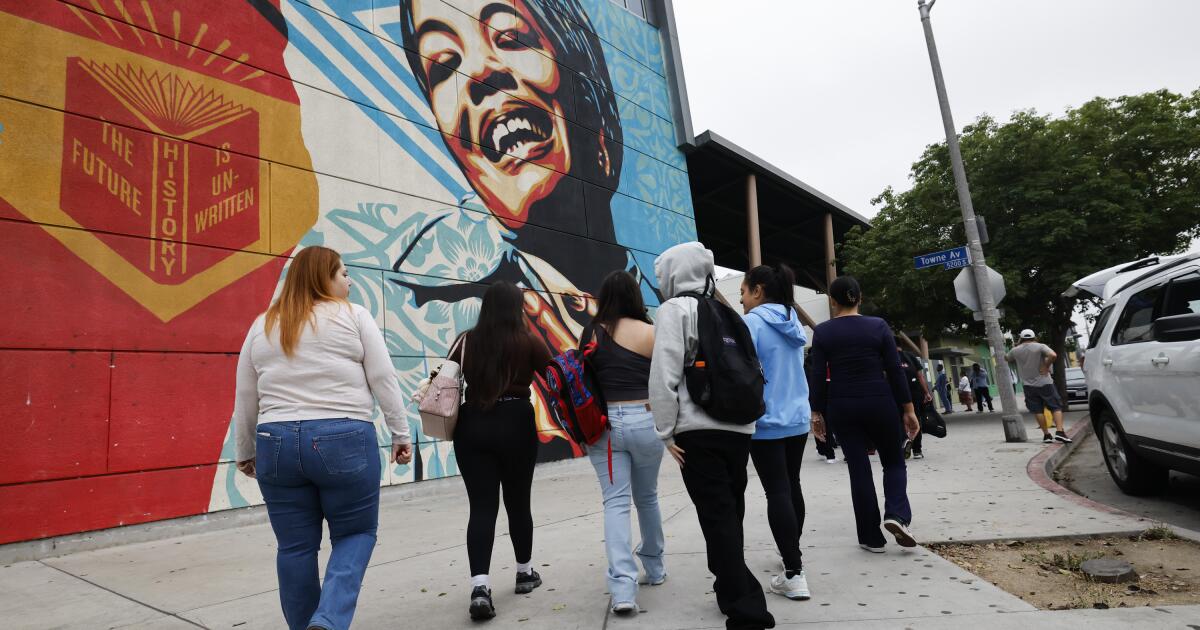

High school principals in California and across the country say raids by Immigration, Customs and Enforcement have caused a “climate of distress” among immigrant students who have been bullied on campus and whose attendance has plummeted, according to a study released Tuesday.
Seventy percent of public high school principals surveyed said students from immigrant families expressed fears for themselves or their families because of ICE crackdowns or immigrant-related political rhetoric, according to the report by the UCLA and UC Riverside researchers.
The findings echo the narrative of what schools and districts have reported across Southern California since President Trump took office in January and began aggressive immigration raids.
A California principal told researchers she saw staff members “burst into tears over a student.”
“It just doesn’t seem very American,” she added.
John Rogers, a UCLA education professor and co-author of the report, said it was “striking” that principals “from all parts of the country are talking about fear and concern in their school communities related to immigration enforcement.”
Researchers surveyed 606 public high school principals from May to August to understand how schools were affected by Trump’s immigration measures. More than one in three principals, or about 36 percent, said students from immigrant families had been bullied, and 64 percent said their attendance had declined.
A decline in attendance has been verified by other researchers who collected data in California’s Central Valley and Northeast states. There has also been a decline in K-12 enrollment that appears to number at least in the tens of thousands, affecting cities like Los Angeles, San Diego and Miami, based on numbers provided by school district officials.
School principals, including in Minnesota, Nebraska and Michigan, have noticed an increase in the number of students using hostile and derogatory language toward classmates from immigrant families. Some cited the political climate that has normalized attacks against immigrants.
The vast majority of principals surveyed, nearly 78 percent, said their campuses had developed plans to respond to visits from federal agents and that nearly half had a contingency plan in case a student’s parents were expelled.
In this effort, Los Angeles County Schools have played a leading role, taking rapid and unprecedented action to protect and reassure families. LA Unified, for example, provided direct home-to-school transportation for some students.
Their fears are not unfounded. In April, Los Angeles principals turned away immigration agents trying to enter two elementary schools, claiming they were conducting a health check with the family’s permission. School district officials said no such permission had been granted.
At a public meeting in November, Los Angeles school board member Karla Griego reported that a parent was arrested on his way to a school meeting about an updated educational plan to address her child’s disabilities.
Charter schools have also taken steps to reassure families. In the days following a major ICE raid in Los Angeles, attendance rates reached Alliance Morgan McKinzie High School in East Los Angeles went from a typical range of 90% to a low of 90%, Director Rosa Menendez said.
“A lot of our families were really affected and terrified,” Menendez said. “Many of our children are afraid to come to school. »
As ICE raids increased last summer, the charter school stepped up its supervision, stationing staff members around bus and train stations to monitor student arrivals and departures. The school will remain open during winter break and will offer sports, video games, and arts and crafts so students will have a safe place to go.
Immigration enforcement is a personal matter for Menendez, who is a child of Salvadoran immigrants and whose family is undocumented.
“As a result of COVID, we were trying to keep our kids safe and healthy, and now it’s a whole new level of safety,” Menendez said. “But we also worry about our own families… It adds a very intense layer of stress.”
Earlier this year, the Department of Homeland Security issued a statement saying ICE does not “attack or target schools.” However, the Trump administration in January rolled back longstanding protections for “sensitive” locations that had prevented ICE since 2011 from arresting people at schools and churches.
A double duty to protect and teach
In addition to the survey, researchers conducted 49 follow-up Zoom interviews with principals chosen to reflect a diverse mix of schools. The names were not released due to fears that their schools could become targets for immigration authorities.
A California principal, whose school is located in a predominantly immigrant neighborhood, told researchers that her school’s sense of safety evaporated in the spring when news of nearby ICE raids was announced at an assembly.
That narrative echoed the unease that spread during a spring graduation ceremony at Huntington Park High School when an ICE raid began at the adjacent Home Depot.
Principals noted that parents felt torn between keeping themselves and their family members safe and supporting their children’s education. At Los Angeles high schools, many parents chose not to attend graduation last spring.
Immigration enforcement doesn’t just affect students. Many school staff feel a “dual sense of duty”: to protect and to teach, the California superintendent said.
This administrator also said teachers joined local immigrant rights networks, walking neighborhood blocks before school each day to ensure a safe path to campus. One teacher, whose father is undocumented, frequently worries about suspicious cars in the school parking lot, the principal said.
“[W]We always want to make sure we’re not caught off guard,” she said. In addition to her long-held fears about a possible active shooter situation, she now worries daily about ICE agents arriving. “It’s a lot,” she added.
Maria Nichols, president of the Los Angeles Associate Trustees and former LAUSD superintendent, praised the district for taking quick action to provide school leaders with protocols to follow in the event of a raid. But she said a principal’s job has become even more taxing because LAUSD’s staff reductions have reduced the number of assistant principals.
“The leader, of course, is responsible for logistics, protocols and procedural matters, but … must also uplift his school and his community,” Nichols said. “They are facing a crisis right now and the toll is very, very difficult and heavy at a time when we have less human capital in schools.”
School leaders across the country echoed the California superintendent’s sentiments.
One principal in Idaho told researchers she feared every day that ICE agents would show up with a court warrant to arrest students. “As the person in charge of the building,” she said, “I feel responsible for their safety. I hate it, because I don’t feel like I can protect them.”


