Illegal Wildlife Trade Tied to Drugs, Arms, and Human Trafficking


November 21, 2025
3 min reading
Illegal wildlife trade linked to drug, arms and human trafficking
Criminals around the world are increasingly mixing the illegal trade in animal parts with trafficking in weapons, humans and more, even going so far as to trade wildlife for drugs.
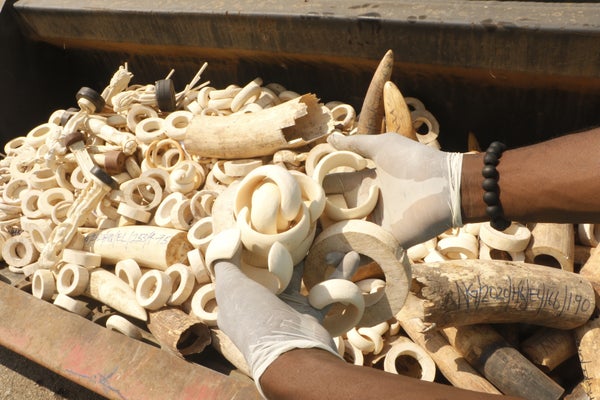
A view of elephant tusks seized from wildlife traffickers, gathered for destruction in Abuja, Nigeria, January 9, 2024.
Emmanuel Osodi/Anadolu via Getty Images
In 2021, South African investigators received information that a Vietnamese organized crime network was operating from a local farm. When they searched the property, they found more than 800 pounds of lion “cake,” a traditional medicine product made by boiling lion bones to remove gelatin from joints. Investigators also discovered 13 gallons of opium that the suspects had added to their lion cake.
The illegal wildlife trade is a multi-billion dollar industry driven by organized criminal gangs whose operations span every continent. Now, new research in the Journal of Economic Criminology confirms that these same gangs are also frequently involved in other forms of criminal activity, including trafficking in drugs, weapons, people, stolen vehicles, mining resources, counterfeit goods and human body parts.
“We find that criminal networks around the world are more adaptable, more interconnected and almost commodity-agnostic,” says study lead author Michelle Anagnostou, a researcher on the illegal wildlife trade at the University of Oxford who conducted the research while she was a doctoral student at the University of Waterloo in Canada. This highlights the need “to take a holistic organized crime approach to trafficking activities as a whole, with less emphasis on the product being trafficked,” she says.
On supporting science journalism
If you enjoy this article, please consider supporting our award-winning journalism by subscription. By purchasing a subscription, you are helping to ensure the future of impactful stories about the discoveries and ideas shaping our world today.
Wildlife crime experts have long suspected a link to other types of crime, but the new findings provide strong evidence that confirms this link and elucidate the many forms it takes. Anagnostou conducted 112 interviews with sources in South Africa, Hong Kong and Canada who deal directly with crime, including wildlife officers, national and local police, customs officials, intelligence analysts and experts on organized crime, money laundering and drugs.
The results revealed a criminal overlap that took a multitude of forms. In some cases, cartels specializing in drugs, gold, diamonds or human trafficking have opportunistically added wildlife products such as rhino horns, rare succulents or bear gall bladders to their transactions; in other cases, wildlife specialists have extended their activities to drugs, stolen goods or sex trafficking. Wildlife was sometimes also used to barter drugs – for example, abalone was traded for methamphetamine and sturgeon for heroin. Anagnostou also heard of drug traffickers protecting their reserves with illegal lions or tigers and of people using illegal weapons to poach animals. Additionally, criminal bosses sometimes exploited people by subjecting them to forced labor to extract illegal goods from the fields, including rhino horn, elk, ginseng, sea cucumbers, and harp seal oil.
These interconnections show that “the long-standing approach of fighting each type of organized crime separately is no longer sufficient,” says Anagnostou. “By working separately and not working together across units, we miss the bigger picture. To bridge this, we need to share intelligence, data, joint working groups, international cooperation that is not limited to certain illegal products, [and] even more coordinated legal strategies.
“It took years of persistent lobbying, backed by evidence, to convince mandated authorities that the illegal wildlife trade was actually being perpetrated by organized criminal networks,” says Mary Rice, executive director of the nonprofit Environmental Investigation Agency. Generating “acceptance and recognition” that wildlife crime also frequently converges with other forms of organized crime is the next step in that conversation, she says, and something the new study could contribute to.
It’s time to defend science
If you enjoyed this article, I would like to ask for your support. Scientific American has been defending science and industry for 180 years, and we are currently experiencing perhaps the most critical moment in these two centuries of history.
I was a Scientific American subscriber since the age of 12, and it helped shape the way I see the world. SciAm always educates and delights me, and inspires a sense of respect for our vast and beautiful universe. I hope this is the case for you too.
If you subscribe to Scientific Americanyou help ensure our coverage centers on meaningful research and discoveries; that we have the resources to account for decisions that threaten laboratories across the United States; and that we support budding and working scientists at a time when the value of science itself too often goes unrecognized.
In exchange, you receive essential information, captivating podcasts, brilliant infographics, newsletters not to be missed, unmissable videos, stimulating games and the best writings and reports from the scientific world. You can even offer a subscription to someone.
There has never been a more important time for us to stand up and show why science matters. I hope you will support us in this mission.


