In western Alaska, compounding climate crises threaten Indigenous families


A week after Typhoon Halong passed Japan in early October, its remnants crossed the Pacific and hit western Alaska. Nearly 50 Alaska Native communities in the Yukon-Kuskokwim Delta near the Bering Sea faced sky-high wind speeds, record storm surges and widespread flooding. At least one person died and 1,500 adults and children, mostly Yup’ik, were displaced from the villages. According to initial estimates, the storm decimated 90 percent of homes in the coastal village of Kipnuk and 35 percent in Kwigillingok, which also experienced spills of toxic chemicals into its fresh water supply.
“It will take years to recover from the disaster,” Sen. Lisa Murkowski said at the Alaska Federation of Natives’ annual convention last month. “Once the floodwaters recede and the damage to the homes and fishing camp is calculated, there is still much work and healing to be done. »
State and federal resources are being mobilized to respond to the disaster. On October 22, along with Governor Mike Dunleavy’s declaration of a state of emergency and the release of disaster relief funds, President Donald Trump authorized a federal emergency declaration and $25 million in funds for recovery and rebuilding efforts. State agencies such as the Alaska Division of Homeland Security and Emergency Management have also begun moving evacuees into long-term housing.
“This declaration is a crucial step toward recovery, but it must be the start of a broader, lasting response,” Vivian Korthius, Yup’ik and CEO of the Association of Village Council Presidents, said in a statement.
Kipnuk and the other villages affected by the storm have been on the front lines of climate change for more than a decade. Rising temperatures have caused permafrost to melt, causing land subsidence and flooding across the delta. According to the Alaska Climate Research Center, Typhoon Halong also exhibited characteristics consistent with the effects of climate change. Rising temperatures have changed the nature of tropical cyclones, leading to heavier precipitation, hurricane-like winds and higher waves. The storm surge that hit Kipnuk, for example, broke a 25-year-old record.
Many Alaska Native villages affected by Typhoon Halong were established in coastal areas as a result of colonial policies imposed by the United States government. When the Russian Empire arrived in Alaska in the early 19th century, fur traders sought to profit from the booming industry along the coast. After Russia sold the land to the United States in 1867, the federal government aimed not only to seize and occupy the land, but also to encourage assimilation through boarding and day schools operated by the Bureau of Indian Affairs.
The boarding school era played a crucial role in the organization of villages. Tribal communities sought to keep their children at home, as boarding schools forced them to live far from their tribal cultures and were associated with abuse. As a result, Yu’pik communities chose to live nearby and send their children to village schools operated by the Bureau of Indian Affairs.
“They were told, or at least it was implied, if not said, that you had to move here to send your kids to school or they might be sent to boarding school,” said Sheryl Musgrove, director of climate justice programs at the Alaska Institute for Justice, which oversees climate adaptation, mitigation and resettlement with village partners in the Yukon-Kuskokwim Delta.
The historic passage of the Alaska Native Claims Settlement Act of 1971, commonly known in the state as ANCSA, also reshaped where communities settled. The law abolished existing indigenous land claims in exchange for 44 million acres that would be managed by private regional and village corporations. These for-profit entities, which operate in sectors such as logging and oil, have created jobs and encouraged settlement in centralized villages and regional hubs. As a result, settlements further solidified along the coast and near rivers.
Bonnie Jo Mount/The Washington Post via Getty Images
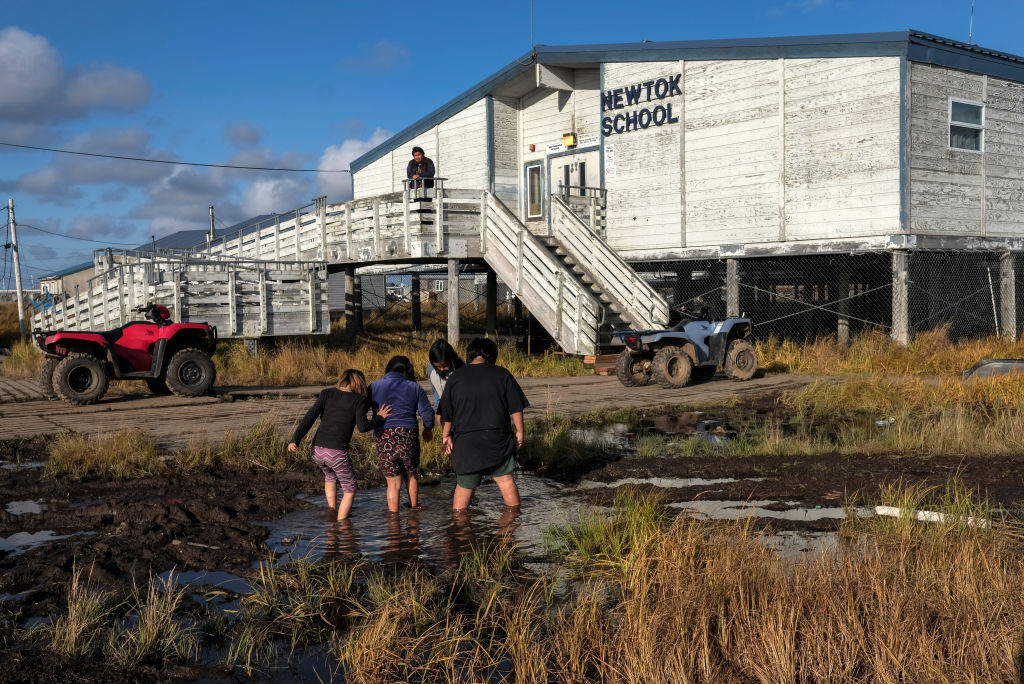
Since the National Oceanic and Atmospheric Administration has predicted that Alaska’s summer waters will be ice-free within the next decade, communities have attempted to relocate with the help of tribal corporations. But moving an entire village is a big challenge. Costs are high and selecting a site to move to with the help of the regional company can be difficult. For example, 300 people from Newtok, a village north of the Yukon-Kuskokwim delta, moved 9 miles away to a new village known as Metarvik late last year. But Metarvik’s infrastructure is already crumbling. Electricity is intermittent, running water is lacking, and residents must use 5-gallon buckets as toilets. The project, which was supposed to serve as a model for other villages, received millions of dollars in federal grants, but ultimately lacked federal guidelines and failed to meet the needs of residents.
Despite different legal terrain and a different colonial heritage, the federal government still has treaty responsibilities to uphold to Alaska’s tribes. In May, the Environmental Protection Agency canceled a $20 million flood protection grant awarded by the Biden administration last year. This historic grant was to accelerate the resettlement of many villages. The cancellation of funding is another example of the lack of federal investment, Musgrove said.
Due to the severity of the storm’s impact, Kwigillingok leaders opted to proceed with the resettlement. It’s a decision the Alaska Institute for Justice will help make.
“No one knows what the future holds, and we need serious investment in these communities like Kwigillingok and Kipnuk to be able to rebuild or move, whichever they choose,” Musgrove said. “So they can be safe from the next storm, whenever that next storm is in the frame.”


