In wrangling dark matter, some scientists find inspiration in the Torah, Krishna and Christ

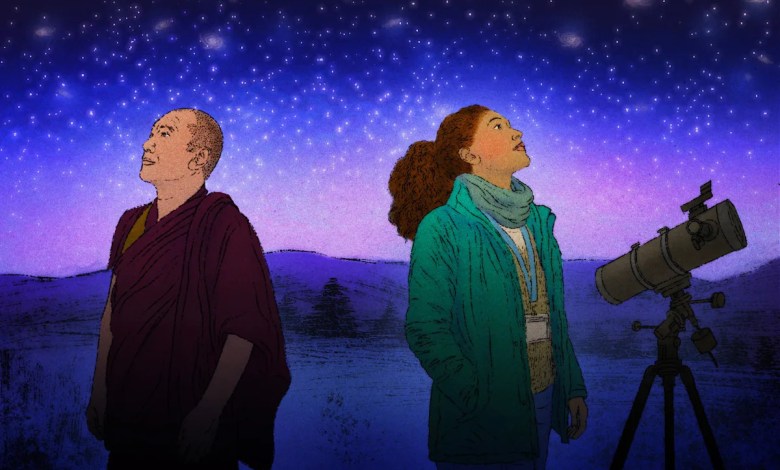
When an invisible entity representing 85% of the mass of the universe baffles the greatest scientific minds of our time, fear is an understandable response.
Physicists call it “dark matter,” a substance they describe as the cosmic glue, the scaffolding, a web that uses gravity to gather, shape and hold together stars, planets and galaxies. However, no one knows exactly what it is.
The existence of dark matter is only inferred from its gravitational effects on visible matter. Along with dark energy – a mysterious force that causes the accelerated expansion of the universe – they constitute the greatest scientific mysteries of our time.
It’s no surprise, then, that dark matter and dark energy, which may hold answers to the origins and fate of the universe, have sparked deep religious and philosophical conversations – inspiring for some scientists, newsworthy for others.
The worlds of science and faith are not as separate as they seem. Many scientists have expressed how the study of the majesty of the cosmos can be complementary rather than contradictory to their faith or spiritual practice.
Astrophysicist inspired by the Torah
Vera Rubin, an astronomer whose observations of galaxy rotation curves in the 1970s provided the first solid evidence for the existence of dark matter, adopted her Jewish faith as a guide to understanding its role in the universe.
When Chanda Prescod-Weinstein met Rubin as a doctoral student in 2009, the renowned astrophysicist asked her an unexpected question: “So how do you think we solve the dark matter problem?”
Prescod-Weinstein, an agnostic-atheist and Jew, cites Rubin’s gracious question as a factor in his decision to study a theoretical particle called an axion, which could potentially solve the dark matter problem. Prescod-Weinstein says she draws on Reconstructionist Jewish teaching and the Torah for her scientific inspiration.
“The Torah stories are about people who lived in a very intimate relationship with the earth and with the night sky, and with a sense that it was all part of creation and the story of creation,” she said.
A scientist searches for clues in the depths
It was an obsession with dark matter and dark energy that led Brittany Kamai to pursue astrophysics. She is only the second native Hawaiian to earn a doctorate in this field. After spending years developing the Fermilab holometer, an instrument designed to understand what space and time are made of, Kamai returned to her spiritual roots in Hawaii as a apprentice navigator and crew member of a voyaging canoe.
Kamai trains in celestial navigation, using the stars, winds and waves to cross the ocean without modern instruments. She wonders if the missing link in these mysteries might lie in spirituality – a quality she says many scientists reject.
While canoeing, Kamai says she learns the importance of being “spiritually attuned,” looking for clues her ancestors may have left behind. She wonders if being in the depths of the ocean could unlock the mystery of dark energy.
“When you boil down physics, it’s just a bunch of waves – particles, sound waves,” she said. “Why wouldn’t we need to be in the deepest part of our ocean to have the deepest connection with the entire universe?”
Researcher found solace in Hindu origin stories
Doug Watson was plagued by doubt as a postdoctoral researcher researching dark matter. When he felt burned out, his wife introduced him to the International Society for Krishna Consciousness, or ISKCON, widely known as the Hare Krishna movement, a branch of Hinduism that glorifies Lord Krishna as the Supreme Being. Watson, who was not religious, said he embraced a religious tradition that encouraged doubt, curiosity and scientific inquiry.
He studied sacred texts like the Srimad Bhagavatam, which describes a scene where Krishna’s transcendental gaze animates the universe. To Watson, this seems “eerily similar” to the observer effect in quantum mechanics – the phenomenon by which the act of measuring or observing a quantum system, such as a proton or electron, changes state.
Watson used these stories as inspiration to overcome the obstacles that caused his burnout.
“I absolutely don’t think that drawing direct lines between religious texts and scientific facts is the right approach,” he said. “Rather, I see how these stories could illuminate and inspire new ways of thinking about the origins of the universe. »
Different interpretations of the meaning of dark matter
Some scientists, like astrobiologist Adam Frank, warn that the search for sanctity in topics like dark matter could end in disappointment because science is constantly evolving.
“You don’t want to base your faith or spirituality on a graph that goes up or down in a scientific article,” he said.
For Frank, a Zen Buddhist, the real connection between science and spiritual endeavor lies in the awe they inspire.
“Whether you love the poetry of your writing or the beauty of the equations you derive from it, they are both appeals to that feeling,” he said.
For the faithful, accepting that there is nothing transcendent in this world is simply impossible, said Caner Dagli, an Islamic scholar and professor of religious studies at the College of the Holy Cross in Massachusetts.
“Transhumanists and other philosophers might think that if we had just enough computing power, we might be able to obtain the equations needed to really completely understand the universe,” he said. “But this is not possible for Muslims because we believe that God intervenes in history, he answers prayer.”
Chris Impey, a professor of astronomy at the University of Arizona, has often traveled to India to teach Tibetan monks and nuns at the invitation of the Dalai Lama. Being in awe of a mystifying universe is like a spiritual experience, he says.
Impey, an agnostic, found many aspects of Buddhism compatible with modern cosmology.
“They can accommodate within their tradition an ancient universe, billions of years old,” he said. “They can adapt to many worlds, to life in other worlds, to life more advanced than ours.”
Scientific research could be a path to the divine
Adam Hincks, a Jesuit priest who teaches at the University of Toronto and is an adjunct researcher at the Vatican Observatory, believes that for some, contemplating dark matter and dark energy could elevate their minds toward God.
“There are also other things in the universe that, for some, would be a similar conduit, like a beautiful waterfall,” he said. “As Creator, God is present in all creation, and contemplating creation is a portal to contemplating the divine. »
Australian astrophysicist Ken Freeman is considered a “dark matter pioneer”, primarily for his landmark 1970 research that provided some of the first modern evidence of invisible mass in spiral galaxies. Freeman is a Christian; like many scientists before him, he questions the role of intuition in scientific discovery.
“You wake up in the middle of the night with a thought and you have no idea where it came from,” he said. “Believers could see the action of the Holy Spirit in this. »
Was his desire to study dark matter the work of the Holy Spirit?
“I wouldn’t describe it that way, but it’s a nagging possibility,” he said.
Jennifer Wiseman, a Christian astrophysicist, draws on her faith for wisdom as she investigates the big puzzling questions of the universe and reflects on using scientific progress to serve humanity.
“Studying the deep universe can make us feel insignificant,” Wiseman said. “But it also gives us a feeling of unity, because we are all on the same planet. (…) The hope is that these contemplations give us a feeling of joy, humility and love.”
___
Associated Press religion coverage receives support through the AP’s collaboration with The Conversation US, with funding from Lilly Endowment Inc. The AP is solely responsible for this content.

:max_bytes(150000):strip_icc()/Health-GettyImages-2205706076-d13ed431a17a4e7baf2f714ca78f6c39.jpg?w=390&resize=390,220&ssl=1 "Can IgA Nephropathy Be Reversed?")


