iPhone battery capacity comparison: Battery life, size, mah, watt hours


Summary created by Smart Answers AI
In summary:
- Macworld has compiled comprehensive battery data for all iPhone models, revealing that capacities have nearly doubled from the iPhone 8’s battery to the 5,088 mAh of the projected iPhone 17.
- The iPhone 15 Pro Max currently has a 4,422 mAh battery, while Apple is keeping these specifications under wraps unlike competitors like Samsung.
- Watt-hours provide more accurate energy measurements than milliamp-hours because they account for voltage differences in battery performance comparisons.
Battery life is one of the most important factors when choosing which iPhone to buy.
Measuring iPhone battery life in consecutive hours of real-world use (as Apple likes to do) is not an accurate metric for comparison purposes, as many usage and environmental factors play a role.
At Macworld, we run our own battery life tests, which should give you a more accurate representation of how long your iPhone’s battery will last. In the table below you can see the battery life (in minutes).
Another way to gauge battery life is to look at the technical specifications to see the battery capacities of each iPhone. Unfortunately, Apple is notoriously secretive about these battery specs, mainly because smartphones from competitors like Samsung have much larger battery capacities. The only way to find out the battery capabilities is to remove the battery from the phone and check the specifications printed on it.
Below is a list and explanation of the battery capacities of every iPhone, from the original iPhone from 2007 to the latest iPhone 17 series, iPhone Air and 17th.
iPhone Battery Life Tests
This graph shows that there is a clear and impressive increase in battery life over time. Battery capacity increased significantly, almost doubling between the iPhone 8 and iPhone 17. But battery life was much longer than that, with the iPhone 17 running the same test, at the same brightness, lasting more than five times as long as the iPhone 8! Keep in mind that the screen size has also increased significantly during this time.
For more details on our battery life tests of every iPhone, from iPhone X to iPhone 16 Pro Max, see: How Much iPhone Battery Life Has Improved.
iPhone mAh and Wh: what is the difference?
We can look at the technical specifications to find out the battery capacities of each iPhone, but as mentioned above, this requires opening the iPhone to see the details on the battery itself.
Battery capacity is measured either Milliampere hours (mAh) or Watt hours (What).
Milliampere-hours are a measure of electrical load, while a watt-hour is equivalent to one watt of energy consumed for one hour. And it’s the energy consumed that matters when we measure actual battery life.
Learn how to properly charge a phone battery.
Wh is a more accurate and consistent way to compare the total amount of energy that similar types of batteries can store.
And it all depends on the battery voltage, which mAh ignores, which determines the power (wattage) of a battery.
If the mAh is the same, the higher the voltage, the higher the actual power stored.
Volts (V) are a measure of electrical pressure. Amps (A) is a measure of current. Multiply V x A and you get Watts (W) which is a measure of power. SO V × A = W.
You can convert watt-hours (Wh) to milliamp-hours (mAh) using this formula: (Wh x 1000) divided by V = mAh.
The lithium batteries that power most portable electronics have a voltage of around 3.6V, but some power banks (such as Apple’s 7.62V MagSafe battery) have a higher voltage, meaning they actually carry more power than their mAh implies.
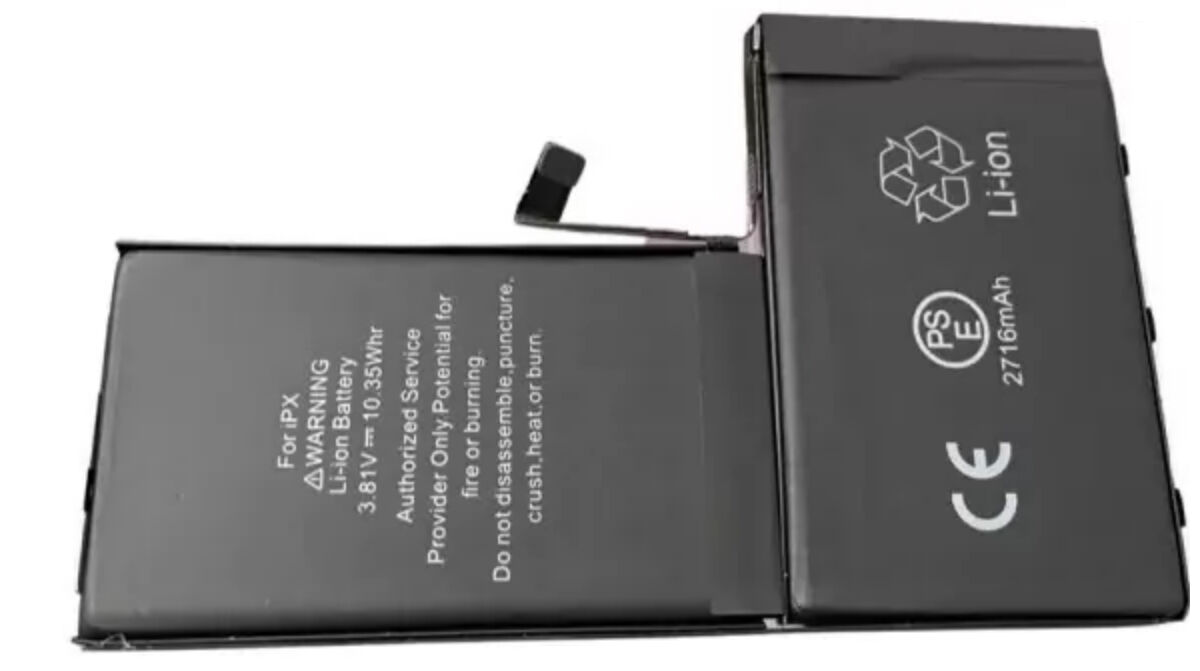
Here we list the battery capacity of every iPhone ever released in mAh and Wh.
iPhone battery capacities
Here are the mAh and Wh for every iPhone ever made.
| iPhone | mAh | Wh |
|---|---|---|
| iPhone | 1400mAh | 5.18 Wh |
| iPhone 3G | 1150mAh | 4.25 Wh |
| iPhone 3GS | 1200mAh | 4.44 Wh |
| iPhone4 | 1420mAh | 5.3 Wh |
| iPhone 4s | 1,432mAh | 5.3 Wh |
| iPhone5 | 1440mAh | 5.45 Wh |
| iPhone5c | 1,510mAh | 5.73 Wh |
| iPhone 5s | 1,560mAh | 5.92 Wh |
| iPhone6 | 1810mAh | 6.9 Wh |
| iPhone6s | 1715mAh | 6.91 Wh |
| iPhone 6s Plus | 2750mAh | 10.45 Wh |
| iPhone SE | 1624mAh | 6.21 Wh |
| iPhone7 | 1960mAh | 7.45 Wh |
| iPhone7 Plus | 2900mAh | 11.1 Wh |
| iPhone8 | 1,821mAh | 6.96 Wh |
| iPhone 8 Plus | 2961mAh | 10.28 Wh |
| iPhoneX | 2716mAh | 10.35 Wh |
| iPhone XR | 2942mAh | 11.16 Wh |
| iPhoneX | 2,658mAh | 10.13 Wh |
| iPhone XS Max | 3,174mAh | 12.08 Wh |
| iPhone11 | 3,110mAh | 11.91 Wh |
| iPhone 11 Pro | 3,046mAh | 11.67 Wh |
| iPhone 11 Pro Max | 3969mAh | 15.04 Wh |
| iPhoneSE2 | 1,821mAh | 6.91 Wh |
| iPhone 12 mini | 2227mAh | 8.57 Wh |
| iPhone12 | 2,815mAh | 10.78 Wh |
| iPhone 12 Pro | 2,815mAh | 10.78 Wh |
| iPhone 12 Pro Max | 3,687mAh | 14.13 Wh |
| iPhone 13 mini | 2,438mAh | 9.34 Wh |
| iPhone13 | 3,240mAh | 12.41 Wh |
| iPhone 13 Pro | 3095mAh | 11.97 Wh |
| iPhone 13 Pro Max | 4,352mAh | 16.75 Wh |
| iPhone SE3 | 2018mAh | 6.96 Wh |
| iPhone14 | 3,279mAh | 12.68 Wh |
| iPhone 14 Plus | 4,325mAh | 16.68 Wh |
| iPhone 14 Pro | 3200mAh | 12.38 Wh |
| iPhone 14 Pro Max | 4,323mAh | 16.68 Wh |
| iPhone15 | 3,349mAh | 12.98 Wh |
| iPhone 15 Plus | 4,383mAh | 16.95 Wh |
| iPhone 15 Pro | 3,274mAh | 12.70 Wh |
| iPhone 15 Pro Max | 4,422mAh | 17.11 Wh |
| iPhone16 | 3,561mAh | 13.7 Wh |
| iPhone 16 Plus | 4,674mAh | 18Wh |
| iPhone 16 Pro | 3,582mAh | 13.8 Wh |
| iPhone 16 Pro Max | 4,685mAh | 18Wh |
| iPhone 16e | 3,961mAh | 15.55 Wh |
| MagSafe battery | 1460mAh | 11.13W |
| iPhone17 | 3,692mAh | 14.5 Wh |
| iPhone 17 Pro | 4,252mAh | 16.7 Wh |
| iPhone 17 Pro Max | 5,088mAh | 20Wh |
| iPhoneAir | 3,149mAh | 12.4 Wh |
| iPhone 17e | 4005mAh | 15.6 Wh |
Discover the best iPhone chargers and USB-C charging cables for iPhone in our test results.
Is your iPhone battery living up to its potential? Learn How to Check iPhone Battery Health and How and When to Replace It.
Do you have an iPad? Read 12 Power Tips to Extend iPad Battery Life


