Iran attacks Israel, Gulf states after naming new leader on Day 10 of war : NPR


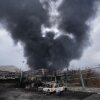
Smoke rises Monday following an Israeli airstrike in Dahiyeh, a southern suburb of Beirut.
Bilal Hussein/AP
hide caption
toggle caption
Bilal Hussein/AP
Iran launched new attacks on Israel and several Gulf states on Monday, hours after naming Mojtaba Khamenei as the country’s new supreme leader.
The 56-year-old is the son of former supreme leader Ayatollah Ali Khamenei, who was killed by airstrikes at the start of the war. He maintains close ties with the Iranian Revolutionary Guards, a testament to his father’s continued regime and hard line.
Meanwhile, Israel launched further strikes overnight, targeting, it said, sites linked to the Hezbollah militant group in the southern suburbs of Beirut, the Lebanese capital, as well as regime-linked infrastructure in Tehran.
The escalation shook markets, with crude oil prices briefly approaching $120 a barrel on Monday. The scale of the conflict has increased fears of supply disruptions in the region.
In Bahrain, national oil company Bapco declared “force majeure” on its operations, allowing it to suspend its contractual obligations amid extraordinary disruption following a drone attack.
The war has left more than 1,200 dead in Iran, nearly 400 in Lebanon and 11 people in Israel, according to figures from Iranian and Lebanese health authorities and Israeli authorities.
The Pentagon said seven U.S. service members have been killed since the war began. Six were killed in a drone attack in Kuwait and the final victim died after being injured in an Iranian strike on a military base in Saudi Arabia.
Here’s what you need to know about the latest developments in the conflict.
To access specific coverage areas, use the links below:
Iran’s retaliatory attacks | The new Iranian leader | Crude Oil Price |Bahrain Oil Attack| Senate Democrats condemn school strike | US officials respond to strikes on Iranian oil
Iran retaliates after Israel launches new attacks on Beirut and Tehran
Iran launched a new series of missile and drone attacks overnight on Monday, targeting Israel and several Gulf states. The attacks came after Israel said it had carried out new strikes on sites linked to the militant group Hezbollah in Beirut’s southern suburbs and on regime-linked infrastructure in Tehran.
On Monday, Bahrain’s official news agency reported that at least 32 people were injured, including children, in an Iranian strike on the island of Sitra, south of the capital Manama.
Qatar’s Foreign Ministry condemned what it called an Iranian strike on a residential complex in Al-Kharj, Saudi Arabia, saying two civilians were killed and others injured.
Officials in Fujairah, United Arab Emirates, said a fire broke out at an oil facility that was attacked overnight. Saudi Arabia said it had intercepted several drones attacking its Shaybah oil field.
In a statement Monday, the Saudi Foreign Ministry reiterated its “strong condemnation of Iranian attacks against the Kingdom” and neighboring countries and warned that it was prepared to defend itself against any future attacks.
“The Kingdom affirms that it fully retains the right to take all necessary measures to safeguard its security, its sovereignty and that of its citizens and residents, and to deter any aggression.”
—Rebecca Rosman
Ayatollah Ali Khamenei’s son named new supreme leader
In a statement released Monday morning in Iran, the Assembly of Experts, the religious body responsible for selecting the country’s supreme leader, said a majority of its members had voted to appoint Mojtaba Khamenei as the third leader of the Islamic Republic since its founding in 1979.
The assembly also called on the Iranian public, political figures, intellectuals and senior clergy to pledge allegiance to the newly appointed leader.
Ayatollah Ali Khamenei was Iran’s supreme leader for 37 years and was killed on February 28 in a US-Israeli strike on Tehran, marking the first day of the war.
President Trump had said that Khamenei’s son would be an unacceptable choice to lead Iran.
The Israeli military had earlier said it would pursue any successor to Khamenei and target those who participate in the selection process. Israeli Prime Minister Benjamin Netanyahu told a news conference that he sought to “destabilize the regime and enable change.”
Crude oil price exceeds $100 per barrel
Global oil prices soared by triple digits as the war continued to disrupt maritime and energy infrastructure in the Middle East.
The price of Brent crude oil, the global benchmark, briefly touched $120 a barrel in early trading Monday amid concerns the conflict would keep tankers sidelined and supplies limited. Crude oil last traded above $100 a barrel in 2022, after Russia invaded Ukraine.
The move had been planned for days. Before the war broke out, crude oil was trading at $70 per barrel. Prices then jumped to just over $80 by the middle of last week. Then the price rally began to accelerate, closing near $93 on Friday.
“We went from traders with ice in our veins to traders with panic in our veins,” Rebecca Babin, an energy trader at CIBC Private Wealth, said Friday.
The average price of gasoline in the United States has already jumped about 50 cents a gallon in one week, from just under $2.98 to $3.45, according to AAA. Patrick De Haan, the oil analyst for the GasBuddy app, says gasoline is expected to reach a national average of $4 this week.
This increase also shook financial markets in Asia. Japan’s Nikkei fell more than 5% on Monday as oil prices rose.
—Camila Domonoske
Bahrain’s national oil company declares ‘force majeure’ on its operations
Bahrain’s national oil company Bapco Energies declared force majeure on Monday, according to its state-run news agency, saying the ongoing regional conflict – and the recent attack on its refinery complex – had disrupted its operations.
Force majeure is a legal maneuver that can allow a company to suspend its contractual obligations in the event of extraordinary events.
Top Senate Democrats condemn strike against Iranian girls’ school
Top Senate Democrats condemned what they called a U.S. strike on a girls’ elementary school in southeastern Iran on Feb. 28, saying they were “horrified” by reports that at least 175 people were killed, most of them children.

NPR reported on March 4, based on a review of commercial satellite imagery and interviews with independent experts, that a strike hit more sites than initially reported and appeared consistent with a precision airstrike on a nearby military compound — raising questions about whether outdated targeting information contributed to the school strike.
A video released by Iranian state media on Sunday shows what appears to be a US cruise missile hitting the compound.

In a joint statement, Sens. Brian Schatz, D-Hawaii, Patty Murray, D-Wash., Jeanne Shaheen, D-N.H., Jack Reed, D-N.H., Mark Warner, D-Va., and Chris Coons, D-Del., pointed to an independent analysis suggesting the strike “may have been carried out by U.S. forces” and called for a full review.
They singled out Defense Secretary Pete Hegseth for what they called an “overtly cavalier” use of force and called for a “thorough” investigation examining “whether policy decisions may have contributed to the disaster.”
US officials unhappy with Israeli weekend strikes on Iranian oil facilities
U.S. officials were unhappy with Israeli airstrikes that hit an oil depot in Tehran over the weekend, a person briefed on the matter but not authorized to speak publicly told NPR.
The strikes, which marked the first time in the war that Israel openly attacked civilian industrial infrastructure in Iran, sent flaming pillars and black smoke into the sky and dropped oily raindrops on the city.
Israel said the Iranian military used the oil to fuel its missile launches toward Israel.
Republican Senator Lindsey Graham, who strongly supported the initial US and Israeli strikes against Iran, tweeted at Israel to be cautious about its targets.
“Please be careful about the targets you select,” Graham wrote in an article on X.
He continued: “Our goal is to liberate the Iranian people in a way that does not cripple their chance to start a new and better life when this regime collapses. Iran’s oil economy will be essential to this effort. »
—Daniel Estrin
Rebecca Rosman contributed to this report from Paris, Camila Domonoske from Washington, DC, And Daniel Estrin from Tel Aviv, Israel.


:max_bytes(150000):strip_icc()/Health-GettyImages-2190494267-9160fcbcd7cb40178395f783ea0f0311.jpg?w=390&resize=390,220&ssl=1 "16 Easy Ways to Add Turmeric to Your Diet for Better Inflammation Support")

