James Webb telescope may have spotted controversial ‘dark stars’ in the far universe


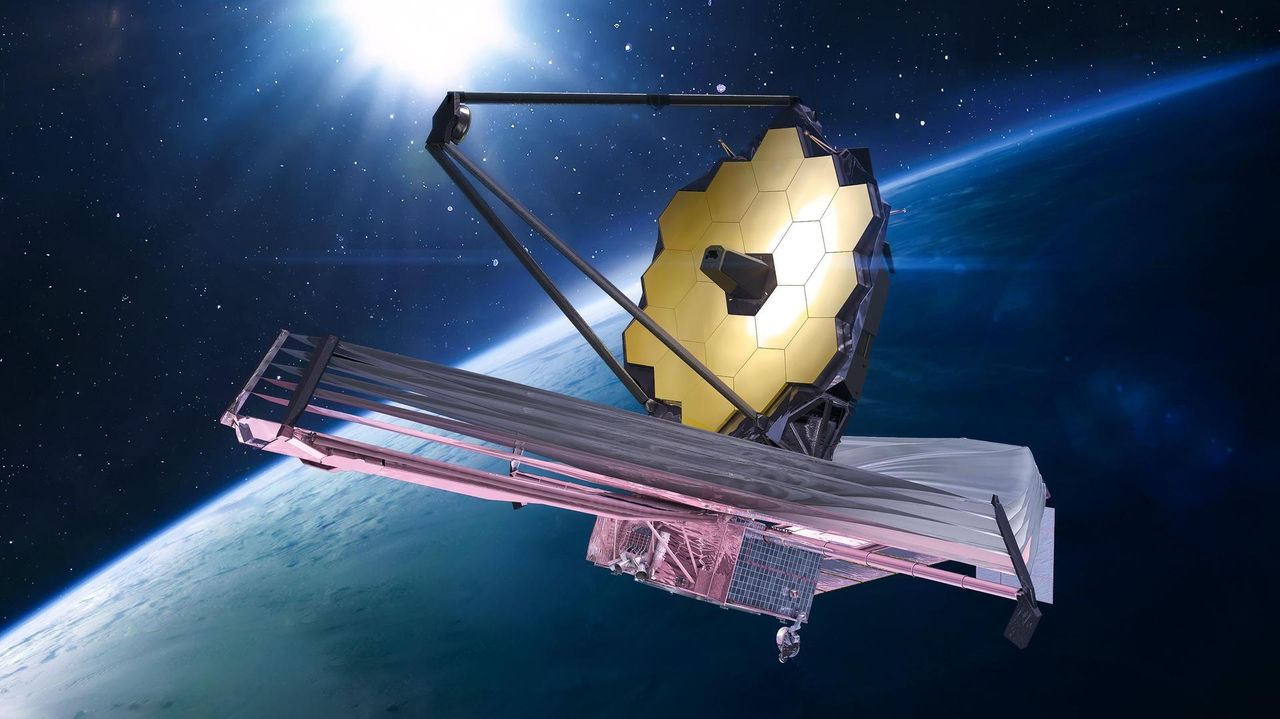
The second most distant object ever spotted by the James Webb Telescope could be a “dark star” powered by dark matter rather than nuclear fusion.
By examining wavelengths of light captured by the James Webb Space Telescope (JWST), researchers identified four candidate dark stars, including one apparently possessing a “smoking” helium absorption signature, the researchers reported in a study published September 30 in the journal. PNAS.
First hypothesis in 2007, dark stars They are thought to be among the first stars – called Population III stars – to form after the Big Bang. According to the theory, they are produced when hydrogen and helium, which on their own would form a black hole, collapse, mix with dark matter. Dark stars are thought to be extraordinarily massive and bright, reaching a million times the mass of the sun and burning a billion times brighter.
“Our initial name ‘black star’ is an inappropriate term,” co-author of the study Katherine Freesephysics professor at the University of Texas at Austin who proposed the dark star hypothesis, told Live Science. “They are neither made [entirely] of dark matter and they are not dark either.
The discovery of dark stars could explain some of the very puzzling objects that JWST has spotted in the early universe, such as the giant supermassive black holes that formed incredibly quicklyFreese said. It would also provide a better understanding of the nature of dark matter. “This is an investigation, not just a new type of star,” she said, “so these candidates are very encouraging for us.”
To spot potential dark star candidates, the team combed through observations of the JWST Advanced Deep Extragalactic Survey (JADES). They focused on the data collected by the Near infrared spectrograph (NIRSpec): an instrument that measures individual wavelengths of light from celestial objects to learn their temperatures, masses, and chemical fingerprints.
The researchers set different criteria in their search: the signals could not be lower than redshift 10 (a red stretch of the ancient light of the universe corresponding to 500 million years after the Big Bang), could only contain hydrogen and helium and had to come from a single object.
This led them to four dark star candidates: JADES-GS-z11-0, JADES-GS-z13-0, JADES-GS-z14-0, and JADES-GS-z14-1. JADES-GS-z14-0 is the second most distant object observed by JWST to date.
Signals from the first stars
Models of each candidate showed that all four could plausibly be dark stars, perhaps even supermassive dark stars.
The team also found clues to the “smoking signature” of supermassive black stars in the JADES-GS-z14-0 wavelength data – single ionized helium atoms absorbing light particles with a wavelength of 1,640 angstroms (an angstrom is a hundred million times smaller than a centimeter).
“No other known high-redshift object should produce such an absorption feature,” the authors wrote in the study, adding weight to their suggestion that JADES-GS-z14-0 is a dim star.
However, the team was surprised to discover that the Atacama Large millimeter/submillimeter array (ALMA) in Chile had detected JADES-GS-z14-0 emitting oxygenan element produced only by stars powered by nuclear fusion. “It worries me a little bit,” Freese said.
The team is currently running simulations to determine how much oxygen is allowed before a dark star can no longer form, study co-author Cosmin Iliephysicist at Colgate University in New York, told Live Science. “Logic tells me there should be some sort of transition,” he said.
Dark stars remain controversial and their existence is by no means accepted. “The majority of the Pop III star community does not believe that dark matter burners [dark stars] can be formed,” Daniel Whalena cosmologist at the University of Portsmouth in the United Kingdom who was not involved in the research, told Live Science.
In fact, Whalen said a “huge problem” with this research is that it doesn’t differentiate between dark stars and dim stars. supermassive primordial stars. “It’s really the elephant in the room here,” he said.
Although candidate dark stars are more massive than most supermassive primordial stars, their wavelength data must be compared for the two types of stars to rule out supermassive primordial stars, Whalen explained.
In response to this criticism, Ilie stated that because supermassive primordial stars do not live as long as dark stars, if many suitable signatures are identified, they are statistically more likely to be dark stars. This means that many more observations are needed to solve this mystery.
Meanwhile, Freese said the team is working on automating the search for dark stars in JWST data “so we don’t have to do anything but keep our eyes open.”


