Iran’s Capital Has Run Out of Water, Forcing It to Move


November 21, 2025
2 min reading
The Iranian capital is moving. The reason is an ecological disaster
The decision to move Iran’s capital is partly driven by climate change, but experts say decades of human errors and actions are also to blame.
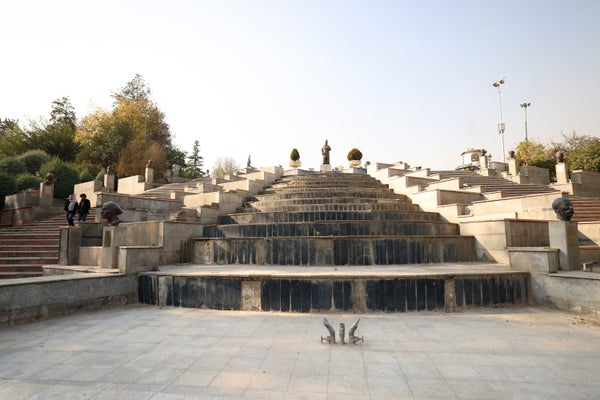
A dry body of water in Tehran on November 9, 2025.
ATTA KENARE/AFP/Getty Images
Amid a worsening ecological crisis and severe water shortage, Tehran can no longer remain Iran’s capital, the country’s president said.
The situation in Tehran is the result of a “perfect storm of climate change and corruption,” says Michael Rubin, a policy analyst at the American Enterprise Institute.
“We no longer have a choice,” Iranian President Masoud Pezeshkian said in a speech on Thursday.
On supporting science journalism
If you enjoy this article, please consider supporting our award-winning journalism by subscription. By purchasing a subscription, you are helping to ensure the future of impactful stories about the discoveries and ideas shaping our world today.
Iranian officials are instead considering moving the capital to the country’s southern coast. But experts say the proposal does not change the reality for the nearly 10 million people who live in Tehran and who are now suffering the consequences of a decades-long dwindling water supply.
Since at least 2008, scientists have warned that uncontrolled pumping of groundwater for cities and agriculture was rapidly drying up the country’s aquifers. Overexploitation not only depleted underground reserves: it destroyed them, as the land compressed and sank irreversibly. A recent study found that Iran’s central plateau, where most of the country’s aquifers are located, is sinking by more than 35 centimeters every year. As a result, aquifers lose about 1.7 billion cubic meters of water per year due to the constant crushing of the ground, leaving no space for underground water storage, says Darío Solano, a geoscientist at the National Autonomous University of Mexico, who was not involved in the study.
“We saw it coming,” Solano says.
Other major cities like Cape Town, South Africa, Mexico City and Jakarta, Indonesia, as well as parts of California, are also facing zero-day scenarios as they sink and run out of water.
This is not the first time that the Iranian capital has moved. Over the centuries, it has moved several times, from Tabriz to Isfahan via Shiraz. Some of these ancient capitals still thrive while others exist only as ruins, Rubin explains. But this is the first time that the Iranian government has moved the capital due to an ecological disaster.
Yet, Rubin says, “it would be a mistake to view the issue solely from the perspective of climate change.” Mismanagement of water, land and wastewater as well as corruption have worsened the crisis, he says. If the capital moves to the remote Makran coast to the south, it could cost more than $100 billion. The region is known for its harsh climate and difficult terrain, and some experts doubt its viability as a national center. Capital relocation is often driven more by political reasons than environmental concerns, says Linda Shi, a social scientist and urban planner at Cornell University. “Climate change is not the cause, but it is a convenient factor to blame to avoid taking responsibility” for bad policy decisions, she said.
Editor’s Note (11/21/25): This article was edited after publication to correct the date of the quoted statement by Iranian President Masoud Pezeshkian and the link to the recent study on the sinking of the Iranian Central Plateau.
It’s time to defend science
If you enjoyed this article, I would like to ask for your support. Scientific American has been defending science and industry for 180 years, and we are currently experiencing perhaps the most critical moment in these two centuries of history.
I was a Scientific American subscriber since the age of 12, and it helped shape the way I see the world. SciAm always educates and delights me, and inspires a sense of respect for our vast and beautiful universe. I hope this is the case for you too.
If you subscribe to Scientific Americanyou help ensure our coverage centers on meaningful research and discoveries; that we have the resources to account for decisions that threaten laboratories across the United States; and that we support budding and working scientists at a time when the value of science itself too often goes unrecognized.
In exchange, you receive essential information, captivating podcasts, brilliant infographics, newsletters not to be missed, unmissable videos, stimulating games and the best writings and reports from the scientific world. You can even offer a subscription to someone.
There has never been a more important time for us to stand up and show why science matters. I hope you will support us in this mission.


