Is it legal in Florida to touch a baby sea turtle?

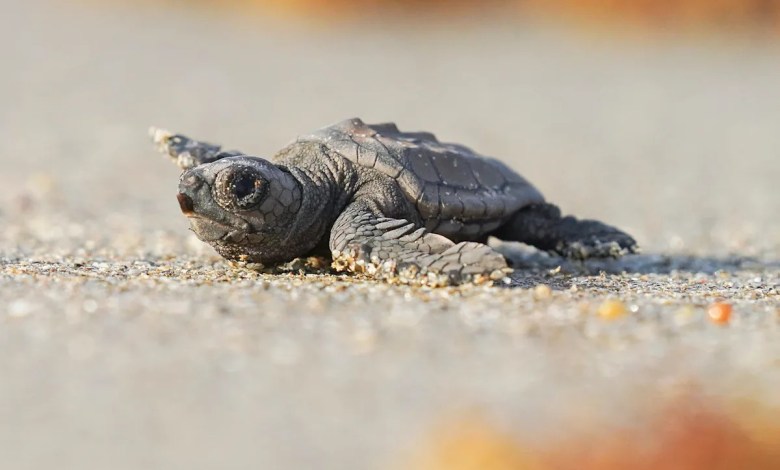
Sea turtle nesting season has begun in South Florida, and soon adorable little baby sea turtles are making their way down the beach and into the water. Can you touch them? What if they get stuck?
Short answer: leave them alone. It’s the law.
Each year, sea turtles that can weigh hundreds of pounds emerge from the ocean, lumber onto the shore and dig holes in which they deposit between 80 and 120 ping-pong ball-sized eggs per nest, cover them with sand and return to the ocean. About two months later, if all goes well, the eggs hatch and the baby turtles emerge and head out to sea.
However, mother turtles and babies are easily disturbed by touch, loud sounds and lights, and endangered species cannot spare any young. More than 100,000 sea turtles nest on Florida’s beaches each year, representing approximately 90% of the sea turtles nesting in the United States. The beaches of Palm Beach County (recently designated the sea turtle capital of Florida) alone are home to approximately 2 million hatchlings each year, Discover the Palm Beaches said in a statement.
There are five species of sea turtles in Florida waters: the loggerhead turtle, green turtle, leatherback turtle, Kemp’s turtle, and hawksbill turtle. All are protected by the federal Endangered Species Act of 1973 and the Florida Sea Turtle Protection Act.
Here’s what to know if you encounter wild sea turtles or their nests.
When is the nesting season for sea turtles?
Florida’s sea turtle nesting season runs from March 1 to October 31. But South Florida beaches will see them first, where it’s warmest.

It’s turtle season along the coast, with sea turtles coming ashore to lay their eggs in the evening and newborn babies heading into the surf before dawn. This little loggerhead hatchling was the last to emerge from the nest, heading east toward the ocean at dawn at Cocoa Beach.
When do baby sea turtles start hatching?
Sea turtles begin hatching between 45 and 70 days later, according to the Florida Museum of Natural History.
Can I touch a sea turtle?

Mote Sea Turtle Research and Conservation Team staff monitor sea turtle nests on Casey Key Beach on Friday, May 21, 2021. Sea turtles, sea turtle eggs and nest marking materials are protected under federal law and any harassment or interference with a sea turtle, living or dead, is subject to penalties.
No. You may not knowingly “possess, take, disturb, mutilate, destroy, cause to be destroyed, transfer, sell, offer to sell, assault, or harass any species of sea turtle or its hatchling, or parts thereof, or the eggs or nests of any species of sea turtle described in this subsection,” according to Florida Statute 379.2431, also known as the Sea Turtle Protection Act.
Sea turtles are extremely sensitive to noise and movement, and they have delicate routines while nesting. A frightened adult sea turtle may disappear into the surf without laying eggs at all, or may not cover them adequately and leave the eggs visible to predators.
Don’t touch the turtles, don’t touch the nests. Nests located in high traffic areas will be marked off with signs and tape to make them easier to avoid.
What if a sea turtle needed help?
If you see a sea turtle of any age in difficulty or stuck, leave it alone and contact the nearest beach manager or call the Florida Fish and Wildlife Conservation Commission (FWC) at 1-888-404-FWCC. Be prepared to describe the turtle’s location, its condition, any visible injuries or signs of distress, nearby landmarks, and any immediate threats it may face.
If you see obstacles in a turtle’s path, such as trash, toys, beach furniture, etc., you can move them out of the way as long as you do so well in advance of the turtle’s approach.
Can I help a baby sea turtle reach the ocean?
No, it is still illegal and can harm the turtle in the long term.
“They must crawl in the ocean to develop essential muscular strength and orient themselves properly,” according to marinelife.org. “This exploration is crucial to their survival, because it imprints vital signals in their memory that will guide them to their natal beaches when it is their turn to nest.
“Getting them back interrupts that process, making it harder for them to find their way back as adults.”

Mote Sea Turtle Conservation and Research Team staff monitor sea turtle nests on Casey Key Beach on Friday, May 21, 2021.
Can I take photos of sea turtles on the beach?
Yes, as long as you maintain a healthy distance of at least 10 feet and don’t use a flash. Light can disorient and frighten a sea turtle, especially at night. In fact, many local ordinances restrict light at night during hatching season.
Why do some cities in Florida ban lighting at night?
The FWC has designated coastal areas that may be used by nesting sea turtles. These areas have adopted guidelines to restrict nighttime waterfront lighting during the nesting season.

Map of Florida counties and municipalities with sea turtle lighting ordinances.
The ordinances prohibit most beach-facing lighting and other light sources that could disturb nesting turtles. Lights can frighten the adult turtle, and hatchlings are attracted to the natural light of the horizon, which guides them toward the ocean.
The light from flashlights, car headlights, or even your phone could be enough to disrupt turtle navigation. When conservationists need to monitor nests or conduct night walks with sea turtles, they use red-filtered flashlights that do not affect the turtles.
Most local ordinances restrict waterfront lighting from May 1 to October 31, although some southern areas start earlier. The City of Palm Beach began implementing lighting restrictions on March 1. Check your local ordinances.
What is the penalty for disturbing sea turtles in Florida?
Under state law, destroying a sea turtle nest or eggs is a third-degree felony, punishable by a fine of up to $5,000 and/or five years in prison.
How can I help sea turtles?
You don’t need to approach a sea turtle to help it.
-
Remove tents, volleyball nets and beach furniture and fill any holes in the sand before leaving.
-
Do not walk, bike, or drive over marked nests or unmarked turtle tracks. Avoid walking on vegetated beach dunes.
-
Do not disturb a turtle crawling to or from the ocean or laying eggs, and stay at least 30 feet away. Do not use lights or flash to photograph and speak quietly.[eakquietly[eakquietly
-
If you’re staying somewhere by the ocean, turn off your lights at night or close your curtains.
-
If you see a sick, injured or dead sea turtle, do not attempt to catch it or put it in the water. Find the nearest beach safety officer or lifeguard or call 1-888-404-FWCC
CA Bridges is a reporter for the Connect Service Journalism team at the USA TODAY Network-Florida. You can get all the best Florida content delivered straight to your inbox every weekday by signing up for the free Florida TODAY newsletter.
This article originally appeared on Palm Beach Post: Florida law protects sea turtles. Here’s what not to do