ISS astronauts photograph 2 comets dancing above the northern lights

When you purchase through links on our articles, Future and its syndication partners may earn a commission.

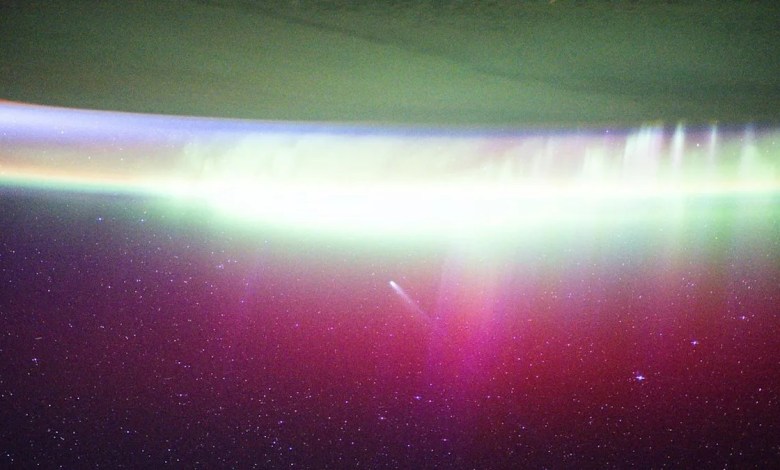
A bright neon-like aurora radiates above Earth, apparently absorbing Comet Lemmon (C/2025 A6) as it flies past the planet at a distance of about 57.2 million miles (92.1 million kilometers) in October 2025. | Credit: NASA
Astronauts orbiting Earth recently photographed not one but two comets as an aurora show danced beneath them.
THE International Space Station (ISS) The Expedition 73 crew took several photos of comets Lemmon (C/2025 A6) and SWAN (C/2025 R2) in recent weeks which have just been posted on NASAon the website and social media pages after the long government shutdown ended.
“Comets Lemmon and SWAN rise millions of kilometers from Earthradiating with aurora and airglow, in these celestial images of the orbital outpost captured in October,” NASA officials wrote on the ISS X feed. Wednesday (November 18).
Comets are small bodies made of ice and dust; when they approach our sunradiation pressure and heat give them spectacular tails. Auroras are light shows that occur when charged particles from the sun interact with Earth’s atmosphere and magnetic field, while airglow is luminescence caused by chemical reactions in the upper atmosphere.
NASA did not say who among the crew took the photos, but they closely resemble images taken by Japan Aerospace Exploration Agency (JAXA) astronaut Kimiya Yui. Yui, unlike the NASA crew, was able to continue posting on the X social media channel during the shutdown. (NASA astronauts were only allowed to perform essential tasks during the shutdown, such as science and maintenance of the ISS.)
Yui also provided descriptions of her photos. “You can…distinguish the two types of tails: ions and dust”, Yui wrote (in Japanese; translation by xAI’s Grok tool) on October 20 of an image of Lemmon with the comet against the background of a blue-purple starry sky. (NASA has published a similar image from the same day on its website.)

Comet Swan (C/2025 R2) appears above Earth’s yellow-green glow just before an orbital sunrise, at a distance of about 27.2 million miles (43.8 million kilometers) from the planet. | Credit: NASA
More images arrived quickly. “After a busy day ended, I continued to take photos to ease my fatigue. Lately, my source of healing has been Lemmon-chan, I suppose?” Yui posted on with a series of images on October 22. “I find myself thinking things like, ‘What kind of expression are you going to show me today, I wonder?’ and I walk to the window, and that moment feels as good as going out on a date.”
Yui sent another set of images October 21noting changes in brightness and the Lemmon tail, as well as changes in Earth’s atmosphere. The photo sets from October 21 and 22 on Yui’s feed are similar to a Image from October 23 on the NASA website.
SO, October 24Yui found Lemmon seeming to blend into a spectacular aurora of green and yellow light, which resembled an entry on the NASA image site. Lemmon was 92.1 million miles from Earth and the ISS was above Fargo, North Dakota, when the image was taken.
“She was like a mermaid swimming in a sea of aurora,” Yui said of Lemmon. He added that the show was “too magnificent” to use the colloquial honorific “chan” when referring to Lemmon, so he chose to adopt the more formal “Lemmon-san”.

Comet Lemmon (C/2025 A6) is shown approximately 57.6 million miles (91.3 million kilometers) from Earth in this long exposure photograph taken from the International Space Station. | Credit: NASA
The same day, Yui turned his attention what does NASA do? identifies like comet SWAN, which was about 27.2 million miles (43.8 million km) from Earth at the time. “As the comet approaches the sun, the opportunities to photograph it from the ISS have become very short,” Yui noted of the image, which shows SWAN floating above the green and yellow bands of aerial light off the coast of Newfoundland and Labrador, Canada.
It’s rare to have two bright comets visible in the sky around the same time, and it is particularly rare for them to reach peak brightness so close to each other: Lemmon and SWAN were both at their peak around October 20 and 21.
Lemon was discovered in January by University of Arizona astronomer David Carson Fuls in images from the Mount Lemmon Survey, using the university’s eponymous telescope near Tucson. SWAN was found in September by Ukrainian amateur astronomer Vladimir Bezugly using images from the Solar Wind Anisotropies (SWAN) instrument on the European Space AgencyThe space-based Solar and Heliospheric Observatory (SOHO).