Underground Microbial Life Could Survive on Mars, Europa and Enceladus Using Cosmic Rays


Radiolysis induced by galactic cosmic rays could provide a viable source of energy for microbial metabolism in the underground environments of rocky planetary objects such as Mars, Europa and Encelade, according to new research carried out by the University of New York Abu Dhabi.
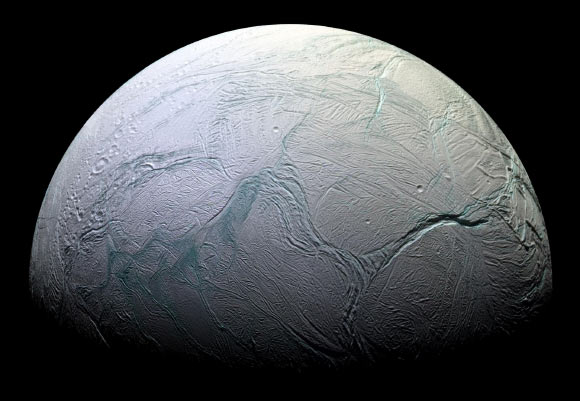
The NASA Cassini spacecraft captured this superb mosaic of enclosure on October 5, 2008 while the spacecraft moved away from this geologically active moon from Saturn. Image credit: NASA / JPL / Space Science Institute.
The ionizing radiation is known to have a destructive effect on biology by causing DNA damage, cells and production of reactive oxygen species, among others.
Although direct exposure to the high radiation dose is not favorable to biological activity, ionizing radiation can and, in some cases, are known to produce a certain number of biologically useful products.
One of these mechanisms is the production of biologically useful products via radiolysis induced by the charged particles.
“We focused on what is happening when the cosmic rays hit water or ice underground,” said Dr. Dimitra Atri atri at New York Abu Dhabi and colleagues at Washington University, the University of Tennessee, Rice University and Universidad Industrial in Santander.
“The impact takes water molecules away and releases tiny particles called electrons.”
“Some bacteria on earth can use these electrons for energy, similar to the way plants use sunlight.”
“This process is called Radiolysis, and it can feed life even in dark and cold environments without sun.”

The surface of Europa is looming in this newly reproduced color view; The image scale is 1.6 km per pixel; The North on Europa is right. Image credit: NASA / JPL-CALTECH / SETI Institute.
Using computer simulations, the researchers studied the amount of energy in this process to be able to produce on Mars and on the frozen moons of Jupiter and Saturn.
These moons, which are covered with thick layers of ice, would have water hidden under their surfaces.
Scientists discovered that Encelade had the most potential to support life in this way, followed by Mars, then Europa.
“This discovery changes the way we think about where life could exist,” said Dr. Atri.
“Instead of only looking for hot planets with sunlight, we can now consider cold and dark places, as long as they have water below the surface and are exposed to cosmic rays.”
“Life could survive in more places we have never imagined.”

This image of the high resolution stereo camera of Mars Express shows the Mars globe on a dark background. The disc of the planet includes yellow, orange, blue and green patches, all with a gray global mute shade, representing the variable composition of the surface. Image credit: ESA / DLR / FU Berlin / G. Michael / CC by-SA 3.0 IGO.
In their study, the authors also introduce a new idea called radiolytic habitable zone.
Unlike the traditional “Goldilocks” zone – the area around a star where a planet could have liquid water on its surface – this new area is concentrated on the places where water exists underground and can be under tension by cosmic radiation.
Since the cosmic rays are found throughout space, this could mean that there are many more places in the universe where life could exist.
“The results provide new tips for future space missions,” said the Reserachers.
“Instead of only looking for signs of surface life, scientists could also explore underground environments on Mars and icy moons, using tools that can detect chemical energy created by cosmic radiation.”
“This research opens up new fascinating possibilities in the search for life beyond the earth and suggests that even the darkest and coolest places of the solar system could have the right conditions for life to survive.”
The study appears in the International Astrobiology Journal.
_____
Dimitra Atri and al. 2025. Estimation of the potential of the radiolysis induced by ionizing radiation for microbial metabolism on terrestrial planets and satellites with rarefied atmospheres. International Astrobiology Journal 24: E9; DOI: 10.1017 / S1473550425100025