It’s a Plastic World, After All



Explore
Last week, cooperation fell. A United Nations Treaty to reduce plastic production melted under the opposition sun in countries that make most of the world plastic, including the United States.
IIn the middle of the last century, we learned to master carbon chemistry. It was a triumph born of war and industry, oil wells and laboratories, and its most versatile offspring was plastic: a material as flexible as imagination and as durable as geological time. We arrived to last eternally – and this is the case. If only we had planned the problem.
At the entrance The Blue ParadoxAn exhibition at the Griffin Museum of Science and Industry in Chicago, you go under a canopy of 1,278 fish, each carved from plastic waste by artist Aurora Robson. The installation is called EmergenceAnd he is aptly named. We can emerge from the plastic crisis. But we must first immerse it.
Paradox is a walk in a mirror held in the modern world. Photo graceful of the Griffin Museum of Science and Industry.
ADVERTISEMENT
Nautilus members benefit from experience without advertising. Connect or join now.
You enter an immersive ocean – light waves, sounds of sounds, the pace of breathing and the tide. It is not a decoration; It is a reorientation. The ocean is not “there”. It is the main engine of the life of the earth. It covers more than 70% of the surface of the planet, produces half of the oxygen that we breathe and regulates the climate which makes our existence possible. Walking under its surface, even virtually, should be remembered that we are not masters of nature, but citizens.
Each year, 14 million metric tonnes of plastic enter the ocean. It is such a large number that it ceases to have meaning. The exhibition gives it a shape: photographs of rivers in Shapefish Indonesia with bottles of shampoo, statistics on microplastics found in whales and uterus, maps of the five large ocean gyres where garbage swirl in slow gyroscopic dances. It is one thing to know that plastic is durable. It is another to see him survive in coral.
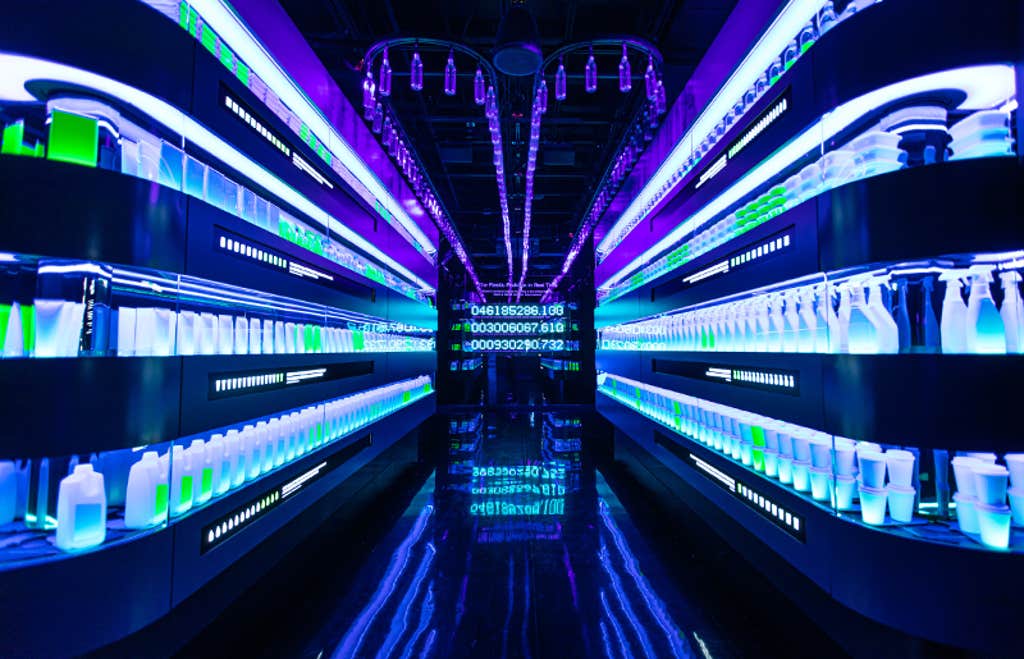
Meet The Blue Paradox– Created by SC Johnson and International Conservation – must not encounter an ecological problem or a scientific phenomenon. It is to enter a mirror held in the modern world.
You are asked not to just observe the plastic, but to count with it.
ADVERTISEMENT
Nautilus members benefit from experience without advertising. Connect or join now.
The interactive exposure screens allow you to trace the trip from a plastic bottle from the factory to the discharge, from the coast to opening at sea. They allow you to calculate your own plastic footprint. A ticker has the tons of plastic produced since you have entered the exhibition. A treadmill is pouring plastic waste into an incessant flood. The experience is not overwhelming by accident. It is designed to provoke the concern of the truth. He succeeds.
But, while you browse virtual waste, the story turns to the paradox – the title of the exhibition. Plastics are a villain. It is in our rivers, our clothes, our food and even blood. But it is also a wonder. This makes modern medicine possible. It stores vaccines and sterile instruments. It preserves food, reduces weight in cars and houses electronics.
The problem of plastic is not in its invention, but in its abandonment. We have made a material that lasts longer than civilizations, and we have built our culture to use it once and throw it away.
ADVERTISEMENT
Nautilus members benefit from experience without advertising. Connect or join now.
The exhibitions refer you to the possibility of hope. Here are the solutions – not very imperfect, but real. Alternative to plastic. Reuse the systems. Legislation. Education. A wall of names, digital and radiant, records the promises made by the guests: reducing, reusing, expressing, vote. It is a quiet room, and yet it buzzes with the potential.
For his part, SC Johnson has chosen to confront his story rather than obscure him. “Plastic is one of the most useful materials we have ever invented,” said Fisk Johnson, CEO of SC Johnson. To resolve the crisis, Johnson adds: “You have to integrate everyone into the plastic recycling loop. And everything must be done on a large scale. ” It is not a call for perfection, but for cooperation.
How are we going to overcome? Exhibitions like The Blue Paradox may indicate the path. Companies that produce plastic are not the last obstacle. They can change.
As you cross the Blue Paradox exhibition, in light that moves and with the floor trembling under your feet, you are asked not to simply observe the plastic, but to count with it. And that means counting with yourself, with the world you want.
ADVERTISEMENT
Nautilus members benefit from experience without advertising. Connect or join now.
Main photo Griffin Museum of Science and Industry
Posted in partnership with: