Warsh Hearing Reveals How Tightly Trump Has Tied Himself in a Knot on Fed Control


President Donald Trump’s own words were repeatedly used against him Tuesday during a heated confirmation hearing for Trump’s nominee for Federal Reserve chairman, Kevin Warsh. During a 2.5-hour Senate Banking Committee hearing, the risk the president posed to the independence of the Federal Reserve loomed large as Democratic and Republican senators pressed Trump’s own statements about pressuring his next Fed chairman to adopt politically influenced monetary policy.
At stake is the credibility of Warsh and the Federal Reserve as a whole, the stability of the entire global financial system, and the cost of living for Americans, many of whom will vote in November.
As it stands, Warsh apparently has no chance of being confirmed, as senators from both parties object to a bogus Justice Department investigation into current Fed Chairman Jerome Powell and the cost of Federal Reserve building renovations that appear to be underway. Republican Sen. Thom Tillis (R-NC) has pledged to oppose the nomination until the investigation is complete. Trump has only increased his efforts to pursue the investigation, which a federal judge has repeatedly suggested has no merit. Trump’s words also put the president in a difficult situation, as he repeatedly and publicly stated that he expected Warsh to cut rates, and even confirmed that he told Warsh so during a meeting. This revelation directly contradicts Warsh’s own statements about the independence of the Fed and his meeting with the president.
In his opening remarks and throughout the proceedings, Warsh emphasized his belief in the Fed’s independence in monetary policy matters.
Asked directly by Sen. Jack Reed (D-RI) if he would commit to being independent of Trump, Warsh responded, “Yes, Senator, I do.” However, he later appeared to qualify that assertion, raising new questions about what exactly Fed “independence” means to him.
“Independence must be won and it is won by keeping the promises and commitments the Fed made,” Warsh said in response to Sen. Mike Rounds (R-SD). Rounds of negotiations have characterized the independence of the Federal Reserve as “critical.”
On Tuesday morning, Trump said in an interview on CNBC’s Squawkbox that he would be disappointed if his new Fed chairman didn’t cut rates “right away.” In December, the president posted on Truth Social that the economy was doing well and his new Fed chairman should lower rates.
“Anyone who disagrees with me will never be Fed Chairman!” » Trump wrote on the post.
Also in December, the Wall Street Journal reported that Trump “pressured Warsh about whether he could trust him to support interest rate cuts” and that Trump “confirmed that information.”
Warsh repeatedly asserted Thursday that Trump never asked him to cut interest rates and that Warsh would never agree to those terms.
“Someone here is lying, then,” said Sen. Ruben Gallego (D-AZ), referring to the Journal’s reporting. “Who’s lying here? Is it you or the president? Because the president confirmed that he did indeed ask you to lower interest rates.”
Warsh has made an about-face in his political position. In the past, he was known for wanting to keep rates high to avoid price inflation. In recent months, he has taken a stance calling for lower rates. His defenders call the 180 a change of heart. Senators feared it was something more sinister.
“I am concerned that your position on interest rates appears to be changing based on what is politically practical, rather than based on sound economic judgment,” said Sen. Chris Van Hollen (D-Md.).
Republican committee members also referred, more gently, to Trump’s overt calls for monetary policy manipulation.
“Can you tell us a little bit,” prompted Sen. Cynthia Lummis (R-WY), “about your conversations with President Trump about interest rates?” »
“The problem is that President Trump said he wouldn’t appoint anyone who wouldn’t agree to lower interest rates,” said Sen. John Kennedy (R-LA). “Have you agreed with the president that you are going to lower interest rates?”
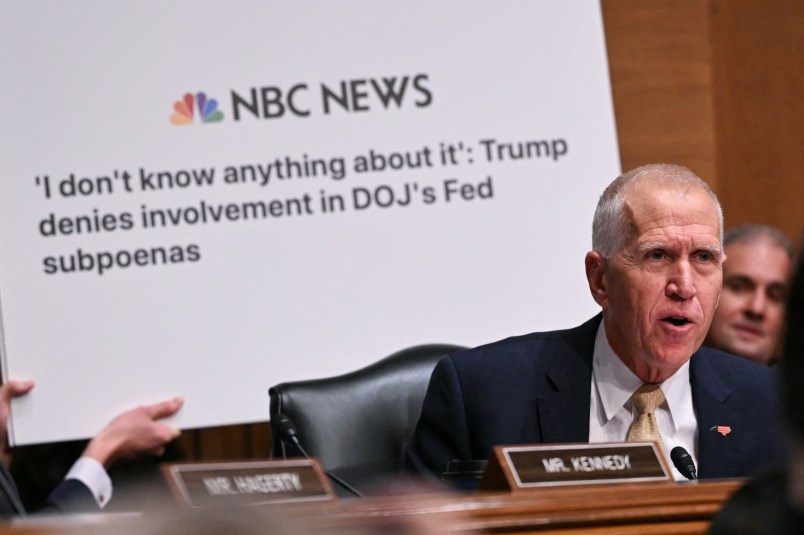
Tillis appeared to try to offer Trump a way out during his comments. With billboards explaining construction and renovation costs, Tillis used his time to denounce the investigation into Powell and reiterated his belief that the cost of the Fed building renovations was justified. But rather than launch a hostile offensive against Trump, Tillis blamed the unpopular investigation on unnamed DOJ officials. Trump denied in January that he had prior knowledge of the Powell investigation.
“The problem I have here is we had a U.S. attorney with a dream or an assistant U.S. attorney who thought it would be cute to subject Chairman Powell to an investigation just a few months before the position opened,” Tillis said. “We have to end this investigation,” Tillis said later. “The big DOJ didn’t know about it. The president didn’t know about it. Let’s put this investigation aside so I can support your confirmation.”
Tillis’ description, however, contradicts Trump’s. During Tuesday morning’s interview on CNBC, the president refused to consider dropping the case.
“We need to find out why a small building costs almost $4 billion,” Trump said.
Warsh said presidents have wanted lower interest rates throughout history. But by attempting to impeach sitting Federal Reserve Governor Lisa Cook, investigating and repeatedly threatening to fire Powell, Trump has taken unprecedented steps to achieve his politicized central banking agenda.
“There are many exit routes that the Trump administration could have taken to end what is a ridiculous exercise,” Sen. Angela Alsobrooks (D-Md.) said Tuesday. “Instead, they have doubled down on their efforts. Do you dispute Chairman Powell’s assertion that the investigations are a pretext for political disagreements?”
Warsh obscured. “I would comply with any judgment of the courts,” he said.
Democrats also raised concerns about Warsh’s asset portfolio, which totals more than $100 million, and the potential conflicts of interest it could raise. Warsh reiterated that he worked with the Office of Government Ethics to develop a plan to divest those assets.
Warsh attempted throughout the hearing to emphasize his own policy priorities. He wants to shrink the Fed’s $6 trillion balance sheet, use alternative data sources to measure inflation and believes artificial intelligence could allow the central bank to cut interest rates without creating price inflation. His beliefs are consistent with those of conservative economic thinkers, Richard Stern, vice president of the economics arm of the conservative think tank Advancing American Freedom, told TPM. The problem Warsh faces is his own nominator, Trump.
“It would not be a good idea for the president to get his own nomination mired in this very politicized fight, as everyone thinks, over personal conflicts with Powell,” Stern said.
Warsh cannot be confirmed without Tillis’ support.


