IVF hormones could be delivered with painless ‘microneedle’ patch someday, early study hints


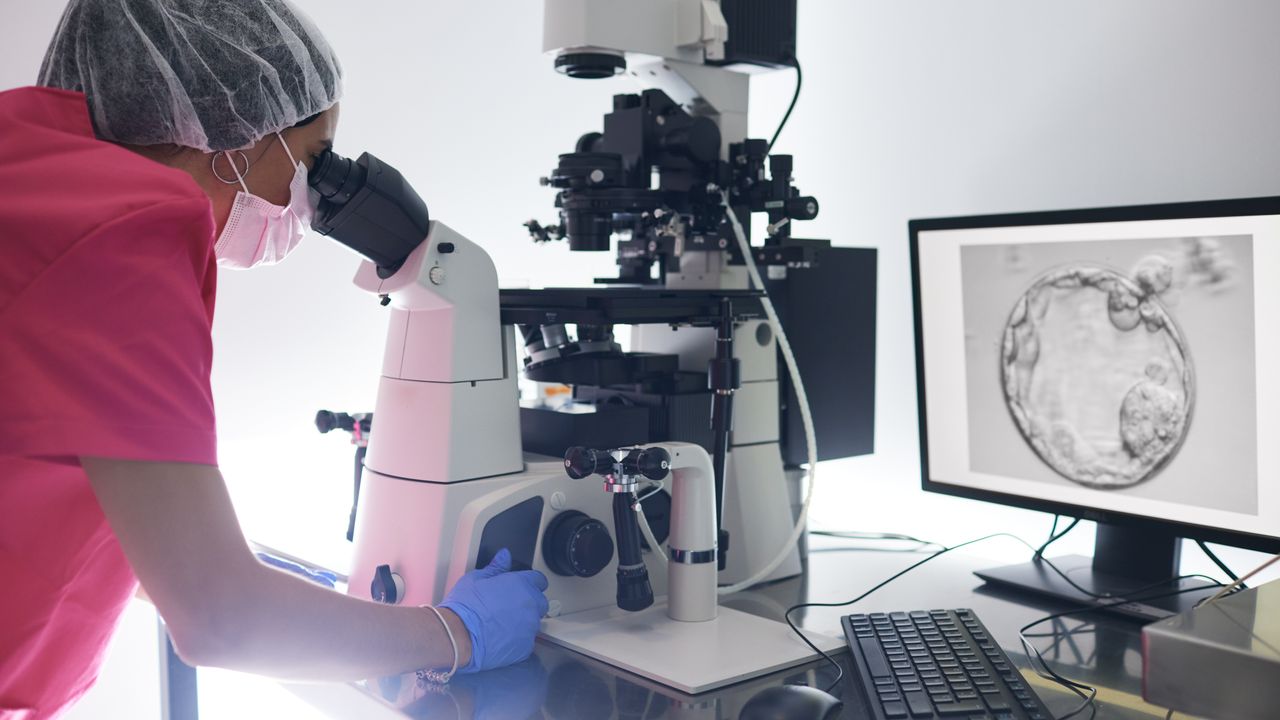
Patients undergoing in vitro fertilization (IVF) must give themselves daily hormonal injections in the weeks before egg collection for the procedure. Now, a research team has developed what it calls a painless, automated way to administer these hormones using a light-activated microneedle patch.
A preliminary study in rats showed that administration of the hormone leuprolide from a patch could be done without pain and without releasing foreign substances into the body. A light can be pre-programmed to turn on at specific times, so the patch releases the hormone at the correct rate.
Vivienne Tamwho was a doctoral student at the time of the study, suggested the potential of their research to help IVF patients, Cerruti said. The group had previously considered using the patch to deliver cancer drugs to patients, Cerruti said.
“From what we read, one of the main reasons for IVF failure is that the drug is not administered consistently,” she told Live Science. The hope is that one day the patch can resolve this issue.
Design a hormone delivery system
In the new study, the team incorporated previous discoveries carried out in two separate laboratories at McGill and INRS research center in Quebec.
The patch is made up of tiny needles containing nanoparticles filled with the hormone leuprolide. The researchers had already developed a potential coating for nanoparticles which breaks down when exposed to low-energy light, called near-infrared (NIR) light. Upon NIR exposure, the nanoparticles then spread their contents.
How this works is that the NIR is converted into higher energy ultraviolet (UV) light by the core of the nanoparticle. This UV light can then break the bonds in the particle’s coating, releasing the molecules inside. “We had this coating that we knew worked,” Cerruti said.
The team also showed that nanoparticles, made of rare earth materials, are non-toxic in animal testing. To then make their patch, they incorporated the nanoparticles into microneedles made of an insoluble synthetic polymer, which is not expected to degrade, Cerruti said.
The needles prick microscopic holes in the outer layer of the skincalled the stratum corneum, which is made up of dead skin cells. These injections are painless because the needles do not penetrate deep enough to reach the sensory nerve endings located in deeper layers of the skin, Tam explained.
In rats, NIR was able to release the drug from microneedles without releasing foreign substances – namely the nanoparticles themselves – into the body, Cerruti said. If the nanoparticles had entered the body with the hormones, they would have accumulated in the liver and other organs, she said, but the team did not observe this in testing.
A potential challenge of this method is that skin thickness and blood flow vary among patients, said Kang of lifeassociate professor in the Faculty of Pharmacy at the University of Sydney, who was not involved in the study. Ensuring that an NIR pulse delivers the necessary light to different body types may be more difficult than delivering the drug with a standard injection, he wrote in an email to Live Science.
Although NIR penetrates the skin better than visible light, its effectiveness decreases with increasing fatty tissue, Kang added. “Since IVF injections are traditionally subcutaneous [delivered under the skin]”researchers need to ensure that the microneedles and light source can communicate effectively at the depth needed to trigger release,” he explained.
The new findings show that the hormone entered the rats’ cells. circulatory system as expected, but researchers still need to test whether this delivery method has the desired effect in encouraging egg maturation, Cerruti said.
The biggest obstacle to any nanoparticle therapy is biocompatibility, Kang said, meaning the material must be compatible with living tissues and not cause toxic effects or harmful immune reactions. Researchers “need to prove that these nanoparticles are either excreted safely or remain inert in the skin without long-term toxicity,” he said.
Although microneedles are not expected to degrade in the body, proving their durability could be difficult, Cerruti said, because “polymers are made of hydrogen, carbon and oxygen — the same elements we are made of.”
Before moving on to studies in larger animals, Cerruti said, researchers want to conduct additional studies in rats to determine the effectiveness of this hormone delivery system.
In their first experiments, the team released only a small dose of the hormone. To make the dose equivalent to that used in IVF, they would have to use more patches on a given mouse, or include more nanoparticles in a given patch, Cerruti said. They could also increase the size of the patch, thereby increasing the number of nanoparticles.
One of the “biggest hurdles to overcome before possible clinical translation is the limited dose of the drug available in the blood,” Cerruti said.
Tam, V., Trana, R., Nieto‐Arguello, A., Olasubulumi, O., Babity, S., Skripka, A., Vetrone, F., Brambilla, D. and Cerruti, M. (2025). Upconversion of nanoparticle-loaded microneedles for responsive near-infrared gonadotropin delivery to increase in vitro fertilization success. Little, 22(1). https://doi.org/10.1002/smll.202513138


