James Webb Space Telescope Finds Atmosphere on Lava Planet TOI-561 b


September 23, 2025
2 Min read
This flamboyant exoplanet breaks down all the rules on extraterrestrial atmospheres, JWST finds
Hot, small and old – exoplanet to 561 B is roughly the worst place to look for extraterrestrial air. Scientists using JWST found it anyway
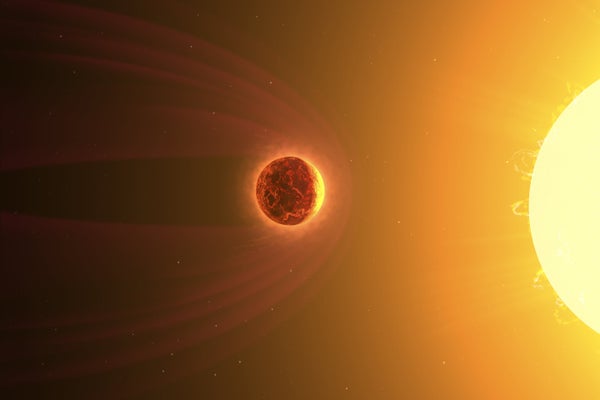
New research suggests that a rocky “lava planet” in orbit around its star probably carries an atmosphere.
Chris Butler / Scientific source
Astronomers found an atmosphere where they expected the least – reducing an exoplanet too small, too hot and too old to have air, at least in theory.
The observations of the James Webb space telescope (JWST) of the Voucan-561 B burning lava planet suggest not only that it has a thick atmosphere, but also that it may have had one for billions of years. This is the strongest proof to date for air around a hot rocky world which is not only a temporary veil of hydrogen and remaining helium of planetary formation. La Découverte, published on the Arxiv.org preparatory server, will soon appear in the Astrophysical newspaper letters.
“It’s super old and ultrahot. These are the worst conditions, ”explains the co-author of the prior study, Tim Lichtenberg, planetary scientist of the University of Groningen in the Netherlands. “It shouldn’t have an atmosphere. And he has one.”
On the support of scientific journalism
If you appreciate this article, plan to support our award -winning journalism by subscription. By buying a subscription, you help to ensure the future of striking stories about discoveries and ideas that shape our world today.
Planetary scientist Joshua Krissansen-Totton at Washington University, who was not involved in the study, agrees. “It is really surprising and exciting to find a substantial atmosphere on this hot rocky planet,” he said.
In our solar system, atmospheres obey a simple rule: the larger and cooler worlds keep their air, and the smallest and warmer do not do so. But you-561 B weighs only two masses of earth and is very, very hot; The planet orbit so close to its orange dwarf star that its years last less than a day of the earth, and its estimated temperature is an rock putting in rock 2,300 kelvins. You-561 B is also about twice older as our solar system, so its sun atmosphere would have had a lot of time to escape. But the researchers suspected that the planet could be more than a naked magma ball due to its unusually low density. And scientists previously spotted the air on a larger hot super-terrely called 55 Cancri E, although the data is “messy and bizarre”, says Krissansen-Totton.
To check Alien Air, the search team used JWST to take the temperature of Tou-561 B. The planet is locked at maturity, so a side cooked in the incessant sun while the other is always dark. Scientists found that the fire -soaked fire -soaked fire was cooler than expected for a bare rock – probably because the gas was there to spread the heat.
The team is “confident” that an atmosphere is the best explanation of the data, explains the astronomer Exoplanet and co-author of study Johanna Teske from Carnegie Science. But finding an unexpected atmosphere “is the kind of result that generates more questions than they answer,” she adds.
On the one hand, scientists do not know what is the air of Toui-516 B or how he survived eons of hellish heat. Lichtenberg thinks that the atmosphere has probably completed the planet’s magma ocean. Each planet of our solar system was once melted like you-561 B, he underlines; This unexpected atmosphere could have a lot to teach us about the origins of our own air.
It’s time to defend science
If you enjoyed this article, I would like to ask for your support. American scientist has been a defender of science and industry for 180 years, and at the moment can be the most critical moment of this two -centuries story.
I was a American scientist The subscriber since the age of 12, and that helped shape my way of looking at the world. Sciam Educates me and always delights me, and inspires a feeling of fear for our vast and magnificent universe. I hope that does this for you too.
If you subscribe to American scientistYou help make sure that our cover is focused on significant research and discoveries; that we have the resources necessary to report the decisions that threaten laboratories in the United States; And that we support the budding scientists who work at a time when the value of science itself does not become often again.
In return, you get essential news, Captivating podcasts, brilliant infographics, Maybe not miss newsletters, videos to watch, Difficult games and the best writings and reports in the scientific world. You can even Give someone a subscription.
There has never been more time for us to get up and show why science counts. I hope you will support us in this mission.