James Webb Space Telescope solves a comet crystal mystery


Some of the more distant comets in the solar system can be confusing. Many contain crystalline silicates that only form after exposure to high heat, which doesn’t make much sense to astronomers. These comets spend most of their time inside the extremely cold Oort Cloud and Kuiper Belt, at temperatures averaging -450 degrees Fahrenheit. So why are silicates linked to heat?
After years of speculation, scientists finally believe they have solved the crystal riddle thanks to new images from NASA’s James Webb Space Telescope (JWST). Their explanation, detailed in an article published this week in the journal Natureindicates that the answer lies near a distant young star the same size as our sun.
EC 53 is just one of thousands of protostars forming inside the Serpens Nebula, about 1,300 light-years from Earth. Like its many siblings, EC 53 is enveloped in extremely hot dust and gases – exactly the type of environment capable of forging crystalline silicates. It’s also capricious. After about 18 months of relative calm, the protostar begins a feeding frenzy lasting about 100 days during which it inhales surrounding dust clouds. Meanwhile, outflow jets purge some of this material toward the edges of its protoplanetary disk.
After pointing JWST’s Mid-Infrared Instrument (MIRI) at the protostar, astronomers identified and mapped the location of certain materials during the active and dormant cycles of EC 53. They soon noticed that crystalline silicates like forsterite and enstatite did not remain near their stellar birthplace. Jeong-Eun Lee, a co-author of the study and an astronomer at Seoul National University in South Korea, now believes that EC 53 and similar protostars shed their newly created silicates into deep space during these feeding times.
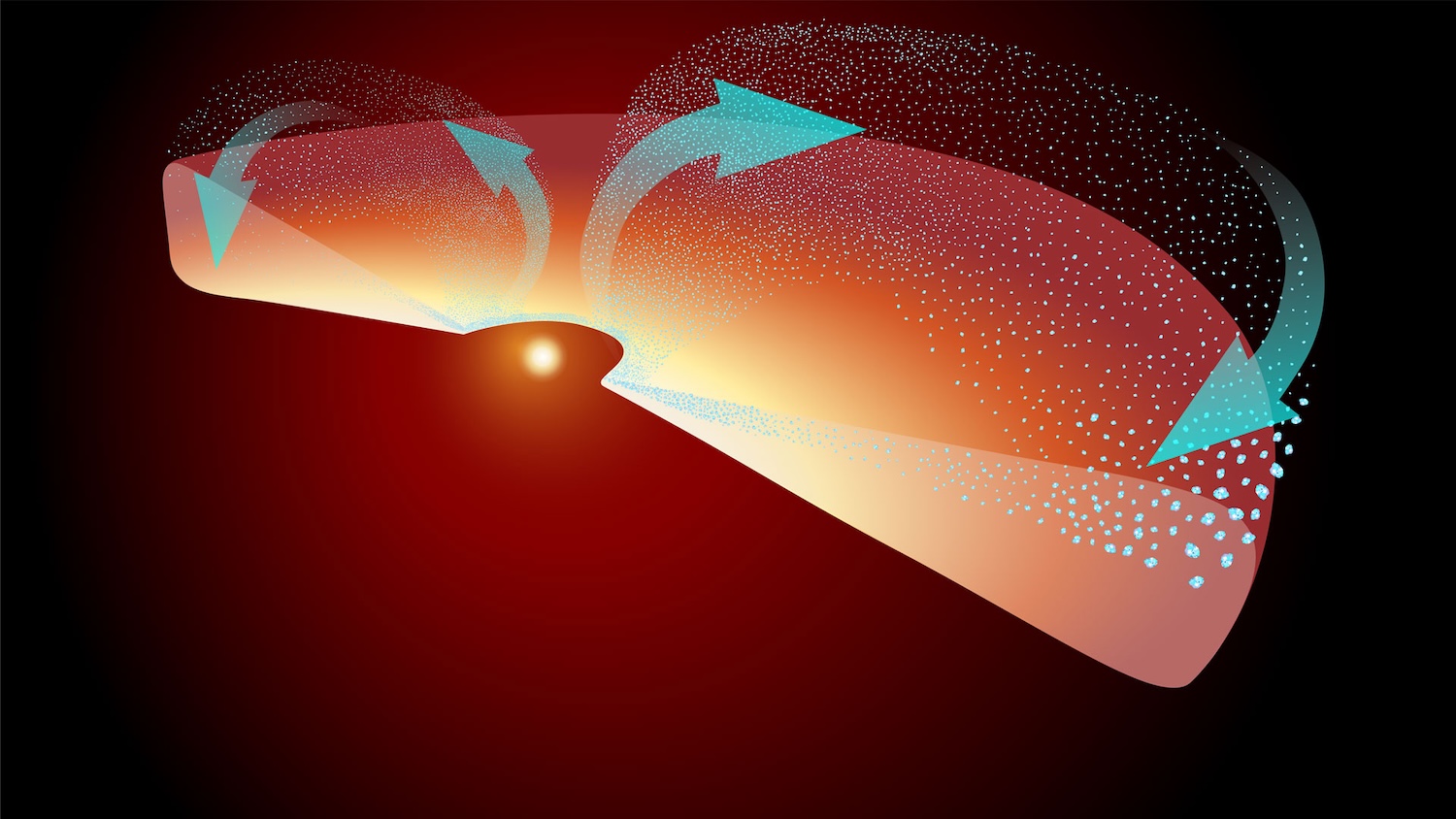
“The layered outflows of EC 53 could lift these newly formed crystalline silicates and transfer them outward, as if they were on a cosmic highway,” Lee explained. “Webb not only showed us exactly what types of silicates are found in the dust near the star, but also where they are found before and during an explosion.”
Doug Johnstone, co-author of the study and research director at the National Research Council of Canada, added: “Even as a scientist, I am amazed that we can find specific silicates in space, including forsterite and enstatite, near EC 53. These are common minerals on Earth. The main ingredient on our planet is silicate.”
While EC 53 has been developing for millions of years, the protostar is far from complete. Lee, Johnstone and their colleagues estimate that the protostar could remain surrounded by its dust cloud for another 100,000 years. All the while, tiny rocks and debris are expected to continue to collide and coalesce to form the building blocks of future gas and terrestrial planets. Ultimately, a new star system similar to the one orbiting the Sun will emerge from EC 53 – and its ejected silicates may very well be on their way to comets of their own.

The best new PopSci 2025 releases


