Trump’s Asia tour sees deals, knee-bending and a revealing Xi meeting


Anthony ZürcherNorth America correspondent, traveling with the president

 Getty Images
U.S. presidential trips abroad are traditionally an opportunity to showcase the power of the American nation on the world stage. By contrast, Donald Trump’s five-day tour of East Asia was a demonstration of Trump’s power – but also, at times, of the limits of that power.
Trump’s stops in Malaysia, Japan and South Korea over the first four days were an exercise in pleasing a sometimes temperamental U.S. president. It was an acknowledgment that Trump, with the stroke of a pen, could impose tariffs and other measures that could devastate the economies of export-dependent countries.
His meeting with Chinese leader Xi Jinping on Thursday, however, was quite different.
It was a meeting of equals on the world stage, where the stakes for both nations – for their economies, for their international prestige, for the well-being of their peoples – were enormous.
With China, Trump can raise his pen, but such actions have consequences. They have a cost.
Through the first four days, Trump’s latest foray into global diplomacy has gone smoothly.
Each stop was punctuated by a mix of traditional trade negotiations – deals made in the shadow of Trump’s “reciprocal” tariffs – and personal accommodations that sometimes bordered on the obsequious.
In Malaysia, Trump gained access to critical minerals and made progress toward finalizing trade deals with Southeast Asian countries. He also presided over a treaty that is expected to ease border tensions between Thailand and Cambodia – the kind of “peace deal” the US president loves to tout.
 Reuters
In Japan, Trump’s Marine One flew over a Tokyo Tower lit in red, white and blue – with a Trumpian gold top.
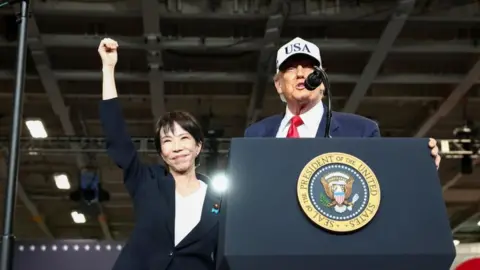
Newly elected Prime Minister Sanai Takaichi detailed $550 billion in Japanese investment in the United States and gave the U.S. president a gift of 250 cherry trees for America’s 250th birthday, as well as a golf club and bag that belonged to Shinzo Abe, the assassinated former prime minister who befriended Trump during his first term.
She also became the latest foreign leader to nominate Trump for his coveted Nobel Peace Prize.
Not to be outdone, South Korea greeted Trump with 21-gun artillery fire and a military band that played Hail to the Chief and YMCA — the Village People song that became a Trump rally anthem.
President Lee Jae Myung held an “honoring ceremony” for Trump in which he presented the US leader with his country’s highest medal and a replica of an ancient Korean dynastic crown.
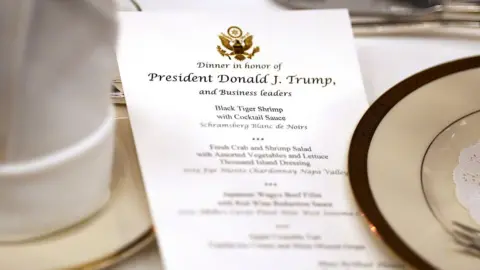
Lunch with Lee included a “Peacemaker Dessert” of gold-encrusted brownies. Later in the day, the Koreans served Trump Vineyard wine at an intimate dinner in Trump’s honor with six world leaders attending the Asia-Pacific Economic Conference summit.
 Getty Images
In the United States, Trump may be the subject of “No Kings” protests from Americans who disapprove of his border-testing expansions of presidential power, but during his time in East Asia he was treated like a king.
And like the kings of old, Trump arrived in Korea to demand tribute – in the form of $200 billion in cash, or $20 billion a year, from South Korea to the United States, to be invested under the leadership of the Trump administration. An agreement on the terms of these payments ensured that the tariff rate on South Korean exports to the United States would drop from 25 percent to 15 percent.
The main event of Trump’s Asia trip, however, came in its final hours, during his meeting with Xi.
There, the power dynamic between the leaders of the world’s two largest economies was decidedly different from the interactions Trump had with his foreign counterparts in previous days.
It lacked all the pomp and pageantry. No military bands, no honor guards, no carefully crafted menus celebrating mutual national affection. Instead, the two leaders and their top aides sat around a long, white negotiating table in a nondescript military building just off the runway at Busan International Airport.
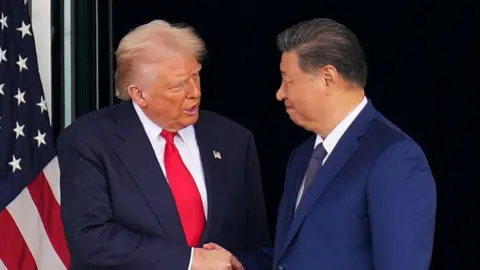
The fact that Trump appeared tense when Trump shook Xi’s hand in Busan perhaps reflects how high the stakes are. It was a far cry from his relaxed attitude when he told me the day before that he was hopeful of having a good meeting.
“I know a little bit about what’s going on because we’ve talked to them,” he said. “I don’t just walk into a meeting coldly.”
For months, Trump had threatened to impose higher tariffs on Chinese exports to the United States — as a source of revenue for the U.S. Treasury and to pressure China to open its markets and control exports of chemicals used to make fentanyl.
China, unlike many other U.S. trading partners, has responded with escalation, not concessions.
If tariffs were a source of economic pain for China, then Beijing would target U.S. vulnerabilities. He suspended purchases of American agricultural products and proposed controlling exports of its large reserves of critical minerals – resources that the United States and much of the world depend on for high-tech manufacturing.
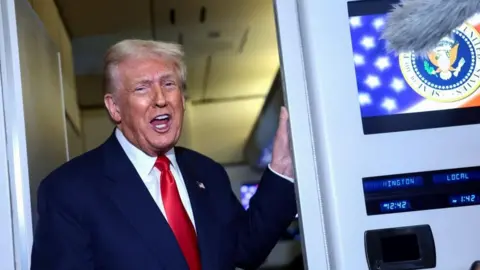
Trump’s mood was upbeat after the meeting, which he called “incredible” and gave it a rating of 12 on a scale of 1 to 10. The president seemed in good spirits even as the plane shook off heavy turbulence as it climbed into the sky.
But it was a battle of wills and economic difficulties that set the two nations on a path that ultimately led to Thursday’s meeting and an agreement by both sides to de-escalate.
The United States lowered tariffs, while China eased access to essential minerals and pledged to resume imports of American agricultural products and increase purchases of American oil and gas.
While this may not be a major breakthrough, both sides recognized that the existing situation was unsustainable.
 Reuters
The international order that will take its place, however, is far from clear. As Xi acknowledged in his opening speech at the bilateral meeting, China and the United States “do not always see eye to eye.”
“It is normal for the world’s two major economies to experience friction from time to time,” he said.
This may represent an improving outlook after months of tension, but it is also a sign that “friction” is here to stay.
China has global and regional ambitions and a growing desire to expand its influence.
Trump, for his part, has attempted to reorder American priorities abroad, using American economic power to pressure allies and adversaries. And it’s America’s allies – countries like Japan and South Korea that have long relied on American political, economic and military support – who are scrambling to adapt to the new reality.
Some of this confusion comes in the form of an unapologetic willingness to accommodate Trump in ways big and small. Gifts and dinnertime honors are easy, but multibillion-dollar payouts, increased military spending, and ongoing tariffs take a toll.
And they could ultimately prompt a reassessment of relations with America – and, therefore, with China.
Trump may have received a royal welcome in South Korea, but, in what might be considered somewhat apt symbolism, as he left, it was Xi who was arriving. And the Chinese leader’s Korean hosts had promised a diplomatic welcome equal to that received by the Americans.
Xi participates fully in Apec leaders’ meetings – procedures Trump chose to skip. If there is a vacuum created by U.S. international maneuvering, it is one that China seems more than willing to fill.
Perhaps Trump will return to America with everything he expected from this trip. But, like the Rolling Stones song he played at his political rallies, it’s not yet clear whether he got what America needs.


