Japan Watches Economic Waters Amid China’s Growing Presence


Japan strengthens its surveying capacities in its vast exclusive economic zone (EEZ) by improving an unprofolded investigation and by building a new mother ship to transport submersibles.
Improvements come as the powerful neighbor of Japan China widens the presence of research ships in the region.
When asked for comments, the Japanese Consulate General in Hong Kong has referred Nowsweek To a document from the Japanese Coast Guard, which said that one of its missions was to keep the ZEE against foreign ships carrying out research activities without the consent or the previous agreement of Japan.
In his response to NowsweekThe Chinese Embassy in Washington, DC, cited a previous comment from the country’s foreign ministry, which questioned Japan’s demand for a reef and said that China’s ships were exercising high -sea freedom.
What is an Eez?
The United Nations Convention on the Law of the Sea (UNCLOS), an international treaty establishing the legal framework of order in the oceans and the seas, defines the EEZ as a maritime zone extending up to 230 miles of the coast and being beyond and adjacent to the territorial sea, which under the treaty does not extend more than 13.8 miles of the coast.
The Japan Eez covers approximately 1.56 million square miles, against its area of around 146,718 square miles. Tokyo said that the EEZ was “essential” in Japan, allowing it to “exclusively develop marine energy and mineral resources and exploit aquatic resources”.
According to UNCLOS, a coastal state has sovereign rights to “explore, exploit, keep and manage” natural resources and jurisdiction on “marine scientific research” in the ZEE.
Collin Koh, a principal researcher at the Defense Institute and Strategic Studies in Singapore, said Nowsweek On Monday, “surveying activities” would be supposed to come from the term maritime scientific research. States seeking to carry out such activities must obtain prior authorization from the competent coastal state before carrying them, he added.
What to know
The Japanese government has decided to build a new mother ship for transporting several inhabited and unanswered probes, local media reported in July. Scheduled for completion in the 2030s, it would replace the current and aging mother ship, the Yokosuka– which was built more than three decades ago – to conduct “effective surveys” on the resources of the seabed.
At the end of July, the Japanese agency for science and technology of the Marine Earth announced that its probe without a deep pilot, the Urashimareached a depth of 26,246 feet during a recent trial in the Izu-Ogasawara trench, which is in southern Japan in the Western Pacific. The probe has been improved for deeper dives, allowing it to reach the deepest parts of the Japan ZEE.

Japanese agency for maritime earth sciences and technologies
The Japanese media noted that half of the Japan ZEE has a depth of more than 13,123 feet, with many areas exceeding 19,685 feet. Consequently, exploration on the high seas is essential for the exploration of rare earths.
The interest in rare earths – including 15 Lanthanides and Scandium and Yttrium, which are essential for modern technologies, such as artificial intelligence – increases in the middle of commercial disputes between the United States and China.
China has the largest rare land reserves in the world with 44 million metric tonnes and produces 70% of the world’s supply.
Chinese challenge
While Japan overcomes technological difficulties in the development of natural resources in its ZEE, China poses a challenge for Tokyo in the protection of its economic waters through the Western Pacific. On Tuesday, three Chinese oceanographic research ships had been detected to carry out research activities in the ZEE without the consent of Japan since January.
Regarding Chinese research activities in Japan’s ZEE, Koh said that the same marine scientific research set would be useful not only to advance scientific knowledge and commercial applications – such as minerals – but also for military operations.
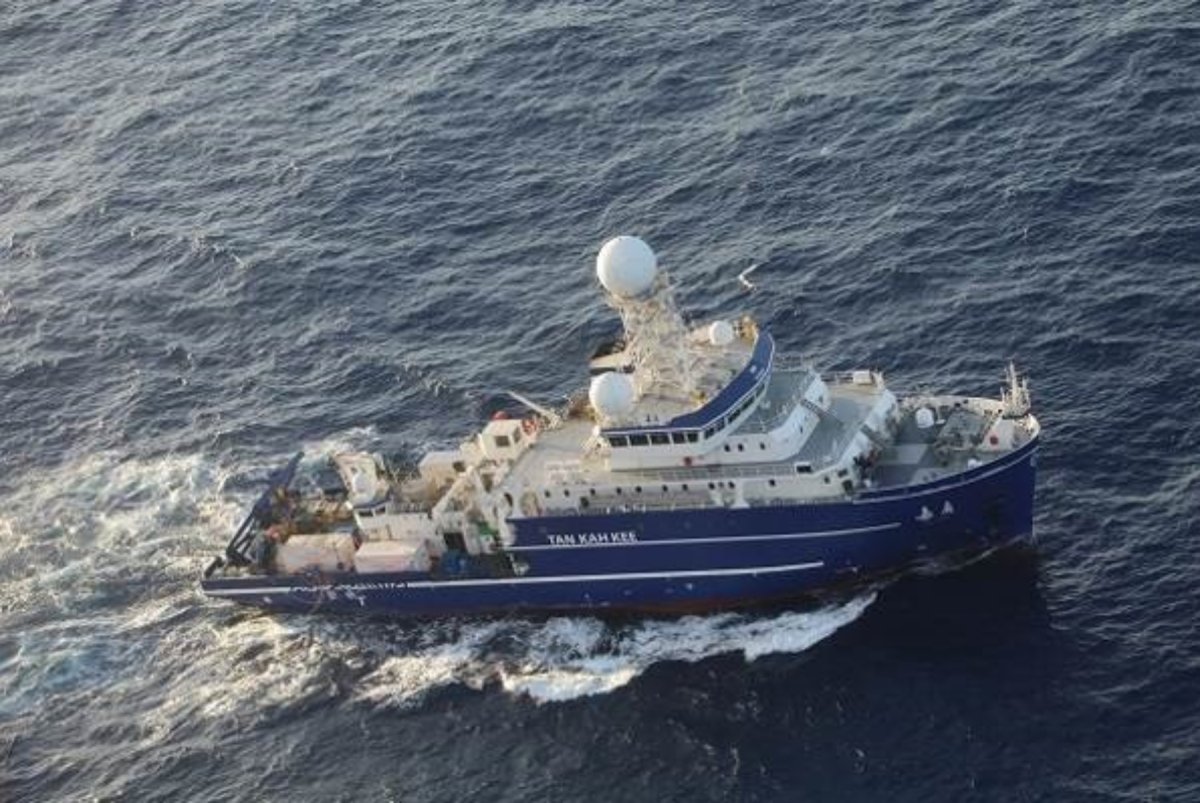
Japan Coast Guard
In the areas known to contain seabed resources, these activities could be intended to prospect marine economic data that supports extractive follow -up operations, the analyst said.
For military applications, the data collected could be used to create “awareness of the underwater domain” to plan operations of underwater and anti-submarine war, he added.
Japan is a key American security ally in the restriction of Chinese military activities in the event of war in the Western Pacific. It is part of the first island channel – as well as Taiwan and the Philippines – a north -south defensive line under an American maritime containment strategy.
While Japan operates one of the maritime forces and the best advanced resources and the best and the best maritime forces, the maritime self -defense force and the Coast Guard, it is confronted with a challenge in the type of response it can do with unauthorized foreign activities in the ZEZ, according to Koh.
“In addition to keeping an eye on and publish an audio and visual challenge, Japan’s maritime forces could not” expel “the foreign ship transgressing in an energetic manner without potentially triggering a diplomatic or worse, an armed climbing confrontation,” he said.

Kyodo via images AP
Last year, Hidden Reach, an initiative of the Center for Strategic and International Studies, published a report identifying a total of 64 Chinese research vessels and active investigation between 2020 and 2023, making it the largest fleet of civilian research vessels in the world.
Many of these ships are operated by organizations affiliated with the state with close ties with the Chinese army, while some questioned the foreigners without prior approval, said the report, warning that “the line between its civil and military research is strongly vague”.
What people say
Collin Koh, a principal researcher at the Institute for Defense and Strategic Studies, said Nowsweek:: “But there is a gray area here which remains to be resolved: what about these oceanographic and hydrography research activities carried out by military actors? It was a bug-bordet highlighted in the case of American naval surveillance activities in Chinese ZEI in particular.”
A Japanese coastal guard document in 2025 said: “In accordance with international law and domestic law, the [Japanese coast guard] Carry out day and night surveillance and vigilance against foreign official ships, oceanographic research ships as well as illegal fishing by foreign fishing ships. “”
What happens next
China should continue to send research ships to the Japan ZEE despite Tokyo’s demonstrations. It remains to be seen how the Japanese coastal guard will improve its surveillance of the country’s economic waters, including by cooperation with the maritime self -defense force.


