How China spectacle shows dangers of Trump’s trade policy


Anthony ZurcherCorresponding to North America

 Getty images
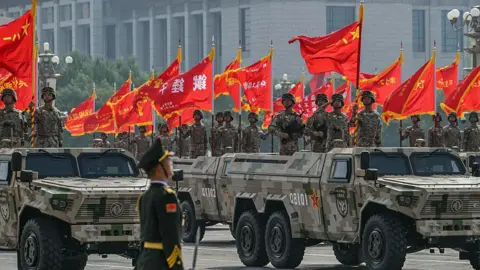
The military power of the People’s Republic of China was fully exposed in a parade marking the 80th anniversary of the end of the Second World War on Wednesday.
Thousands of kilometers away, at the White House in Washington DC, Donald Trump was careful.
“They hoped I was looking at and I was looking at,” he said.
The American president did not detail his reflections on the massive celebration extended to the Tiananmen square, except that it was “very, very impressive”. China’s message – to Trump and the world – however, seems quite clear.
There is a new growing power center worldwide and a new alternative to the order supported by the Americans of the last century.
Trump’s remarks at a meeting at the Oval Office with Polish President Karol Nawrocki, also Wednesday, also highlighted the issue.
They have been the culmination of a series of reflections typically in circuit by the American president on events in China in recent days. It was a mixture of ambivalence, grievance and worry.
During an interview with Podcast on Tuesday, Trump was not unchanging about the parade, saying that he was “not concerned” by the Chinese force show before Putin, the North Korean chief Kim Jong Une and more than two dozen other heads of state.
Tuesday evening, however, he hung on his Truth social website that China did not give credit to the United States for his support during the Second World War.
“Please give Vladimir Putin and Kim Jong Un, while you conspire against the United States of America,” he wrote.
Aside from the plots, Trump has a weakness for parades and manifestations of military power. He welcomed Putin in Alaska last month with an overview of the stealth bomber and a red carpet bordered by American military jets. He has good memories of attending the celebrations of the Bastille day in France during his first presidential mandate. And he organized his own military parade to celebrate the 250th anniversary of the American army in Washington two months ago.
Unlike the elegant display of high -tech armaments in Beijing and precision walking masses, Trump’s parade was a discreet tribute to American military history, while the tanks of the Second World War and soldiers of the revolutionary era have marched with casualness the Avenue Constitution near the White House.
It was in his heart a nostalgic affair, which suited Trump’s “Make America Great” to Trump’s slogan and his economic policy rooted in 19th century mercantilism – a time when Trump often insisted, America was at his greatest.
Of course, the Chinese parade – while dripping with futuristic weapons – also offered a historic account – an attempt by the communist government to claim a more important role in the defeat of fascism and imperialism during the Second World War. If this conflict launched the so-called “American century”, Beijing perhaps hopes that a new respect for its role could smooth the transition to a future designed in China.
“This is the first step in a concerted effort to rewrite road rules,” said Richard Wilkie, secretary to the veterans of the veterans during Trump’s first presidential mandate. “And you do it first by rewriting the story.”
He added that Chinese nationalists and American forces had much more to do with the Asian defeat of Japan than the Communist Army.
The parade was not the only image that comes out of China this week that American decision-makers intend to maintain an international order led by the United States could however find concerning.
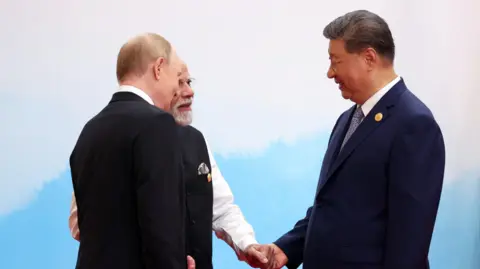
On Monday, Xi and Putin huddled with Indian Prime Minister Narendra Modi at an economic summit in Tianjin – an indication that freezing relations between China and India can largely thaw due to the heat generated by Trump’s pricing policies, which have reached the two particularly harsh nations.
Donald Trump’s “America First” perspectives on world trade have blurred the economic and political alignments in the world, and the apparent relations between the leaders of China, Russia and India have provided a powerful illustration in the way of the largest pieces of the geopolitical puzzle could come together in a difficult, but not entirely unpredictable way.
Trump, of course, considers prices as an integral part of his plan to protect American industry and generate new income for the federal government. If there is a diplomatic price, it seems to be the one he is – for the moment – ready to pay.
“Koreans, the Japanese, the Philippines, the Vietnamese know that the real threat is not a hiccup in a commercial partnership with the United States,” Wilkie, co-representative of American Security at the America First Institute, told Trump. “The threat is to grow Chinese military power.”
 Reuters
Trump was also ambivalent as to conflicts and concerns far from the American soil, rather focusing on a “sphere of influence” which includes a keen interest in the immediate geographic district of America – Greenland, Panama and Canada, among them.
The danger for Trump, however, is that his radical commercial actions could end up being all risk and without reward. There are growing indications that the newly built commercial regime in America could be dismantled in the coming days by the American judicial power.
Friday, a court of appeal ruled that many of his prices were based on a defective interpretation of federal law. Trump promised that he turns to the United States Supreme Court for a reversal, but that the conservative judges who dominate the chamber frequently govern in favor of Trump, they also adopted a low vision of the presidents who adopt large policies without the explicit authorization of the Congress. There is no guarantee that the Court will support the generous interpretation of Trump of the presidential power.
Regarding trade, Trump walked to his own beat – taking America on a new dramatic course and creating new international bed companions in a few months.
It is an ambitious strategy that Trump promised will lead to a second American golden age. But the dangers, whether on the parade grounds of Place Tiananmen or in American audience rooms, are very real.

Follow the twists and turns of Trump’s second term with Trump’s newsletter, the correspondent of North Correspondent Anthony Zurcher. Readers of the United Kingdom can register here. Those outside the United Kingdom can register here.


