‘The timing was extremely lucky’

When you purchase through links on our articles, Future and its syndication partners may earn a commission.

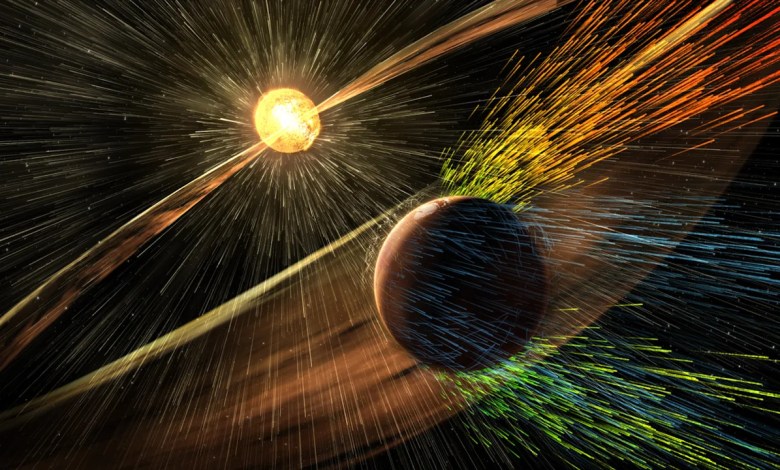
Artist’s depiction of a solar storm removing charged particles from the Red Planet’s upper atmosphere. | Credit: NASA/GSFC
Two European Space Agency Mars-orbiting missions, the Mars Express and ExoMars Trace Gas Orbiter spacecraft, observed that a powerful solar “superstorm” that ravaged Earth also hit the Red Planet. The storm caused spacecraft malfunctions and an overloaded upper Martian atmosphere.
THE solar storm hit Earth on May 11, 2024, proving to be the largest recorded impact on our planet in over 20 years. It generated light auroragenerally limited to the poles of our planet, as far toward the equator as Mexico. And indeed, the storm also affected Marchwith the Mars-Express and the ExoMars Trace Gas Orbiter (TGO) received 200 days of radiation in just 64 hours.
“The impact was remarkable: Mars’ upper atmosphere was flooded with electrons,” said Jacob Parrott, ESA researcher and team leader. statement. “It’s the largest response to a solar storm we’ve ever seen on Mars.”
The solar storm increased the number of electrons in two layers of the Martian atmosphere: a 45% increase at an altitude of 68 miles (110 kilometers) and a whopping 278% increase at 81 miles (130 kilometers) above the Martian surface. This represents the largest number of electrons planetary scientists have ever seen in the Red Planet’s atmosphere.
The solar superstorm also demonstrated the negative impact such space weather can have on space technology, a risk that motivates researchers to develop better space weather forecasts.
“The storm also caused computer errors for both orbiters – a typical space weather hazard, because the particles involved are very energetic and difficult to predict,” Parrott continued. “Fortunately, the spacecraft were designed with this in mind and built with radiation-resistant components and specific systems to detect and correct these errors. They recovered quickly.”
Parrott and his colleagues used a pioneering technique called radio occultation to study the effects of this solar storm. This involved Mars Express transmitting a radio signal to the TGO as it dipped below the Mars horizon. This signal was then refracted at Mars Express by the atmospheric layers of the Red Planet. This revealed the details of these layers.
“This technique has actually been used for decades to explore the solar system, but using signals transmitted from a spacecraft to Earth,” said team member Colin Wilson, an ESA project scientist for Mars Express and TGO. “Only in the last five years have we started using it on Mars between two spacecraft, such as Mars Express and TGO, which typically use these radios to transmit data between orbiters and rovers. It’s great to see it in action.”
What this revealed was the fact that Earth and Mars react very differently when bombarded by charged particles from the sun.
Solar storms impact Mars and Earth differently
The main difference between Mars and Earth in their response to solar storms is that our planet has a protective magnetic field, the magnetosphere. This lessens the impact of solar storms on our atmosphere and also diverts charged particles from Earth toward the poles, where they can cause auroras.
The absence of a magnetosphere around Mars makes it difficult to compare the Red Planet to Earth. Studying space weather around our neighboring planet is also complicated by the fact that the Sun scatters its charged particles and radiation irregularly.
“Fortunately, we were able to use this new technique with Mars Express and TGO just 10 minutes after a large solar flare hit Mars,” Jacobs explained. “Currently we only make two observations per week on Mars, so the timing was extremely lucky.”

Diagram shows radio signal bounce technique used by researchers to study impact of solar storm on Mars’ atmosphere | Credit: ESA
Scientists studied the consequences of three solar events that were part of the same global storm: a radiation flare, an explosion of high-energy charged particles, and material launched from a coronal mass ejection (CME). When radiation and materials from these events hit the Martian atmosphere, electrons were stripped from neutral atoms, causing these negatively charged particles to fill the atmosphere in numbers never before recorded.
The team’s study of the event could also help us understand how the Red Planet became an arid, barren landscape.
“The results improve our understanding of Mars by revealing how solar storms deposit energy and particles into Mars’ atmosphere – which is important because we know that the planet lost enormous amounts of water and most of its atmosphere to space, likely driven by the continuous wind of particles flowing out of the sun,” Wilson added. “But there’s another side to this: The structure and content of a planet’s atmosphere influences how radio signals propagate through space. “If Mars’ upper atmosphere is filled with electrons, that could block the signals we use to explore the planet’s surface via radar, which would make it a key part of our mission planning and impact our ability to explore other worlds.”
The team’s results were published Thursday March 5 in the journal Natural communication.


