Judge blocks Trump administration from ending protections for Haitians : NPR

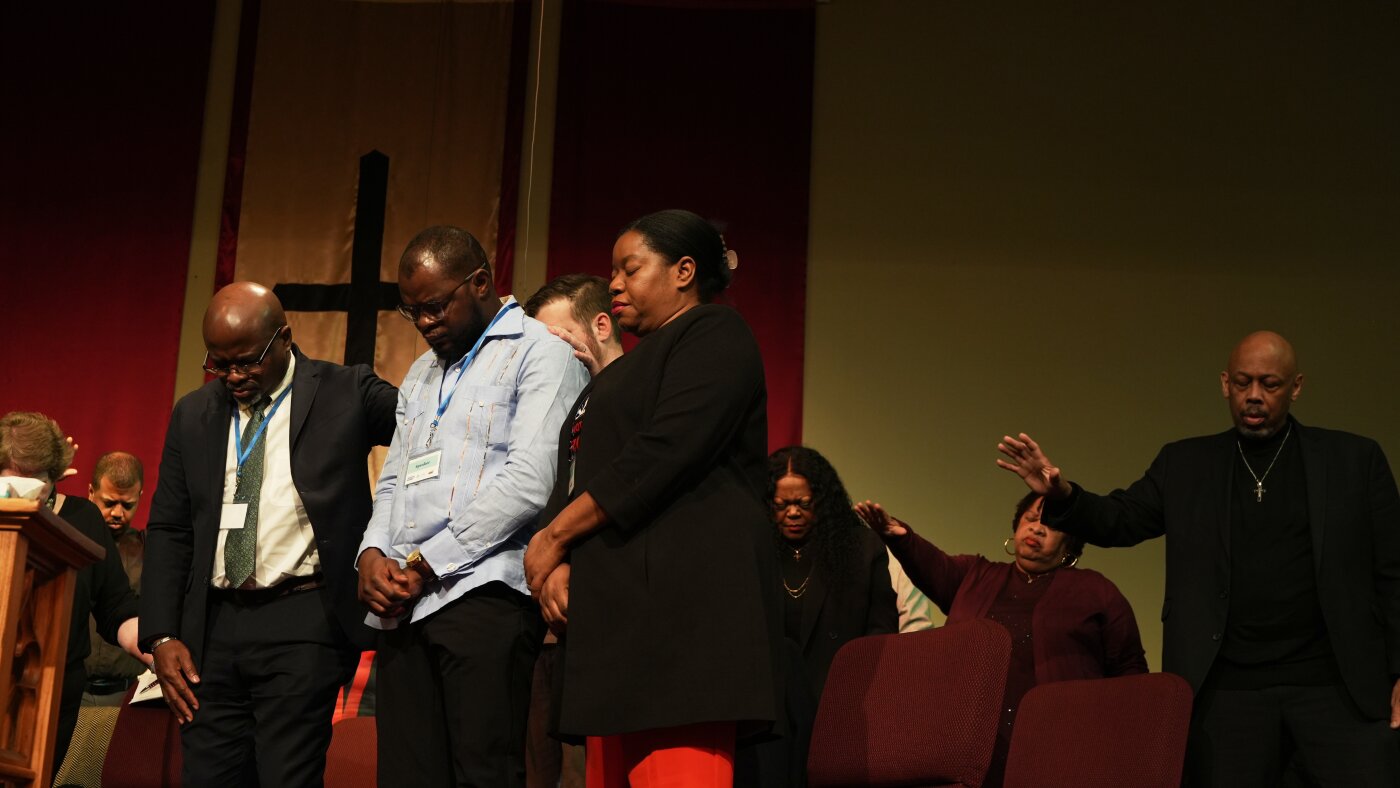

Faith leaders and Haitian community leaders pray at St. John Missionary Baptist Church in Springfield, Ohio, Monday, Feb. 2, 2026, during an event in support of Haitian migrants fearing the end of their temporary protected status in the United States.
Luis Andrés Henao/AP
hide caption
toggle caption
Luis Andrés Henao/AP
SPRINGFIELD, Ohio — A federal judge on Monday blocked the end of protections that have allowed about 350,000 Haitians to live in the United States, representing another legal setback, although perhaps temporary, for President Donald Trump’s immigration agenda.

U.S. District Judge Ana Reyes in Washington granted a request to stay the termination of temporary protected status for Haitians while a lawsuit challenging that status continues. The termination, set for Tuesday, “will be null, void and without legal effect,” she wrote.
“We can breathe a little,” said Rose-Thamar Joseph, director of operations for the Haitian Support Center in Springfield, Ohio.
Reyes said in an 83-page opinion that the plaintiffs were likely to prevail on the merits of the case and that she found it “substantially likely” that Homeland Security Secretary Kristi Noem predetermined her termination decision because of “hostility toward nonwhite immigrants.”
The judge, appointed by President Joe Biden, said Noem did not have “unlimited discretion” and was required to consult with other agencies on conditions in Haiti. The ruling cites Noem’s own words three days after she announced the end of Haitian protections, calling for a ban on travel from Haiti and “all the damn countries that have flooded our nation with killers, leeches and rights junkies.”
Although the decision grants temporary aid to Haitians, the next legal steps remain unclear.
Department of Homeland Security spokeswoman Tricia McLaughlin denounced the decision as “lawless activism.”
“Haiti’s TPS was granted following an earthquake that occurred over 15 years ago,” she said. “This was never intended to be a de facto amnesty program, and yet that is how previous administrations used it for decades.”
DHS says Haiti has improved, but community leaders say country remains dangerous
Temporary protected status may be granted by the Secretary of Homeland Security if conditions in the country of origin are deemed unsafe for return due to a natural disaster, political instability, or other dangers. Although it grants TPS holders the right to live and work in the United States, it does not provide a legal path to citizenship.
Haiti’s TPS status was initially activated in 2010 after a catastrophic earthquake and has been extended several times. The country is ravaged by gang violence which has displaced hundreds of thousands of people.
The Trump administration has aggressively sought to remove this protection, making more people eligible for deportation. These measures are part of a larger, massive deportation effort by the administration.
In addition to migrants from Haiti, Noem ended protections for about 600,000 Venezuelans, 60,000 people from Honduras, Nicaragua and Nepal, more than 160,000 Ukrainians and thousands of people from Afghanistan and Cameroon. Some have lawsuits pending in federal courts.
“If the termination stands, people will almost certainly die,” lawyers for Haitian TPS holders wrote in a court filing in December. “Some will probably be killed, others will probably die of disease, and still others will probably die of starvation.”
They claim the decision to end Haiti’s status was motivated by racial animus and that Noem failed to take into account the existence of an ongoing armed conflict that would pose a “serious threat” to personal security, as required by law.

DHS said conditions in Haiti had improved. In a court filing in December, administration lawyers said the plaintiffs’ allegations of racial animus were based on statements “taken out of context, often from other speakers and from years ago, and not directly related to the Secretary’s determinations.”
“To the contrary, Secretary Noem provided reasoned and apparently sufficient explanations for her decisions.” they said.
A government notice in November announcing the termination said there had been positive developments for Haiti, including the authorization of a new multinational force to combat gangs. Noem determined that allowing Haitians to remain in the United States was contrary to the national interest, the opinion said.
Jerome Bazard, a member of the First Haitian Evangelical Church of Springfield, said it is still too dangerous for many members of his community to return to Haiti.
“They can’t go to Haiti because it’s not safe. Without TPS, they can’t work. And if they can’t work, they can’t eat, they can’t pay their bills. You’re killing people,” he said.
Haitians in Springfield are plunged into uncertainty
Earlier Monday, two dozen religious leaders and hundreds of worshipers in Springfield sang and prayed together in support of Haitian migrants who feared their protected status would end this week. They hoped the federal judge could intervene.
Uncertainty over TPS has compounded concerns among the city’s already struggling Haitian community.
Trump denigrated the community of about 15,000 Haitians during his 2024 campaign for a second term, falsely accusing its members of eating their neighbors’ cats and dogs while pitching voters on his plans for an immigration crackdown. The false claims have exacerbated fears of division and anti-immigrant sentiment in this predominantly white working-class city of about 59,000.
In the weeks following his remarks, schools, government buildings and elected officials’ homes received bomb threats.
Since then, Haitians in Springfield have lived in constant fear that has only been exacerbated by federal immigration crackdowns taking place in Minneapolis and other cities, said Viles Dorsainvil, manager of the Springfield Haitian Community Assistance and Support Center.
Many of Springfield’s Haitian children are U.S. citizens whose parents are living in the country illegally. Some families are too afraid to send their children to school, Dorsainvil said. If detained, he said, some parents have signed affidavits that appoint a legal guardian in hopes of keeping their children out of foster care.
Volunteers from nearby towns have offered to deliver food to those afraid to leave their homes, Dorsainvil said. Others stocked up on supplies in case immigration officials flooded the area.
Some, he said, received desperate calls from family members abroad urging them to leave. “They keep telling them that Springfield is no longer a safe place for them.”
Lynn Tramonte, executive director of the Ohio Immigrant Alliance, said “the court’s 11-hour stay is, of course, welcome. But people can’t live their lives like that, tying their family’s future to a court case.”


:max_bytes(150000):strip_icc()/Health-GettyImages-BodyweightExercisesOnTheGo-87392e9c8ff9449596ff54212d214aba.jpg?w=390&resize=390,220&ssl=1 "8 Simple Bodyweight Exercises to Keep You Active While Traveling")
