Minnesota citizens detained by ICE are left rattled : NPR

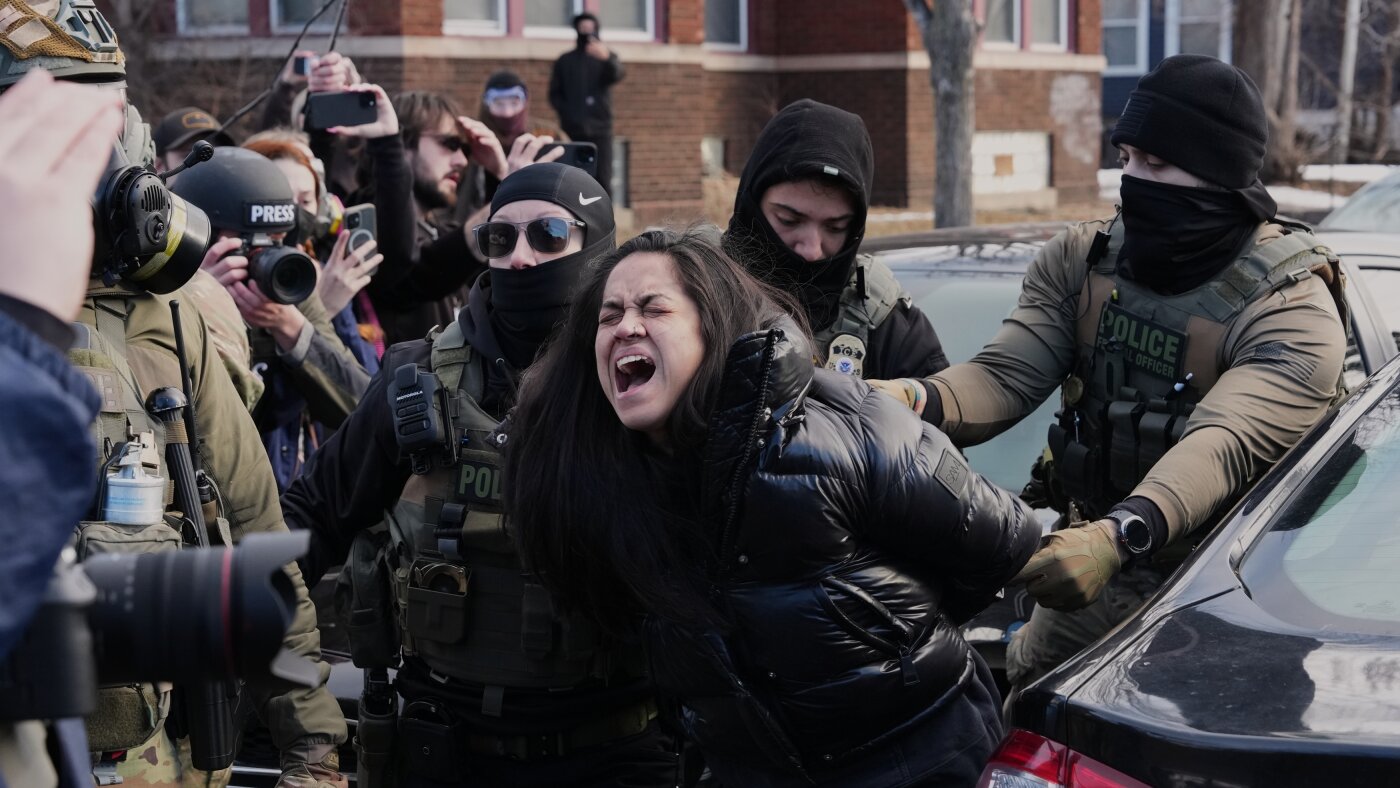

Aliya Rahman is being detained by federal agents near the scene where Renee Macklin Good was fatally shot by an ICE officer on January 13 in Minneapolis.
Adam Gray/AP
hide caption
toggle caption
Adam Gray/AP
It’s a video that many have seen on social media shortly after it happened: Immigration and Customs Enforcement, or ICE, agents dragging a woman from her car and forcing her to the ground.
The woman in the video is Aliya Rahman, a Bangladeshi-American and U.S. citizen. On the day of her arrest, Rahman was on her way to the doctor when she came across an ICE operation and a group of people protesting. She said ICE agents told her to move her car, but the scene was chaotic and she was given multiple instructions at once.
The Department of Homeland Security said in a statement previous statement they arrested Rahman because she “ignored several orders.” But Rahman, who is autistic and also recovering from a head injury, says it sometimes takes him a while to understand auditory commands. Before she knew it, the police officers took her away by the limbs.

“I thought I might die,” Rahman said. She was placed in an SUV with three ICE agents.
“I heard the driver on the radio laughing, ‘We’re bringing in a body,'” she recalled. It took her a second to realize they were talking about her.
In recent days, federal officials have signaled a desire to reduce the large number of immigration agents in Minnesota, although they say any reduction will depend on state and local cooperation. Even if a withdrawal occurs, they will leave behind a transformed community, including many citizens questioned and detained by immigration officials in recent weeks.
Rahman was taken to the Whipple Federal Building in Minneapolis, where immigration agents brought detainees before releasing them or deporting them out of the state. At Whipple, Rahman experienced a severe headache and sought medical attention for more than an hour. Finally, she passed out. She said she woke up in a downtown hospital, where doctors told her she had suffered a concussion.
Her arrest took place more than two weeks ago, but she can’t shake her fear.
“I don’t feel safe in my own home and on these streets,” she said. “And even then, I’m in a much better situation than many other people who have been detained.”
Rahman is far from being the only American citizen in Minnesota with such history.
ChongLy Scott Thao, a Hmong man and American citizen, was taken from home wearing only sandals, underwear and a blanket over his shoulders. Thao said immigration officials drove him “to the middle of nowhere” and photographed him. He told reporters he feared they would beat him. They then took him home.
Mubashir Khalif Hussen, a Somali-American citizen, was also arrested by ICE.
“I wasn’t outside for a few seconds before I saw a masked person running at full speed,” Hussen said in one meeting. press conference last month. “He tackled me. I told him, ‘I’m an American citizen.’ He didn’t seem to care. He dragged me outside in the snow while I was handcuffed, tied up, helpless and pushed me to the ground.”
Hussen is now sue the Trump administration in a class action lawsuit, accusing him of racial profiling. According to the lawsuit, ICE eventually released Hussen outside the Whipple building, telling him to walk the seven miles to where they had detained him.
In a statement to NPR, the Department of Homeland Security said “allegations that ICE engages in ‘racial profiling’ are disgusting, reckless and categorically false.”

But Walter Olson, a senior fellow at the Cato Institute, a libertarian think tank, says many legal experts come to a different conclusion.
“This is no longer just a series of accidents that could have been caused by a poorly trained person or one bad apple. This is a systematic attack on constitutional rights,” he said.
The Fourth Amendment protects people from arrest without reasonable suspicion and arrest without probable cause, a higher standard. Courts in the United States decided that skin color alone did not meet either condition.
However, last fall, the The Supreme Court ruled that “apparent ethnicity” could be used to determine reasonable suspicion, provided there were other factors as well. Legal experts say the ruling could give ICE more discretion.
Olson says that even if immigration enforcement in Minnesota eases, the same concerns could arise elsewhere. He noted that judges ruled against the federal government during its crackdown in Los Angeles, Chicago And Portland.
“And they didn’t have to cancel or rethink the campaign. They just regrouped and came back to another state,” Olson said.
Even citizens who were not arrested but were still questioned are shaken after clashes with immigration officials. Luis Escoto, owner of the El Taquito taco shop in West St. Paul, said immigration agents surrounded his wife Irma’s car in the driveway of their restaurant as she went out to get lettuce before dinner time. Escoto ran outside.

Luis Escoto poses for a portrait inside his restaurant, El Taquito, in West St. Paul, Minnesota.
Jaida Gray Eagle for NPR
hide caption
toggle caption
Jaida Gray Eagle for NPR
“I said, ‘Hey, wait. She’s just my wife,'” Escoto said. “They said, ‘We need proof of U.S. citizenship,’ and I said, ‘She’s a U.S. citizen.'”
Both Luis and Irma Escoto are citizens. Escoto showed one of the officers their passport cards, which he still had in his wallet after a recent trip to Mexico.
“He said, ‘Well, next time she should have it on her at all times, because if she doesn’t have proof of citizenship, we’re going to arrest her,'” Escoto recalled.
The immigration officers left. But weeks later, Escoto is still shaken and angry. Some of his customers now walk him and his wife home every evening when the restaurant closes.
When he became a citizen 35 years ago, Escoto said he was nervous because the government took away his green card. He asked the judge about it.

Irma Escoto poses for a portrait inside her restaurant, El Taquito, in West St. Paul, Minnesota.
Jaida Gray Eagle for NPR
hide caption
toggle caption
Jaida Gray Eagle for NPR
“I said, ‘Sir, what will happen if the immigration officials arrest me?’ And he said, ‘Well, today you’re proud to be an American citizen,'” Escoto said.
The judge told him that you don’t need documents when you’re a citizen. But now, Escoto says, that doesn’t seem so true.