Juno Observes Ultraviolet Satellite Footprint of Jupiter’s Moon Callisto


Jupiter hosts the most brilliant and spectacular aurora in the solar system. Close to its posts, these shimmering lights offer an overview of how the planet interacts with the solar wind and the moons swept by the magnetic field of Jupiter. Unlike the lights of the northern earth, the greatest moons of Jupiter create their own auroral signatures in the atmosphere of the planet. These Aurorae induced by the Moon, known as satellite imprints, reveal how each moon interacts with its local space environment.
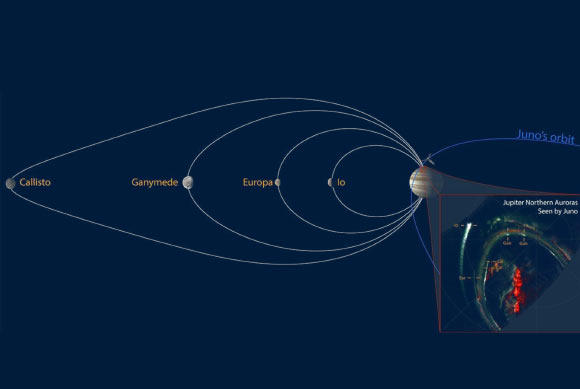
Juno capturing the marks on Jupiter of the four Galilean moons; The dawn linked to each are labeled IO, EUR (for Europa), Gan (for Ganymede) and Cal (for Callisto). Image credit: NASA / JPL-CALTECH / SWRI / UVS Team / MSSS / GILL / Jónsson / Perry / Hue / Rabia.
Before the NASA Juno mission, three of the four largest moons of Jupiter, known as Galilean moons – IO, Europa and Ganymede – proved to be produced these distinct auroral signatures.
But Callisto, the furthest from the Galilean moons, remained a mystery.
Despite multiple attempts using the NASA / ESA Hubble spatial telescope, Callisto’s imprint had proven to be elusive, both because it is weak and because it is most often at the top of the main darling oval, the region where the dawn are displayed.
The NASA Juno mission, in orbit Jupiter since 2016, offers unprecedented close views of these polar light emissions.
But to imagine the imprint of Callisto, the main auroral oval must withdraw while the polar region is colorful.
And to wear the arsenal of Juno instruments studying fields and particles, the trajectory of the space machine must transport it through the magnetic field line connecting Callisto and Jupiter.
These two events occurred by chance during the 22nd juno orbit of the giant planet, in September 2019, revealing the auroral footprint of Callisto and providing a sample of the particle population, electromagnetic waves and magnetic fields associated with interaction.
The magnetic field of Jupiter extends far beyond its main moons, cutting a large region (magnetosphere) wrapped and shaken by, the solar wind streaming of our sun.
Like solar storms on earth push northern lights towards more southern latitudes, the aurora of Jupiter are also affected by the activity of our sun.
In September 2019, a massive solar flow and high density shaken the Jupiter magnetosphere, briefly revealing – while the dawral oval moved to the equator of Jupiter – a weak but distinct signature associated with Callisto.
This discovery finally confirms that the four Galilean moons leave their mark on the atmosphere of Jupiter, and that the imprints of Callisto are supported a bit like those of his brothers and sisters, completing the family portrait of the Auroral Signatures of the Galilean Moon.
“Our observations confirm the electrodynamic coupling between Callisto and Jupiter,” said Dr. Jonas Rabia, researcher at the Astrophysics and Planetology and CNRS research institute, and his colleagues.
“This coupling will be analyzed in more detail by the JUICE mission of NASA, successfully launched in April 2023, which will repeatedly visit Callisto and its local environment, allowing a better characterization of the interaction of Callisto with the magnetosphere of Jupiter.”
“The reported in situ And distance observations complete the family portrait of the Auroral Galilean moon fingerprints and resolve the long -standing mystery as to whether the electromagnetic interaction of Callisto is fundamentally different from the three interior Galilean satellites. “”
“The similarities observed, both in the auroral structure and the electron in situ Properties, point to a universal physical mechanism at work for magnetospheric interactions of the moon and the planet, relevant for other binary systems which are only accessible, in the solar system and beyond. »»
The team’s article was published this week in the newspaper Nature communications.
_____
J. Rabia and al. 2025. In situ And the remote observations of the ultraviolet imprint of the Moon Callisto by the Juno spaceship. Nat common 16, 7791; DOI: 10.1038 / S41467-025-62520-4


