Key stats from every American League team that fantasy baseball players need to know

If readers have been following along with how I typically operate when researching team and player-level data, it usually leads us toward an unexpected path. To peek behind the curtain, often the research leads us toward questions that may or may not have data to support the hypothesis. Though the plan was to examine one stat from every MLB team for fantasy baseball purposes, it turned into a few stats for every team, especially since we examined some player-level information.
[Draft your Yahoo Fantasy Baseball team for the 2026 MLB Season]
As we mentioned in a previous article, fantasy baseball leagues or weeks (head-to-head formats) can be won or lost when finding those outliers. That said, most of these team-level stats were notable as high or low based on plate discipline, batted ball data, pull rates, bat speed and pitch usage across MLB.
Advertisement
This is a beefy one, so it might take some time to digest. Here’s the American League. You can check out the National League story here.
Athletics
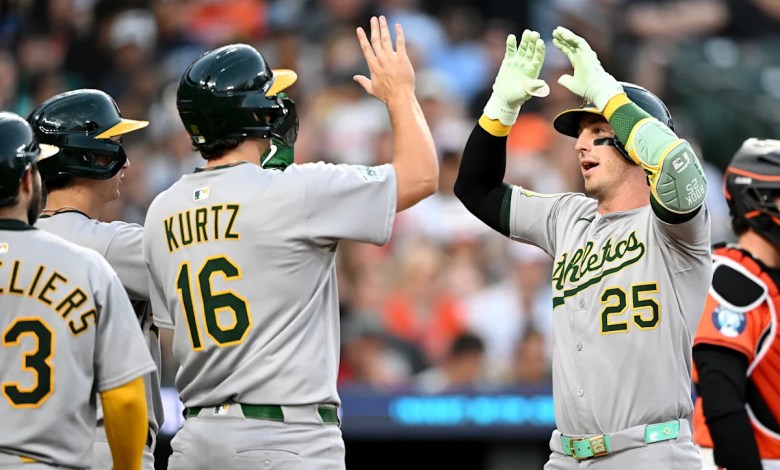
At Sutter Health Park, the Athletics had the sixth-best home run park factor (112) in 2025. That’s significantly higher than the Oakland Coliseum, which ranked 28th in home run park factor (84). The Athletics were seventh in home runs as one of nine teams with 200 or more in 2025. They had five hitters with 20 or more home runs, including three with 30 or more. The Athletics’ home park had the second-best run-scoring park factor behind the Rockies.
It should be another high-offensive scoring environment at the Athletics’ home park. Be careful streaming pitchers against the Athletics since they have some mashers in their lineup like Nick Kurtz, Shea Langeliers, Tyler Soderstrom and Brent Rooker.
Advertisement
Orioles
The Orioles like throwing curveballs (No. 2) and sinkers (No. 10). This is where context matters because the Orioles had Charlie Morton, who threw it 27.1% of the time. The other notable pitchers with curveball usage in the double digits include Cade Povich (21.8%), Dean Kremer (12.8%), Zach Eflin (16.8%), Brandon Young (15.7%) and Kyle Bradish (13%). Maybe they should stop throwing so many curveballs, since the Orioles allowed the highest weighted on-base average (wOBA) and fifth-highest expected wOBA against this pitch type.

Orioles’ sinker and curveball usage in 2025. (Photo by Corbin Young/Yahoo Sports)
Rogers throws from a lower arm angle (22 degrees), leading to the sinker generating above-average horizontal movement (+2.9 inches versus the average). Meanwhile, Bradish relies on sinkers to left-handed hitters (30.3%) with success in 2024 (.185 wOBA, .230 xwOBA) and 2025 (.260 wOBA, .285 xwOBA). Bradish often throws sinkers (36.3%) and sliders (45.8%) to right-handed hitters, with the goal of the sinker being a groundball machine. It’s worth noting that Bradish’s sinker generated groundballs 65.9% of the time in 2024, which dipped to 44.8% in 2025.

Chris Bassitt pitch percentage vs. RHB by season. (Photo by Corbin Young/BaseballSavant)
Wildly enough, they added Chris Bassitt, who likes to throw sinkers and curveballs. Bassitt pumps sinkers (53.5%) and curveballs (13.6%) to right-handed hitters. He leads the way with sinkers to lefties (32.9%) while throwing curveballs 17.9% of the time. In the age of stuff and whiffs, the Orioles have been prioritizing sinkers and curveballs as a potential way to be more efficient and pitch deeper into games.
Advertisement
Red Sox
The Red Sox throw the second-most cutters at 5.3% behind the Rangers. Brayan Bello (15.7%), Walker Buehler (15.5%), Garrett Crochet (27.8%) and Peyton Tolle (13.5%) were the most notable Red Sox pitchers who threw a cutter quite often. As a team, the Red Sox allowed the seventh-lowest wOBA (.304), third most whiffs (265) and 13th-highest whiff rate (21.1%).

Ranger Suarez wOBA vs. RHB by season. (Photo by Corbin Young/BaseballSavant)
They acquired Ranger Suárez, who threw a cutter 20.7% of the time to right-handed hitters. However, Suárez’s cutter has been awful, allowing a .387 wOBA (.305 xwOBA) against right-handed hitters. Similarly, Sonny Gray joins the Red Sox, and he throws a cutter 20.6% to right-handed hitters. Unfortunately, right-handed hitters crush the cutter, as it’s given up a .342 wOBA (.379 xwOBA). Expect the Red Sox to make tweaks to Suárez and Gray’s arsenal, particularly the cutters.
Advertisement
White Sox
The White Sox hitters ranked 27th in expected batting average, ahead of the Rockies, Angels and Guardians. They ranked 16th in barrel rate (8.1%), 20th in hard-hit percentage (40.1%) and 28th in Exit Velocity 90 (EV90), accounting for the 90th percentile of their average exit velocity. That suggests that the White Sox hitters might not be a team to target for home runs and power. Munetaka Murakami (28), Colson Montgomery (23), Miguel Vargas and Andrew Benintendi (19) are the only hitters projected for 15 or more home runs, according to ATC Projections.

Colson Montgomery bat speed distribution. (Photo by Corbin Young/Yahoo Sports)
Montgomery’s power is legitimate with an elite bat speed (77 mph) and fast-swing range at 71.7%. For context, the league average bat speed was 71.7 mph and fast swing rate (percentage of swings at 75 mph or higher) at 23.6% in 2025. There’s 30 home run potential for Montgomery. Murakami had big-time home run totals in the Nippon Professional Baseball (NPB) League, hitting 31 or more home runs for four straight seasons from 2021 to 2024, including 56 in 2022. The plate discipline remains a concern since he averaged a 63-64% contact rate over the past two seasons in the NPB.
Advertisement
Besides Murakami and Montgomery, the White Sox lineup shouldn’t be a major power source for fantasy baseball leagues in 2026.
[Yahoo Fantasy+ unlocks premium draft tools, player projections and more]
Guardians
In the past, the Guardians built their lineup around plate discipline. In 2024, the Guardians boasted the sixth-highest contact rate (78.9%) and the eighth-lowest swinging-strike rate (10.4%). However, there was a slight shift in 2025, with the Guardians having the 15th-best contact rate (76.9%) and 18th-best swinging-strike rate. That’s notable because only Steven Kwan (92.2%), José Ramirez (86.2%) and Angel Martinez (80%) had contact rates above 80% in 2025, with a minimum of 100 plate appearances.
Advertisement
That’s further evident in the projections, given Ramirez and Kwan are the only Guardians’ hitters projected for a batting average above .245. The Guardians’ home park tied for ninth in strikeout park factors, suggesting they have a more pitcher-friendly environment. If Kyle Manzardo and Chase DeLauter don’t become threats in the Guardians’ lineup, we might be able to stream against them in 2026.
Tigers
The Tigers’ hitters can hit for power, but tend to whiff. They ranked seventh in barrel rate (9.4%), fourth in strikeout rate (23.9%) and 11th in swinging-strike rate (11.1%). Specifically, their hitters with the most power, like Riley Greene and Kerry Carpenter, often whiffed but crushed the ball. Greene had a 14.6% swinging-strike rate with Carpenter at 12.6%. Unsurprisingly, Greene led the team in barrel rate (17.1%) and ranked second in EV90 (107.8 mph). Meanwhile, Carpenter posted a 12.3% barrel rate and a 104.6 mph EV90 in 2025.
Advertisement
Spencer Torkelson had a 13.5% barrel rate and 104.6 mph EV90 while showing average contact (76.3%) and having a chase rate (25.8%) that’s seven percentage points below the league average. Greene, Carpenter and Torkelson remain the core of the Tigers’ lineup. However, they play in a home ballpark that ranks 16th in home run park factor, hinting at their power skills being in the high-end to near-elite range.
Astros
The Astros were one of three teams to average 5.5 innings per game started from 2023 to 2025. That list included the Phillies and Mariners. That shows these teams have pitchers they trust to pitch deep into games with quality depth. Hunter Brown and Framber Valdez have headlined their rotation as two workhorse starting pitchers with quality skills. With Valdez joining the Tigers, Brown leads the rotation with several wild cards like Cristian Javier, Tatsuya Imai and Mike Burrows.

Teams averaging 5.5. innings per game started. (Photo by Corbin Young/Yahoo Sports)
We could see the average innings per start fall unless they allow their less proven arms or ones with injury concerns to have longer outings. Theoretically, it helps their relievers stay healthy and fresh when starters go deeper into games. With Josh Hader dealing with biceps inflammation in February, it takes away their closer and one high-leverage reliever to finish games. The Astros expect to have a six-man rotation with two days off within the first 28 days of the season. Besides Brown, the other starters might not go deep into games to begin the year.
Advertisement
Royals
The Royals ranked second in saves (47) behind the Padres (49), tying them with the Guardians and Phillies. They had 41 (No. 13) in 2024 and 28 (No. 29) in 2023. Carlos Estévez accounted of 89% of the team’s saves in 2025. That’s notable because James McArthur had 44% and Lucas Erceg converted 26.8% of the team’s saves in 2024. Scott Barlow was the only Royals pitcher with double-digit saves (13) in 2023, leading to a 46.4% share of the saves, with McArthur (14.3%), Carlos Hernández (14.3%) and Taylor Clarke (10.7%) as the only other relievers with three or more.

Carlos Estevez fastball velocity by season and 2026 spring training. (Photo by Corbin Young/Yahoo Sports)
We’re dealing with an uber-small sample in Spring Training of around 50 pitches, but we’ve seen Estévez’s four-seam velocity fall to 89 mph after averaging at 95.7 mph in 2025. Estévez’s horizontal release point shifted over four inches (4.3) farther away from his midline, with his vertical release moving two inches higher in Spring Training compared to 2025. Whenever we see a pitcher throw their fastball over 5 mph slower, it raises injury concerns. Depending on the pitch environment and context, we sometimes see pitchers lose 1-2 mph of velocity.
Advertisement
Monitor the news around Estévez as he might be in the early stages of ramping up velocity. If these velocity issues continue without any beat writers reporting it’s part of his plan, we may want to avoid Estévez and speculate on Erceg or Matt Strahm.
Angels
The Angels saw the third-largest difference in stolen bases when comparing 2025 (72) and 2024 (133). They trailed the Nationals (-96) and Brewers (-88). However, the Brewers were two of the three teams with over 200 stolen bases in 2024, so those numbers were likely going to regress. Kurt Suzuki takes over as the Angels manager, and it’s unknown about his philosophy regarding stolen bases. We’ve seen a former catcher like Dan Wilson allow the Mariners to run wild, but it’s to be determined for Suzuki.

Teams that lost 30 or more stolen bases from 2024 to 2025. (Photo by Corbin Young/Yahoo Sports)
Sometimes, it’s about the players on the team. Zach Neto (26) and Luis Rengifo (10) were the only two Angels hitters with double-digit stolen bases in 2025. However, there were five hitters with 10 or more in 2024, including Neto (30), Rengifo (24), Jo Adell (15), Kevin Pillar (10) and Nolan Schanuel (10). The Angels added Josh Lowe, who projects for 21 stolen bases, joining Neto (27) as the only one above 10 heading into 2026. Adell might be the wild card, though we saw his stolen base opportunity rate go from 30% (2024) to 5% (2025) while logging the most plate appearances in 2025.
Advertisement
Besides Neto and Lowe, the Angels don’t seem to have the personnel to run more often in 2026. Meanwhile, Adell showed his massive power and stayed healthy in 2025, so maybe that’s an optimal approach.
Twins
The Twins turned to former Pirates’ manager Derek Shelton after having Rocco Baldelli as their manager. Under Baldelli, we’ve seen the Twins use hitter platoons. One way to quantify this is by looking at the player’s plate appearances against left-handed hitters. There’s a health factor involved, but the Twins only had five hitters log over 100 plate appearances against left-handed hitters. That list includes Byron Buxton (123), Royce Lewis (119), Trevor Larnach (118), Ryan Jeffers (145) and Brooks Lee (178).
Larnach was the only left-handed hitter on this list, with Matt Wallner (97) and Kody Clemens (89) as the only other lefties facing lefties in 50 or more plate appearances in 2025. The Twins added Josh Bell, Victor Caratini and Ryan Kreidler during the offseason. Larnach projects to be the main hitter in a platoon, with Bell as a switch hitter and Wallner as the only other lefty in the starting lineup. Assuming Shelton doesn’t lean into the platoon tendencies, we could see increased plate appearance volume for Larnach and Wallner in 2026, assuming health.
Advertisement
Yankees
The Yankees’ starting pitchers tied for first in Stuff+ with the Phillies. However, the Yankees ranked 23rd in Location+. They tied for first in 2024 with the Phillies again. Meanwhile, the Yankees tied for third in Stuff+ with the Marlins behind the Phillies and Rays in 2023. That suggests the Yankees prioritize stuff for their starters. Cam Schlittler (114), Max Fried (111), Carlos Rodón (104), Clarke Schmidt (101), Will Warren (100) and Luis Gil (100) all had a Stuff+ at 100 or higher in 2025.

SPs with above-average Stuff+ and 100 Location+ or higher in 2nd half of 2025. (Photo by Corbin Young/Yahoo Sports)
The visual above shows the starting pitchers with an above-average Stuff+ grade and a Location+ at 100 or higher in the second half. If there’s an error (#DIV/0!), that means they didn’t register a pitch in that category. Schlittler boasts a cutter (121), slider (122) and curveball (122) with mind-blowing Stuff+ grades in 2025. He has been a fade at starting pitcher for me since those pitches tend to fare well against same-handed hitters. Let’s see if Schlittler can remain successful against lefties with a supinator bias. We’re also monitoring if Schlittler develops the sinker or adds a changeup/splitter.
Advertisement
Mariners
The Mariners’ starting pitchers have been known for being control and command artists. That’s evident in the Mariners tying for first in Location+ in 2025, ranking second in 2024 and first in 2023. Interestingly, the Mariners were tied with the Twins in Location+ in 2023 and 2024, suggesting there might be more signal than noise for the Twins and Mariners starting pitchers. George Kirby (112), Logan Gilbert (110), Bryan Woo (110) and Luis Castillo (106) had an above-average Location+ in 2025. Kirby, Gilbert and Woo have high draft costs. Fantasy managers value them highly based on their success, skill, and ace-like upside. Castillo doesn’t have the dominant stuff from his prime, but he should be a valuable veteran in the middle rounds.
Advertisement
[Yahoo Fantasy Bracket Mayhem: Make your picks for $50K in total prizes]
Rays
The Rays value pitchers’ stuff. When we don’t filter by starting pitchers only, the Rays ranked second in Stuff+ (104) in 2025, second in 2024 (104) and third in 2023 (105). Specifically, the Rays’ starting pitchers ranked third in 2025, third in 2024 and first in 2023. Among the Rays starters that pitched 10 or more innings, Drew Rasmussen (112), Joe Boyle (110), Ryan Pepiot (109) and Shane Baz (107) were the four pitchers with above-average Stuff+ grades in 2025. We expect the Rays’ starting pitchers to have better outcomes in 2026 because they’re going from the 14th-best strikeout park factor at George Steinbrenner Field (2025) to the third-best in Tropicana Field (2023-2024).

Team SP leaders in Stuff+ in 2025. (Photo by Corbin Young/Yahoo Sports)
Rangers
The Rangers ranked 26th in batting average (.234), 25th in bat speed (71.1 mph) and 12th in contact rate (77.2%). They lost Marcus Semien, Adolis García and Nathaniel Lowe among their leaders in plate appearances. Without Lowe and Semien, we could see the team struggle to make contact. Meanwhile, the Rangers added Brandon Nimmo (trade), Danny Jansen (free agency) and Andrew McCutchen (non-roster invitee) in the offseason. Wyatt Langford and Corey Seager might be the only hitters with strong plate discipline and power in their projected starting lineup.
Advertisement
Currently, Seager (.273), Langford (.250), Nimmo (.250), Josh Jung (.247) and Jake Burger (.241) project for a batting average above .240 in the Rangers lineup. All besides Jung (17), project for 20 or more home runs. Jung has an identical home run projection to Joc Pederson (17) in the Rangers’ lineup. Losing Semien, Garcia and Lowe feel like significant offensive losses, hinting at a potential down season for the Rangers’ hitters unless Seager, Nimmo, Langford and other key contributors like Evan Carter and Jung will stay healthy and step up.
Blue Jays
The Blue Jays love their contact hitters, ranking first in contact rate in 2025, third in 2024 and fourth in 2023. That coincides with the Blue Jays’ hitters averaging the second-lowest swinging-strike rate, meaning they put the ball in play often and don’t strike out. Kazuma Okamoto fits the contact-oriented mold with a 78-80% contact rate in the NPB over the past two seasons. That can be concerning for teams with pitchers that don’t miss bats often or generate above-average whiff rates.

Teams with the highest contact rates in 2025. (Photo by Corbin Young/Yahoo Sports)
What’s even scarier is that they have multiple hitters who can do damage with the ball when they make contact. Although the Blue Jays rank 16th in barrel rate, they rank 11th in EV90 and 19th in EV on FB/LD. If we filter by the top half of the lineup or primary hitters, Vladimir Guerrero Jr., Daulton Varsho, George Springer, Addison Barger and Alejandro Kirk have above-average power skills. Even without Anthony Santander, the Blue Jays should have one of the better hitting lineups. Invest in their hitters for fantasy baseball leagues.


