Trump would like the government he leads to pay him billions : NPR

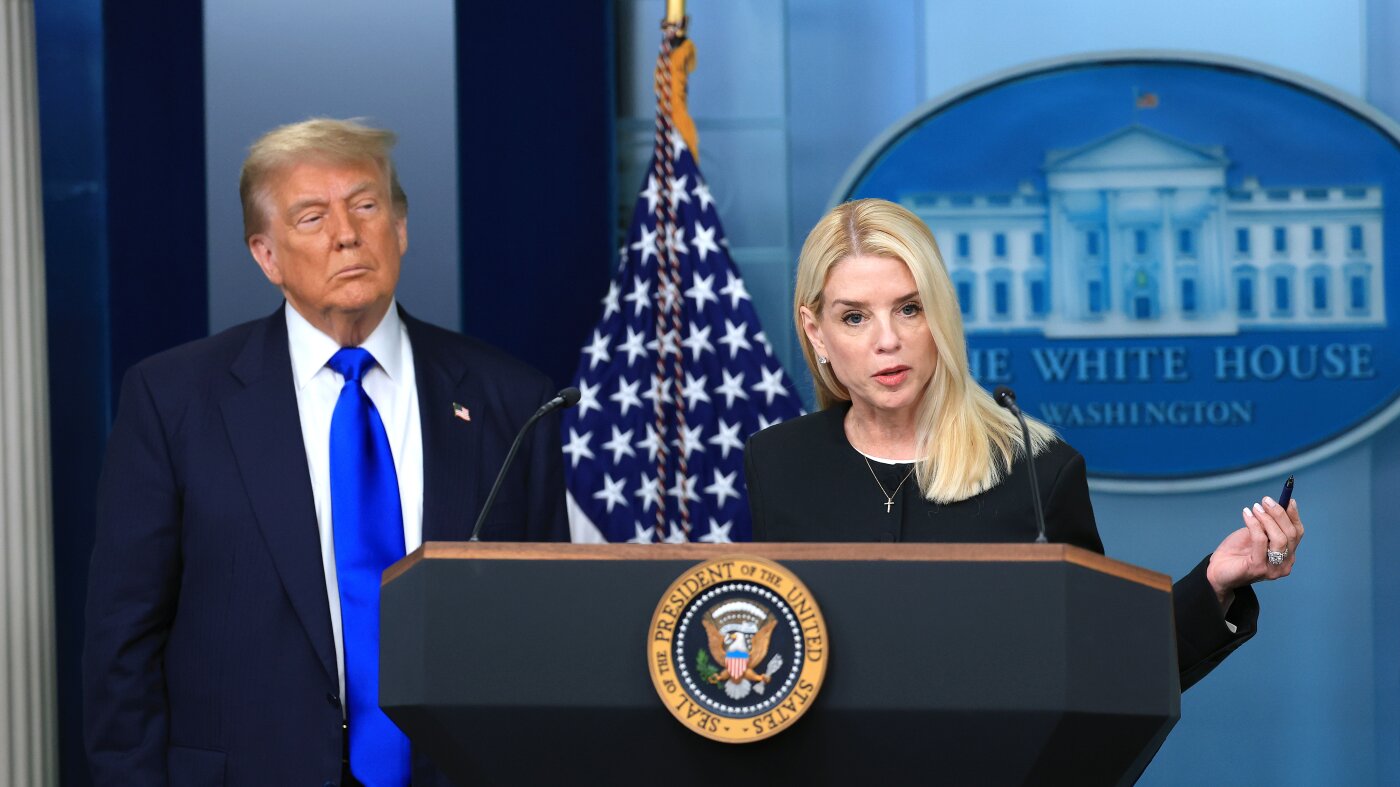

Attorney General Pam Bondi speaks alongside President Trump in the White House briefing room June 2025 in Washington, DC.
Joe Raedle/Getty Images
hide caption
toggle caption
Joe Raedle/Getty Images
Of all the ways President Trump has pushed the limits of executive power, one stands out to lawyers and monitoring bodies.
The president wants the government he leads to pay him billions of dollars.
Trump has filed several complaints, saying he was hurt by the Justice Department’s investigations and leak of his tax returns years ago. It’s now up to his own political figures to determine whether to settle with their boss – and for how much taxpayer money.
“There is a blatant conflict of interest with Trump being on both sides,” said Edward Whelan, a former Justice Department lawyer and political conservative who once worked for the late Justice Antonin Scalia. “It is outrageous that he and those who respond to him decide how the government responds to these outlandish claims.”

An unfinished business
For Trump, filing lawsuits, including those that are frivolous or in which he has little chance of success, has long been standard operating procedure, a way to express his displeasure. A White House official, speaking behind the scenes because he was not authorized to speak on the record, said the claims represented unfinished business for the president.
It’s clear they weigh on his mind. In December, Trump was in North Carolina, near the end of a speech on the economy, when, out of nowhere, he began talking about the FBI raiding his Florida resort in 2022.
“These animals were trying to attack me at Mar-a-Lago,” he said. “They got into my wife’s closet.”

Federal agents seized classified documents from a bathroom, ballroom and office as part of a broad, court-approved investigation into the illegal withholding of government secrets and alleged obstruction of justice.
The president viewed the search as an attack, part of an ongoing militarization of the government against him personally. So he filed a complaint with the Justice Department, seeking $230 million for the Florida operation and an earlier investigation into his campaign’s ties to Russia.
“And they say, you know, it’s never been a case like this,” the president said at a rally last December, taking on the animated voice of a news anchor. “‘Donald Trump is suing the United States of America. Donald Trump becomes president. And now Donald Trump has to settle the lawsuit.'”
Trump was not in office when the administrative claims were first filed. The Russia investigation ended without any charges against Trump. Then, after he won the 2024 election, the Justice Department dropped its appeal of the classified documents case against him in Florida. And now Trump finds himself on both sides of the conflict.
“But isn’t that a strange position,” the president said at the rally. “I have to make a deal. I’m negotiating with myself.”
“An order of magnitude higher”
There is a process at the Department of Justice for people who claim they have been harmed by the federal government.
In the normal course of business, these claims are evaluated by career lawyers. They rarely involve criminal investigations as high-profile as those of Trump.
“Some of them are ordinary, right?” said Rupa Bhattacharyya, a former Justice Department lawyer who has evaluated these types of allegations. “Postal vehicles are involved in traffic accidents, VA doctors are the subject of malpractice complaints, people slip and fall in federal buildings.”
Even in the most serious cases, such as those involving injuries to people cleaning up after the Sept. 11, 2001, terrorist attack, Bhattacharyya said awards almost never exceed $10 million.

Trump wants much more than that – 23 times more – for Justice Department investigations against him.
“Two hundred and thirty million dollars would be an order of magnitude greater than any administrative settlement the department has ever accepted in a Federal Tort Claims Act case,” Bhattacharyya said.
Typically, the Justice Department would fight claims in court and defend the work of its career prosecutors and FBI agents. And in this case, they would have strong legal defenses. After all, a federal judge approved the search of Trump’s Mar-a-Lago property — finding probable cause.
Given the scale of the issue, senior officials at the Department of Justice would make the final decision. And that adds another complication.
Attorney General Pam Bondi and Todd Blanche, her deputy, both worked as Trump’s personal lawyers. The Justice Department’s third-in-command, Stanley Woodward, represented Trump’s valet, who was charged as an alleged co-conspirator in the Mar-a-Lago affair.

“The fear that many have is that the Justice Department will fold and ask Donald Trump how much money the Donald Trump administration should allocate to it,” said Whelan, the former Justice Department lawyer.
In a recent interview with NBC’s Tom Llamas, Trump did nothing to quell the notion that he would be the final decision-maker. “Well, what I would do is tell them to pay me, but I will give 100 percent of the money to charity,” the president said.
A $10 billion lawsuit
But Trump wasn’t just upset about those old Justice Department investigations. He still had scores to settle. Last month, he filed another lawsuit against the federal government, a $10 billion lawsuit over the leak of his 2019 tax returns by an Internal Revenue Service contractor.
Tax law experts believe this case has major flaws. On the one hand, the statute of limitations appears to have expired. Additionally, the leak took place during Trump’s first term, so the president is suing the government for actions that occurred while he was in office. The entrepreneur is currently serving a prison sentence for this leak.

Congressional Democrats have been pressuring top administration officials over the IRS case in recent weeks. Treasury Secretary Scott Bessent told lawmakers that’s a problem for the Justice Department, which is defending Treasury and the IRS in the case.
In a separate hearing, Attorney General Bondi offered no further insight, telling a senator that she would not discuss the ongoing litigation.
A Justice Department spokesperson told NPR, “In all circumstances, all Justice Department officials follow the advice of career ethics officials. »
Last summer, Bondi fired the Justice Department’s top ethics lawyer after he said he asked questions about the gifts and tickets.

Taxpayer-Funded Settlement
Whelan, the conservative lawyer, said one solution would be to put the IRS case on hold until Trump is no longer president.
If the Justice Department ultimately approves a settlement, the money will come from what’s called the judgment fund, a pot of money funded by taxpayers.
Bhattacharyya said this means “the American people will be responsible for these claims if liability is assessed against the government.”
A spokesperson for Trump’s private legal team said in a statement: “The IRS wrongly allowed a rogue, politically motivated employee to disclose private and confidential information about President Trump, his family and the Trump Organization to the New York Times, ProPublica and other left-wing media outlets, which was then illegally disclosed to millions of people.” President Trump continues to hold accountable those who harm America and Americans.

Pressed at a recent news conference on Air Force One whether it was fair to ask the American people to pay such a large settlement, Trump dismissed any concerns, insisting that whatever he made would be donated to charity.
“They give money to charity anyway,” Trump said. “They give $40 billion a year to charity, to our government.”
It’s unclear where Trump got this figure from. The White House did not respond to questions about that or which charities would receive the money.
But at a time when Americans say their main concern is the cost of living and making ends meet, the idea of the president receiving a huge sum of money from the government he leads might not sit well with voters — even if it goes to charity.


