Laptop docking stations may evolve into ‘AI docks’ with video and apps


For better or worse, laptop docks are generally “dumb” devices. Synaptics and its customers hope to change that.
Currently, there are two main technologies that “compete” in the docking space: USB4 (which Intel puts its own spin on with its Thunderbolt 4 technology) and DisplayLink (a technology purchased by Synaptics in 2020). Thunderbolt provides more raw bandwidth to docks, while DisplayLink uses compression technologies to deliver a high-speed video experience that approximates Thunderbolt.
Normally, the best Thunderbolt docks compete with DisplayLink docks, and it’s easy to get lost in the raw power offered by a Thunderbolt dock. Synaptics believes, however, that its high-speed signaling finesse can give it a head start in future devices.
Synaptics sells its DisplayLink chips to dock makers like Anker, Kensington, Plugable and Ugreen, making Synaptics the leading chip maker for these docks. Although Synaptics is planning a major expansion of “competing” USB4 technology, it recently demonstrated a docking station concept at a technology expo at its headquarters (in San Jose, Calif.) this week that transformed the docking station into something like a thin client with basic video and perhaps even applications living at the edge.
For now, perhaps the closest approach to Synaptics’ vision would be the Anker Prime Charger, a 250W USB-C charging station with a built-in display. But Synaptics was particularly proud of its Astra series of IoT SOCs, the SL2610 series of which leverages a “Kelvin” NPU that Google contributed to the industry as an open source design. What do you get when you take a regular dock and add an Astra? A “smart” dock.

Mark Hachman / Executive
Synaptics demonstrated some office applications, consumer applications and videos all running on an Astra development board connected to a Plugable DisplayLink dock. At CES 2026, the company plans to showcase some LLM AI models working in addition, said Ganesh Tekkatte, director of product marketing at Synaptics.
“It’s a traditional dock, but now it’s also an AI-enabled dock,” added Harsha Rao, vice president of high-speed interfaces and distributed computing at Synaptics.
Synaptics calls this “edge AI” and it was a key part of the company’s demonstrations. This all sounds somewhat familiar, with a demo showing gesture controls used to control a consumer video streaming device, with visual recognition coming next. This is a feature we’ve seen before with Microsoft Kinect (although, years later, Synaptics can now do it much smaller and for much less money). Another opportunity is the automotive space, where your car could recognize you and adjust your seating, heating and entertainment options differently than with other drivers of your family. In the PC market, Rao said a smart docking station could replace a business PC in a hotel’s conference center or hotel room, or in a shared business environment.
Placing intelligence in a dock could solve three problems: diagnosing problems the user might encounter at the edge; intelligent bandwidth monitoring and management; and analysis of failures of accessories connected to the dock.
Intelligent bandwidth management could be a nice feature, since DisplayLink typically works with a generic 10Gbps USB-C port rather than a specialized Thunderbolt connection. Rao said the dock could recognize that some applications (like email) could still be routed to a connected 1080p display, while more intensive applications (like CAD) were routed to a 4K display. “And the idea is that you can connect that to an on-screen display, because no one wants to use the joystick. [on the back of the display]”Rao said.
Rao also said that Synaptics is also working on a USB4 solution, which will debut in about a year and a half. He called DisplayLink a “poor man’s GPU” and said the market was moving toward a more universal USB4 solution that could provide a cost-effective solution for Thunderbolt 4 and Thunderbolt 5. “And now is the time for us to do it.” »
Edge AI via sight and sound
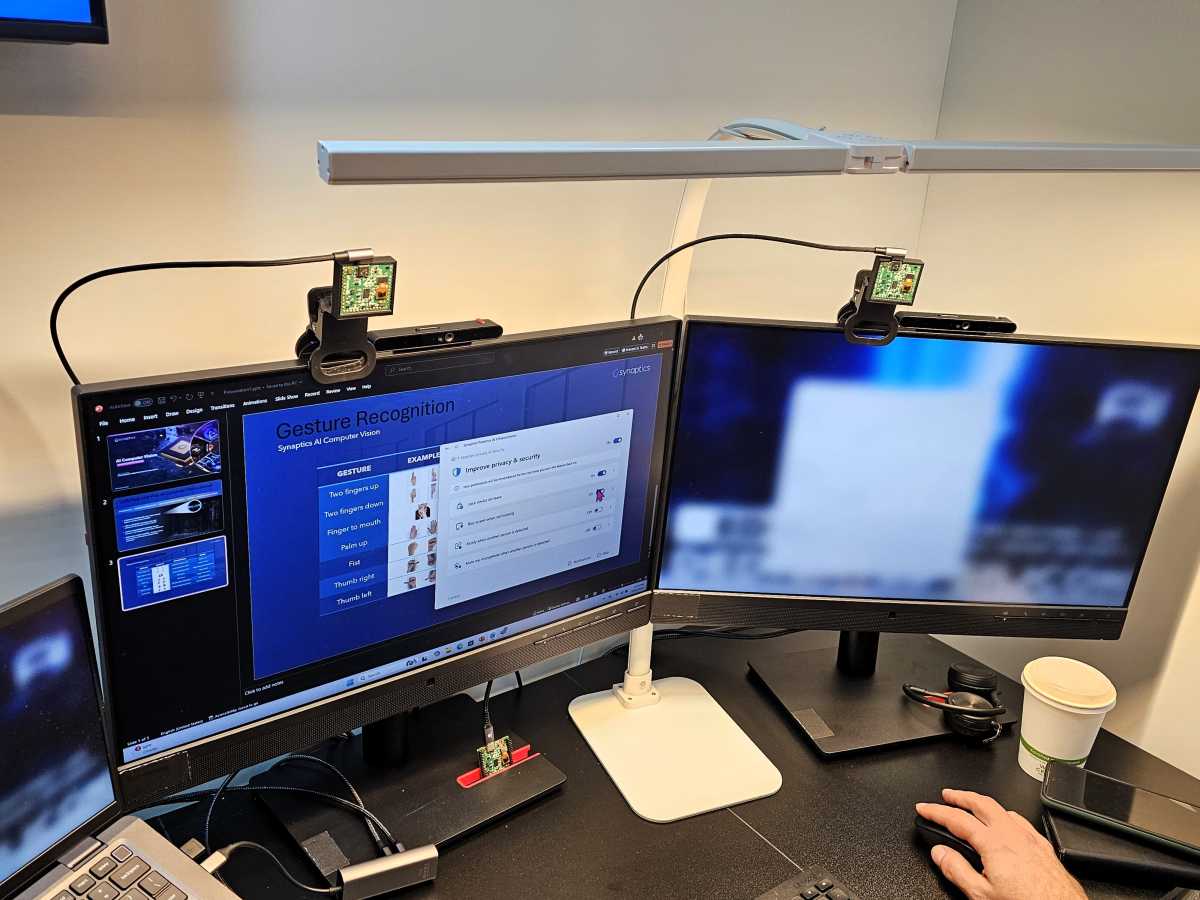
Synaptics also presented its vision for universal presence detection using the Astra chip. Presence detection is nothing new: in Windows (Settings > Accounts > Sign-in options), you may see a “dynamic lock” option, which uses a paired Bluetooth phone to detect when you’re nearby. But Synaptics is working with Dell’s Pro series laptops to integrate a presence-sensing sensor into the webcam, and is also working with Lenovo to add presence-sensing to Lenovo’s displays as well.
Mark Hachman / Executive
In the demonstration, presence detection simply identified which of two screens the user was looking at and blurred the other. Synaptics has also implemented gesture control to move the screen and control the volume function, although its customers are not required to use it. One of Synaptics’ customers used the webcam for presence detection, but Synaptics would prefer a dedicated edge sensor that could provide the same function for about 20 cents more and up to 50 milliwatts.
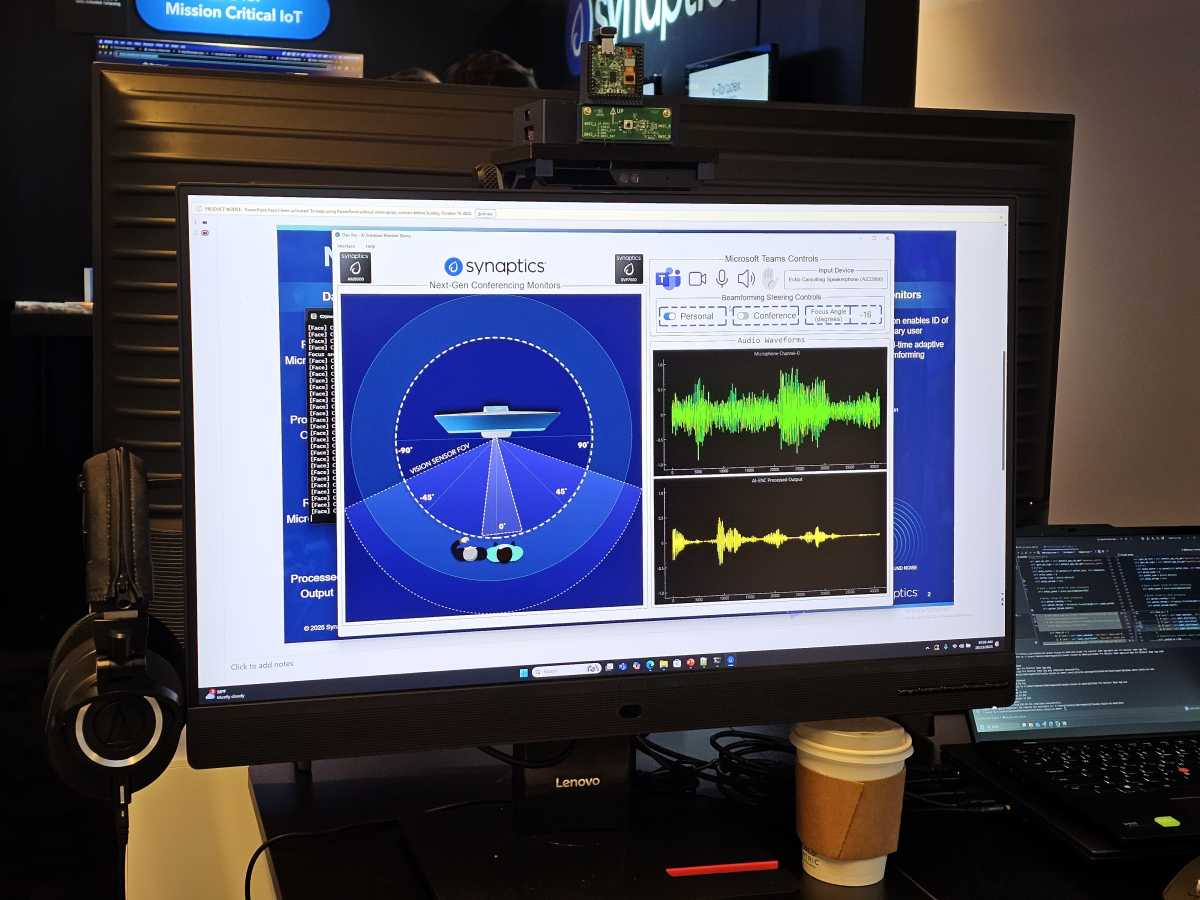
Synaptics also showed how a smart display could detect the “owner” of the screen and prioritize their voice during a video call.
Mark Hachman / Executive
Again, this all sounds somewhat familiar. Brian Krzanich’s tenure at Intel was marked by BMX bikers performing stunts on a CES stage and claims that edge sensors would provide the data that Intel’s processors constantly demand. “We are the only company that can truly take a solution approach,” Rao said.
“What I find out from my hospitality customers is what their computing needs are, and then we talk to the processor. [team]”, Rao said. “Intel can’t do that. Advantage is not just coming in with a hammer and saying, we have a processor. We actually go in there and say, what’s the one solution I can solve with all the LEGO blocks we have? »


