Largest ALMA Image Ever Spans 650 Light-Years, Revealing the Chaotic Heart of the Milky Way


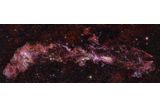
An extraordinarily complex new image shows the center of the Milky Way in stunning detail, with swirling clouds of cosmic dust, wisps of cold molecular gas and a generous scattering of stars.
The image, taken by the Atacama Large Millimeter/submillimeter Array (ALMA), is the largest of its kind to date and shows a vast area spanning 650 light years. His subject is the Central Molecular Zone (CMZ) – a particularly chaotic and intense part of the galaxy, filled with fast-living stars and gas that move at supersonic speeds.
Taken by researchers at the ALMA CMZ Exploration Survey (ACES), it offers astronomers the opportunity to study the mechanics of the early universe in a region a little closer to home.
“The CMZ hosts some of the most massive stars known in our galaxy, many of which live fast and die young, ending their lives in powerful supernova explosions, and even hypernovae,” Steve Longmore, ACES leader and professor of astrophysics at Liverpool John Moores University, UK, said in a statement.
“By studying how stars are born in the CMZ, we can also get a clearer idea of how galaxies grew and evolved.”
Learn more: The middle of the Milky Way is home to a supermassive black hole – here’s what we know
Capturing the central molecular area
The CMZ is located at the center of the galaxy, approximately 27,000 light years from Earth. It is an extreme and tumultuous environment with a supermassive black hole at its center and vast clouds of gas and dust invisible to the naked eye. According to the Harvard and Smithsonian Center for Astrophysics, it contains almost 80% of all the dense gas stored in the Milky Way.
Taken at millimeter wavelengths, the ACE image captures an area 650 light years across, which, from our perspective here on Earth, would look like three full moons side by side.
What’s exciting about this image is that researchers are now seeing everything in detail for the first time, a bit like going from a black-and-white photo to a 4K color film, Ashley Barnes, an astronomer at the European Southern Observatory (ESO) in Germany, explained in an ESO video.
A glimpse of the early universe
Thanks to the image’s impressive and unprecedented detail, researchers will be able to use it to explore the CMZ in depth, from gigantic gas structures spanning light years to the (relatively) tiny gas clouds that envelop stars.
ACES astronomers have already studied the composition of the CMZ and identified several compounds, including carbon monosulfide, isocyanic acid, silicon monoxide, sulfur monoxide and cyanoacetylene. In the image, different molecules are shown in different colors.
In the future, researchers hope it will offer a rich new resource to help astronomers study the evolution of galaxies, star formation and the physics of the early universe.
As for the technology itself, this may just be the beginning.
“ALMA’s upcoming broadband sensitivity upgrade, along with ESO’s Extremely Large Telescope, will soon allow us to penetrate even deeper into this region, resolving finer structures, tracing more complex chemistry, and exploring the interaction between stars, gas, and black holes with unprecedented clarity,” Barnes explained in a statement.
“In many ways, this is just the beginning.”
Learn more: Unusual snowfall shuts down one of Earth’s most advanced telescopes in the Atacama Desert
Article sources
Our Discovermagazine.com editors use peer-reviewed research and high-quality sources for our articles, and our editors review the articles for scientific accuracy and editorial standards. See the sources used below for this article:


