Lasers beam ‘artificial stars’ above Chile

When you purchase through links on our articles, Future and its syndication partners may earn a commission.

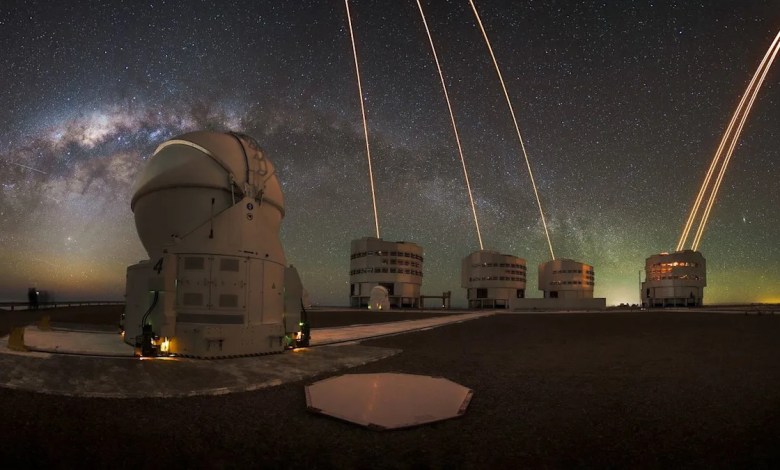
The Milky Way shines above the Very Large Telescope in Chile. | Credit: A. Trigo/ESO
The European Southern Observatory has released a breathtaking photo of the Milky Way shining above the Paranal Observatory in Chile, as lasers create artificial “guide stars” in the perfectly dark sky above.
What is this?
Stars, satellite trails, galaxies and the tools astronomers use to observe them are all on display in a single photo taken by a Chilean astrophotographer Alexis Trigopublished by the European Southern Observatory (ESO) on February 9.
Each of the four ‘unit telescopes’ looming in the background houses an 8.2 meter primary mirror which, in conjunction with other cutting-edge instruments, is capable of observing distant distances. exoplanets and the deep universe with incredible details.
The UTs – named Antu, Kueyen, Yepun and Melipal from left to right – are capable of working independently or in concert as Very large telescope. The 1.8 meter auxiliary telescope in the foreground is, in reality, much smaller than its UT cousins and can be repositioned on rails to enhance the VLT’s light-gathering capabilities as needed.
Why lasers?
The four lasers firing from the UT-4 (Melipal) to the right of the screen are designed to penetrate 56 miles (90 kilometers) into Earththe upper atmosphere where they hit the sodium atomsmaking them shine to create artificial “guide stars”. By tracking these particles, the adaptive optics technologies mounted on the VLT’s primary mirrors are able to correct the blurring and distortion effect of Earth’s atmosphere in real time!
Melipal has been putting its guide star lasers to good use since their installation in 2016. The other three unit telescopes were equipped with their own lasers in December 2025, with the aim of supporting the Very Large Telescope’s interferometer instruments (VLTI and GRAVITY+). Now the veteran observatory is able to correct for atmospheric distortion more effectively, while being guided by a custom-made constellation of artificial stars.
Check out our explanatory article on the VLT to find out more!


