Lead Exposure May Have Influenced Evolution of Human Brain, Behavior, and Development of Language


Several hominids — African Australopithecus, Robust Paranthropusearly Homo sp., Black Gigantopithecus, Pongo sp., Papio sp., Homo neanderthalensisAnd Homo sapiens – have been constantly exposed to lead for more than 2 million years, contradicting the idea that lead exposure is solely a modern phenomenon, according to a new analysis of fossil teeth from parts of Africa, Asia, Oceania and Europe.
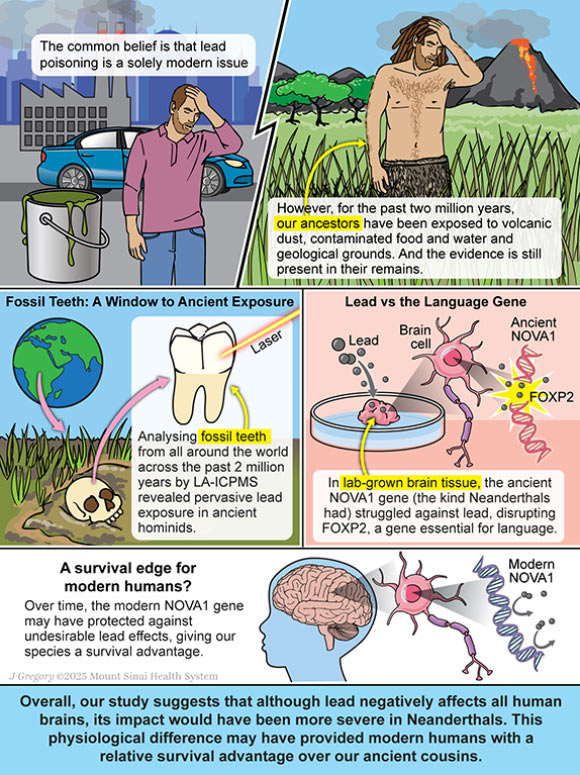
Leading the exposure to modern day humans compared to our ancestors. Image credit: J. Gregory / Mount Sinai Health System.
“Our data shows that lead exposure was not just a product of the industrial revolution: it was part of our evolutionary landscape,” said Professor Renaud Joannes-Boyau, a researcher at Southern Cross University.
“This means that our ancestors’ brains developed under the influence of a powerful toxic metal, which may have shaped their social behavior and cognitive abilities over millennia.”
Using precise and validated microspatial laser ablation sampling protocols, the authors analyzed 51 fossil samples from African Australopithecus, Robust Paranthropusearly Homo sp., Black Gigantopithecus, Pongo sp., Papio sp., Homo neanderthalensisAnd Homo sapiens.
They found clear signs of episodic lead exposure in 73% of samples (71% for hominids). Australopithecus, ParanthropistAnd Homo).
Some of the geologically oldest samples — Black Gigantopithecus estimated early (1.8 million years ago) and middle Pleistocene (1 million years ago) – show repeated events of lead exposure separated by periods of negligible lead uptake.
The researchers also turned to the laboratory to explore how this ancient exposure might have affected brain development.

African Australopithecus. Image credit: JM Salas / CC BY-SA 3.0.
Using human brain organoids (miniature models of the brain grown in a laboratory), they compared the effects of lead on two versions of a key developmental gene called NOVA1a gene known to orchestrate gene expression upon lead exposure during neurodevelopment.
The modern human version of NOVA1 is different from that found in Neanderthals and other extinct hominids, but until now scientists did not know why this change evolved.
When organoids carry the archaic NOVA1 variant were exposed to lead, they showed marked disturbances in the activity of FOXP2 — expressing neurons in the cortex and thalamus — regions of the brain essential for speech and language development.
This effect was much less pronounced in organoids with modern technologies. NOVA1 variant.
“These results suggest that our NOVA1 This variant could have offered protection against the harmful neurological effects of lead,” said Professor Alysson Muotri of the University of California, San Diego.
“This is an extraordinary example of how an environmental pressure, in this case lead toxicity, could have driven genetic changes that improved survival and our ability to communicate using language, but now also influence our vulnerability to modern lead exposure.”

Artist’s impression of a group of Black Gigantopithecus in a forest in southern China. Image credit: Garcia / Joannes-Boyau, Southern Cross University.
The study’s genetic and proteomic analyzes revealed that lead exposure in archaic variant organoids disrupted pathways involved in neurodevelopment, social behavior and communication.
The modified FOXP2 This activity particularly indicates a possible link between ancient lead exposure and the evolutionary refinement of linguistic abilities in modern humans.
“This study shows how our environmental exposures have shaped our evolution,” said Professor Manish Arora, a researcher at the Icahn School of Medicine at Mount Sinai.
“From the perspective of interspecies competition, the observation that toxic exposures can provide an overall survival advantage offers a new paradigm for environmental medicine to examine the evolutionary roots of disorders related to environmental exposures.”
The study was published in the journal Scientific advances.
_____
Renaud Joannès-Boyau and others. 2025. Impact of intermittent lead exposure on the evolution of the hominid brain. Scientific advances 11 (42); doi: 10.1126/sciadv.adr1524


