How Many People Have Ever Lived on Earth?


How will you answer the question “How many people have ever experienced on this planet?” If you type that in Google or in an artificial intelligence chatbot, you will get a response fairly quickly, generally 117 billion. This number, at least in my opinion, seems far too small. After all, the world’s population is Currently estimated at 8.2 billion people. This means that we represent about 7% of all people never born.
The figure of 117 billion 117 billion includes each person who has already seen the light of day, including those who died young. Life expectancy has however increased in the world over time. Consequently, there are other strange questions to consider. For example, a 2014 article in the Economist said half of all those who have already been 65 years old or more are alive Today. Can it really be true? And how do you even calculate something like that?
Demographers have asked such questions for decades. One of the biggest challenges they face comes from data: you should know how many people have experienced at different times, as well as average life expectancy or the birth rate. Such figures are available today (although the recordings are not always reliable) but less for past centuries. Statistical analyzes and censuses have not been regularly carried out everywhere and in all companies. Demographers must therefore be based strongly on estimates.
On the support of scientific journalism
If you appreciate this article, plan to support our award -winning journalism by subscription. By buying a subscription, you help to ensure the future of striking stories about discoveries and ideas that shape our world today.
And then there are a few fundamental questions to consider. What exactly do we mean by “human”? Let us want to say all the members of the genre Homo who traveled our planet or just Homo sapiens especially? Given the challenges, it is astonishing that when the estimation of all the people who have already lived, we are generally presented in only one number, 117 billion, rather than a range with a low and high estimate. I argue that this is fully appropriate from a scientific point of view and indicates that the result is an approximation. The order of magnitude may seem plausible, but the question cannot answer exactly.
Demographic growth modeling
To realistically assess the estimate of $ 117 billion, you first need data. From the 20th century to the present day, you can find many population figures, thanks to the regular censuses made in many countries since the 1850s.
By looking further in history, the number of people living can be roughly estimated according to the size of cities and population density. For still times, archaeological remains offer clues.
However, some sources have put the world population in the year 1 to 170 million people and others to 300 million, almost double this number. There is also the question of how far we should even look. There are estimates in which demographers go back to 4.5 million years to consider all members of the genre Homo. Others, however, focus on Homo sapiens And look back between 50,000 and 200,000 years.
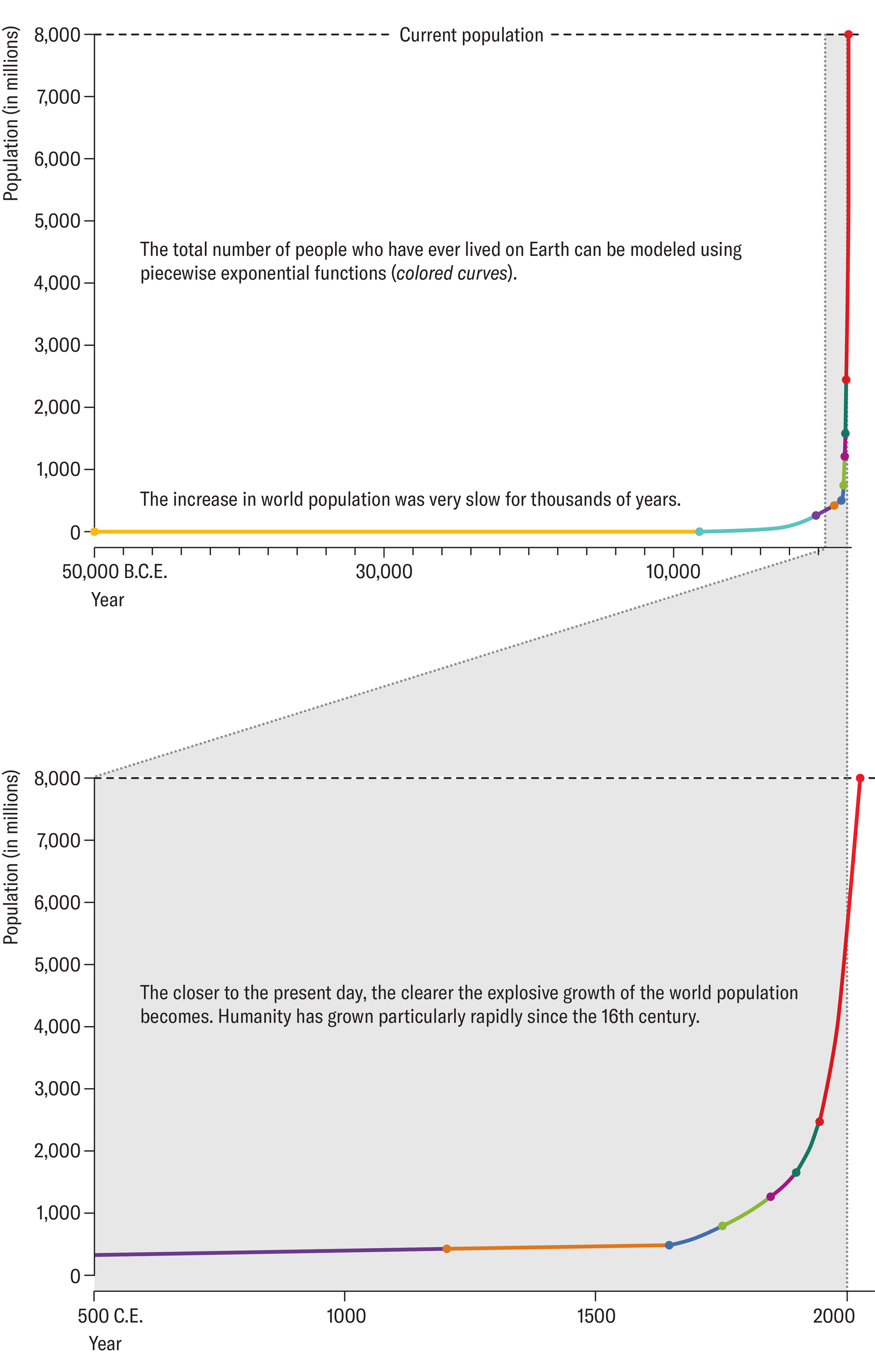
Over the years, not only the number of living humans, but also the corresponding population growth rate has changed considerably. The world’s population increased very slowly but seems to have developed faster in the last centuries. Indeed, the birth rate has decreased while the mortality rate has further decreased – a combination that can be difficult to model.
The growth rate can however be supposed to be constant for small intervals of time. Demographers use this hypothesis to estimate the number of all living people in a given time interval. You must divide the period considered in different sections; For example, you can start 50,000 years before our time and end in the year 2025. The more subdivisions you make, the more precise the result.
If we now assume that the birth rate g and the mortality rate s are constant in a section of this chronology, then the size of the population N Modifications according to the following differential equation:
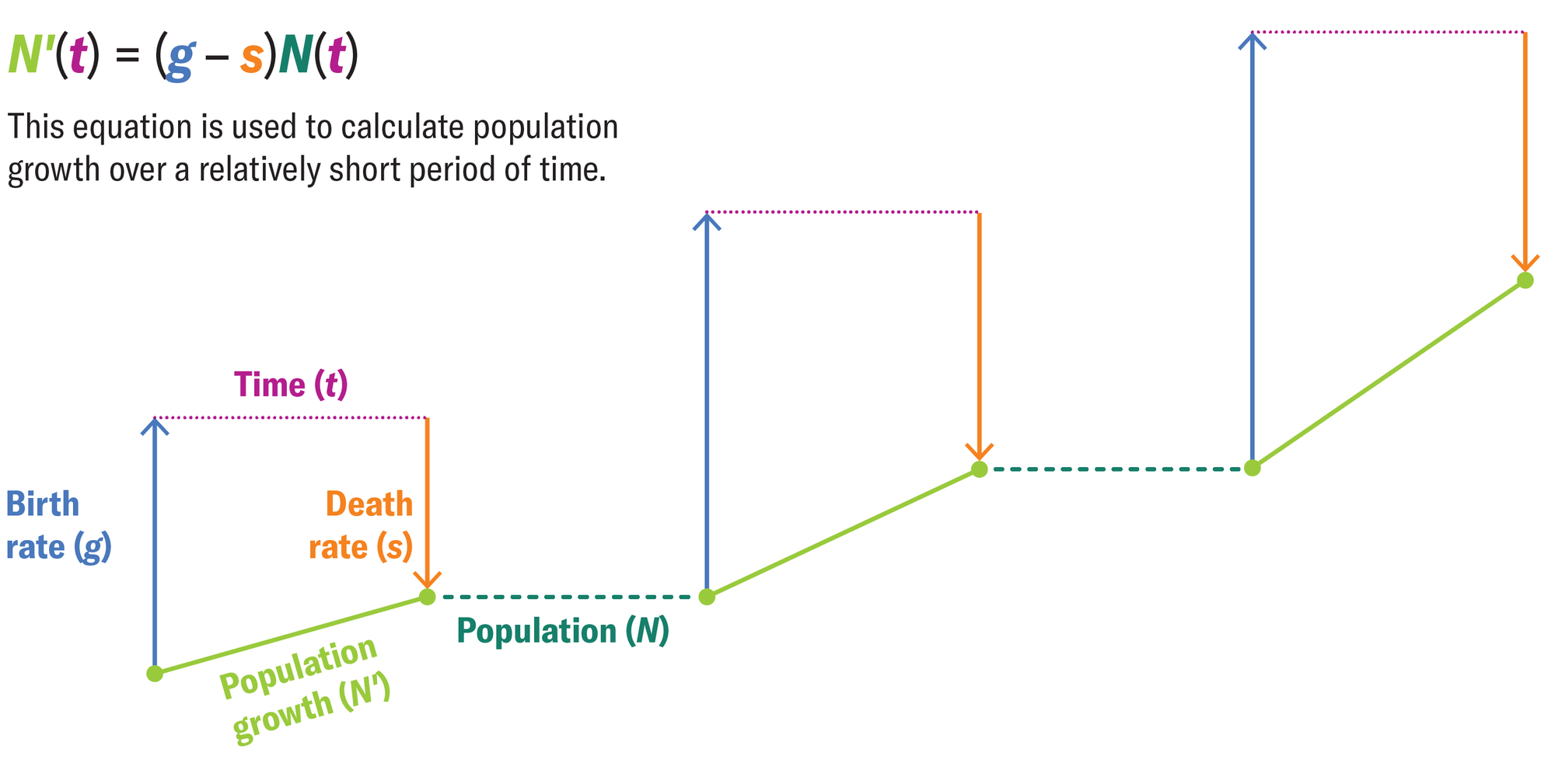
Given that g And s are supposed to be constant in an interval, the size of the population in this area can be modeled using an exponential function: N(t) = N0ektwhere the parameters k (the rate of net growth) and N0 (The size of the population when time t = 0) are determined by the data points.
To determine how many people have ever lived, you should add the number of all living people at all times t. This can be done by calculating the integral of the function defined by pieces on t In the respective section:
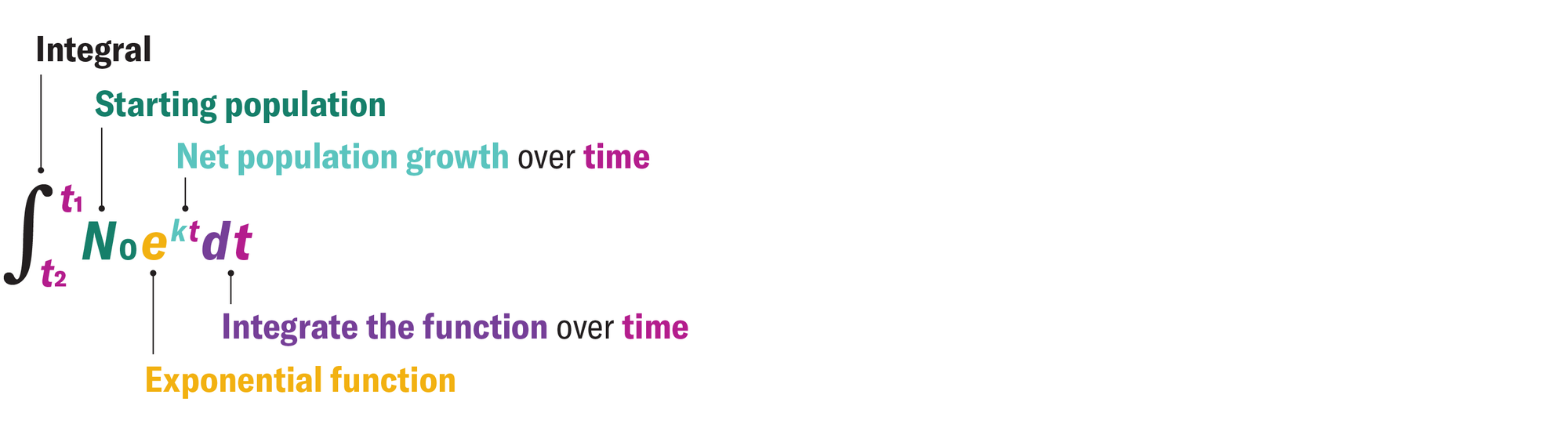
However, this approach overestimates the real answer. Think about it this way: if you read this article, you are currently alive; However, you were probably already alive 10 years ago and you also contributed to the world population at the time. The integrated result must therefore be divided by the respective life expectancy of people who lived during the period in question. At the end, you can add the results for all periods and …Ta-da!—The result should correspond to the total number of people who have already lived.
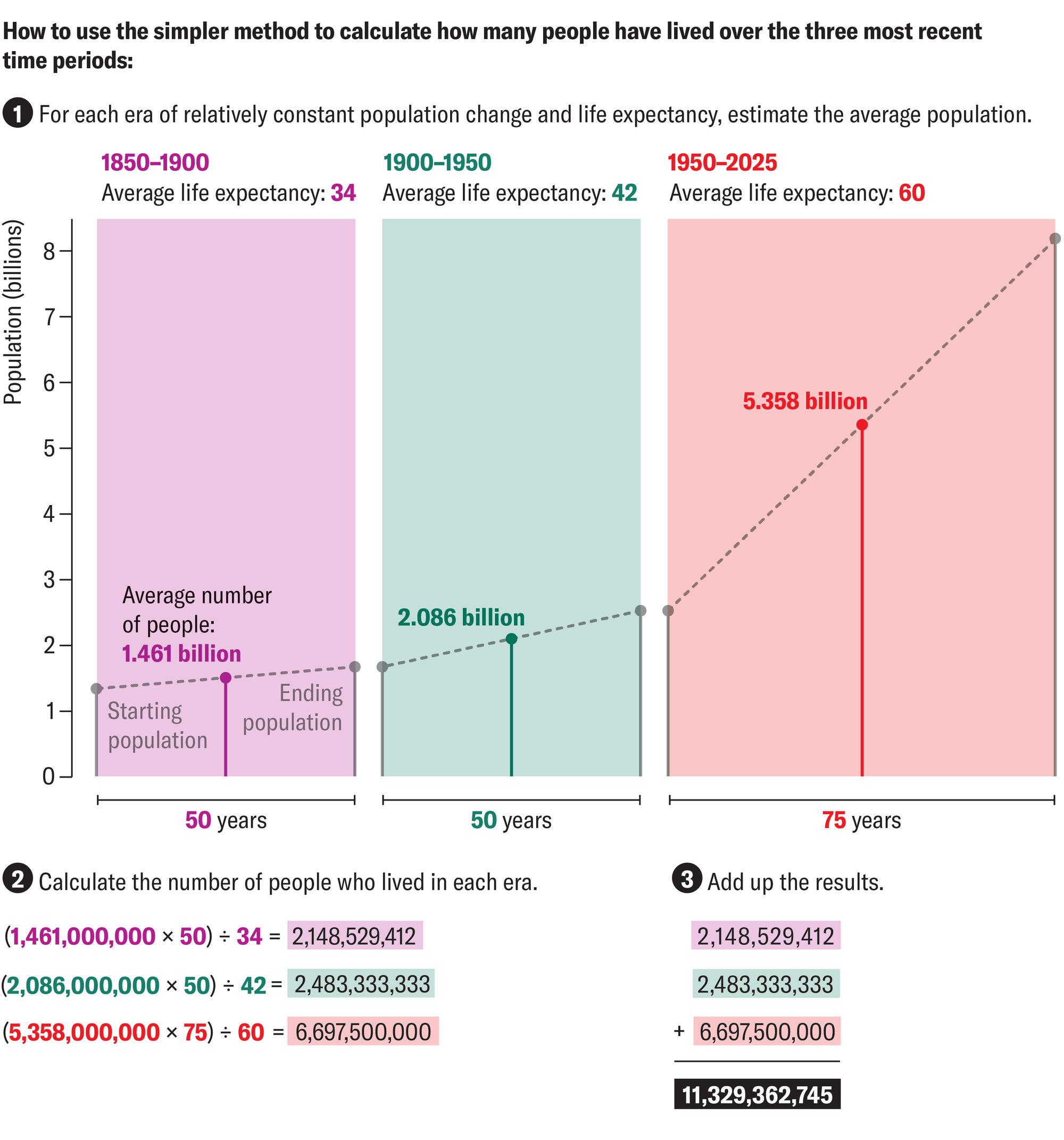
Technically, there is a simpler approach, as demonstrated by German Mathematics Professor Bruno Scheja with a school project. He placed his students the same task: they had to estimate the number of everyone who has ever experienced. But these students did not yet know how to calculate the integral of an exponential function.
A group of students has decided to simply calculate the average value for specific time intervals. For example, if there were about 1.6 billion people in 1900 and 2.5 billion in 1945, students assumed that an average of 2.05 billion people lived in these 45 years. They then multiplied these average values by the respective period (45 years, in this case) and divided them by the average life expectancy that people had at this time (taking an average of the lifespan in 1900 and 1945). This method gave the group an approximate estimate of the entire world population without having to use complex calculation methods such as integrals.
Two methods with surprisingly similar results
To compare these techniques, you can calculate the population figure using an example. I chose to use data that was previously used by demographer Carl Haub in an article in the population’s reference office published in 2011. He assumed that humanity was originally 50,000 years ago with two people. He also estimated life expectancy for each time interval.
I added a final point of data with the estimated population and life expectancy in 2025.
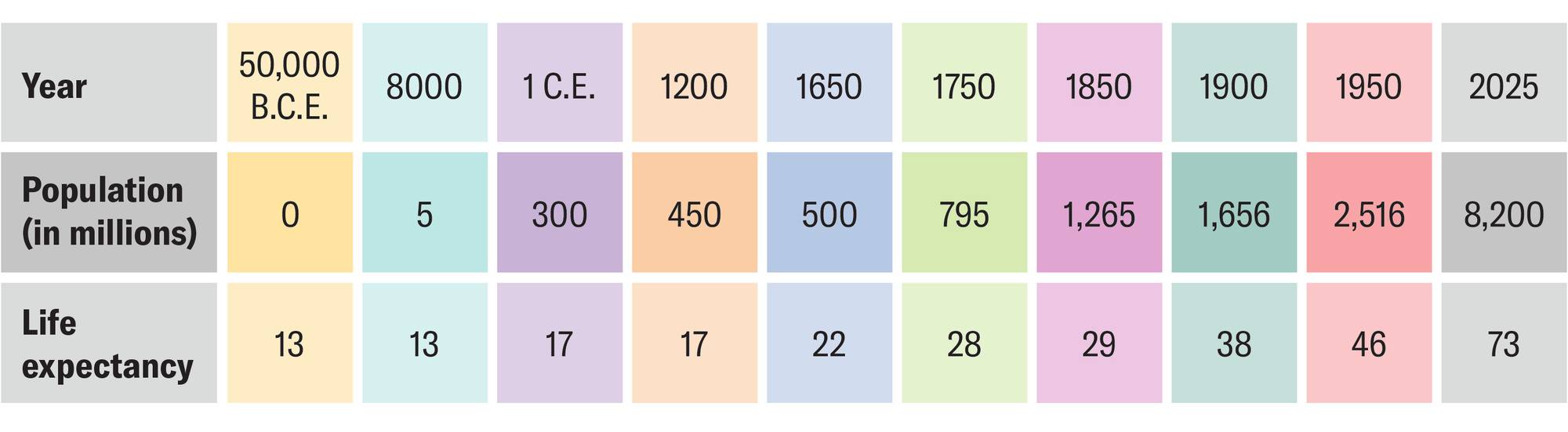
In total, there are 10 points available in this example that delimit nine sections. In these, appropriate exponential functions can be defined to model respective growth. By dividing them by the average life expectancy during this period, you can get the number of people alive at that time.
This leads to the conclusion that a little more than 93 billion people were born. The figure of 117 billion is based on a more recent estimate of Haub and demographer Toshiko Kaneda which appeared in 2022 with updated population data. (Researchers assumed, among other things, that the human race came 200,000 years ago.)
If you apply the simplest calculation method used by Scheja students to the data in the table above, the final result is more than $ 140 billion, more than the result obtained by the other method. This difference may seem large, but it is actually impressive that it ends up being of the same order of magnitude.
What about people aged 65 and over?
The two approaches presented make it possible to estimate the number of people who were born. But what about the report by journalist Fred Pearce in his 2010 book The accident of the coming population That of all people who have already reached the age of 65, half of them are alive today? In 2017, a team of demographers led by Miguel Sánchez-Romero du Wittgenstein Center for Demography and Global Human Capital examined this declaration after having resurfaced in 2014 Economist article. The researchers developed two different demographic models to study: one in which population growth was constant and a second in which they considered the growth of the hyperbolic population.
They also used various data sets for their modeling in order to provide realistic error estimates. Their conclusion: Fred Pearce was incorrect. “Indeed, such a number would never be achievable or theoretically (in a stable population), or empirically according to existing data,” they wrote in their article.
Depending on their calculations, the proportion of people who have already reached the age of 65 or over who are alive today is between 5.5 and 9.5%. This means that even in the most extreme case, just under 10% of all people who have never been 65 years of age or over are alive today. Even if it considerably softens the original declaration of Pearce, I always find the result quite surprising. Imagine that there was a kind of lottery that decided when human history you would be alive according to your lifespan. If you have reached the age of 65, you would have a probability of approximately one in 10 to be alive today, even if you take into account the last 200,000 years.
This article originally appeared in Spektrum der Wissenschaft and was reproduced with permission.


