Leopard seals sing like the Beatles


The oceans of the earth have always been a wild world of sound. A symphony of chattering between creatures, the rain striking the surface, the boom of the calving ice, the thermos of the waves and the sparkling of bubbles, the rumble of underwater earthquakes, and even the sounds of charlatan.
However, time has moved slowly and surely on our agitated land. During its history of around 4 billion years, the ocean sound landscape has evolved gradually, in rhythmic tandem with the transformation of the planet itself. But in the past two centuries, it has changed spectacular, stronger and stronger and more chaotic, due to a cacophony of human manufacturing noise. Activities such as global navigation, seismic air pistol surveys for oil and gas, construction and offshore drilling, and the emerging threat of the exploitation of the deep sea now floods the seas of its constant and disruptor.
This din threatens to drown the own voices of the ocean – long structured longs that a leopard seal (Hydrurga Leptonyx) The melody seems to be somewhere between a whistle of dolphin and a human lullaby.
[ Related: As humans get louder, monkeys mark more territory. ]
A brief history of ocean noise
With the dawn of the industrial revolution came from steam ships crisscrosing the oceans, introducing regular noise at low frequency of engines and propellers as global trade has widened. In 1950, shipping traffic increased fivefold, with larger ships and noisier propellers. Between 1964 and 2004, ambient noise levels in the 30 to 50 Hz strip increased by ten times in sound energy. And in the years since 2004, the global maritime transport fleet has experienced cumulative growth of around 110%.
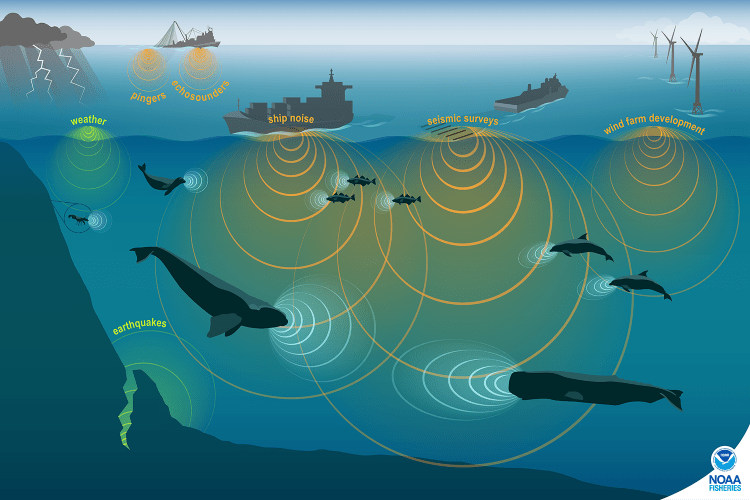
Climate change also rewrites the acoustic script of the ocean. While the seas warm up, the researchers have noticed that the sound is more distant, and that the increase in acidity modifies the chemistry even in the way the vibrations move in salt water, remodeling the ways of the song and the echo. Meanwhile, slimming glacial caps form strange acoustic ceilings, trapping the sound in shallow layers where it ricoche and persists. The sounds made by man warm up in warming seas, drowning delicate echolocations and calls for marine life, leaving signals once clear has been lost in an increasing ocean roar. The average cargo cargo produces a regular rumble between around 20 and 200 hertz, roughly the same low frequency band as a bass speaker, with an equal volume with a chainsaw at a blank.
And, we only start to understand its impacts on marine species. Risk songs
Risk songs
Since water is a denser and more resistant element than air, it folds and stifles light and sound in a way that earthly life never meets completely. Below 328 feet, almost all sunlight has disappeared, so ocean life has learned to “see” in other respects over time. During the millennia, marine animals perfected the ears and capacities of Sonar to read their world into vibrations and echoes, transforming the ocean into a living place with sound and fine tones to its subtleties.
Such noise is particularly critical for the communication of cetaceans, where it is used for navigation, hunting, mating and social ties. Humans have long studied echolocation, noting how dolphins and certain whales emit clicks and listen to the return echoes to map their world. And yet, this same dependence on sound which makes their communication so spectacular, makes them particularly vulnerable to anthropone noise intruders in their environment.
Dolphins may have disrupted hunting and social behavior from strong noise, while whales can abandon critical habitats or change the migration paths in response. The Narwhals presented intense fear responses to the seismic air pistols used in oil and gas exploration, making sudden and deep dives to escape explosions. Some whales have become stranded or collided with ships when submerged by anthropogenic noise, while others have been dangerously left to reduce the song completely.
For many species, scientists only begin to recognize the role of sound in their survival, including leopard seals. A study recently published in Scientific relationships have found that Leopard Seals organizes their songs with a surprising sense of order.
Each reproductive season, male leopard seals plunge under the ice and repeat the long -term sequences of five distinct types of calls for hours. The researchers analyzed these models using a tool of information theory called entropy, which quantifies variation or chance in a sequence with patterns. They discovered that the underwater arias of the seals were more structured than the whistles of dolphin or the bump songs, but less rigid than human music. In fact, the SEALs landed in the same statistical range as nursery rhymes, where repetition and predictability help a message to carry and remember.
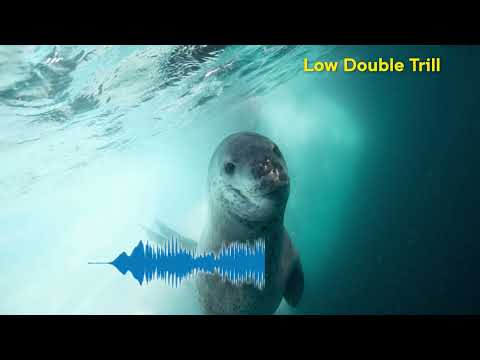
Credit: University of New South Wales / Aleksander Wynne, / Tracey Rogers
“We cannot assume that a particular sound has a particular meaning in the way we do it with the words,” says Lucinda Chambers, a bio-acoust from the University of New South Wales in Australia and the main author of the study, explains the main author of the study Popular science. “But we can assume that a particular combination of sounds is very significant.”
These sound combos have placed leopard seals curiously next to us. When their calls were compared to everything, from the chatter of squirrel monkeys to the melodies by the Beatles, their songs have shown a balance between chance and order that suggests style, not just repertoire, communication issues. In the vast and noisy southern ocean, such predictability can be the key to helping rivals or potential partners to recognize an individual voice through miles of ice and water.
Each man combines the five types of calls in his own fixed sequence – operating almost as a personal name which allows others to recognize it through ice, notes the rooms.
[ Related: Arctic seals have special noses. ]
Few shelters
Leopard Seal original recordings were captured in distant and robust Antarctica in the 1990s. However, even here, at the bottom of the earth, the sound landscape changes. The continent remains relatively isolated from the constant buzzing of the shipping routes or the coastal industry, but it is not immune. Tourism, Krill fishing and the circulation of ships are all increasing.
“It becomes stronger and louder,” explains Chambers, who notes that scientists only begin to understand how such changes in background noise could change the way the leopard seals and other marine animals learn and transmit their songs.
Leopard seals are intensely lonely mammals, dispersed on large stretching of package ice, which makes you difficult how young seals ever learn reproductive songs in the first place. Women sing, but not with the same long and patterned displays as men. Researchers suspect that they can play a role in teaching puppies, but it remains uncertain.
Many scientists and political decision -makers at all levels test solutions to maintain the acoustic world of the intact ocean. Silent ship technologies, speed restrictions in sensitive areas and designated “silent areas” can give marine species the breathing room they need. Strict surveillance of industrial activity, the adoption of low -noise alternative technologies and public education campaigns aim to reduce the noise generated by humans before it overwhelms ocean life.
But even if new tools and strategies are emerging to calm the seas, the legal basis that has long saved marine life is under pressure.
Since 1972, the Navy Mammal Protection Act has served as a buffer against this cacophony, giving regulators tools to limit damage and protect the species of fatal tangles, ships and industrial noise. A proposed reutorization, however, could weaken these guarantees, reduce the standard to maintain healthy populations to simple survival and limit the rules that agencies can start to reduce the disturbances caused by humans.
Scientists warn that without strong protection, sound -based critical behavior (communication, hunting, mating, etc.) could be more and more disturbed, which puts populations in danger.
“Animals will generally increase the volume of their sounds in response to the increase in background noise,” explains Chambers. “If their distribution is interrupted, it will have an additional impact on how these sounds are learned, or the way in which these songs can be transmitted.”

More offers, reviews and purchasing guides


