Lessons From Garment Factories Fighting Heat Stress

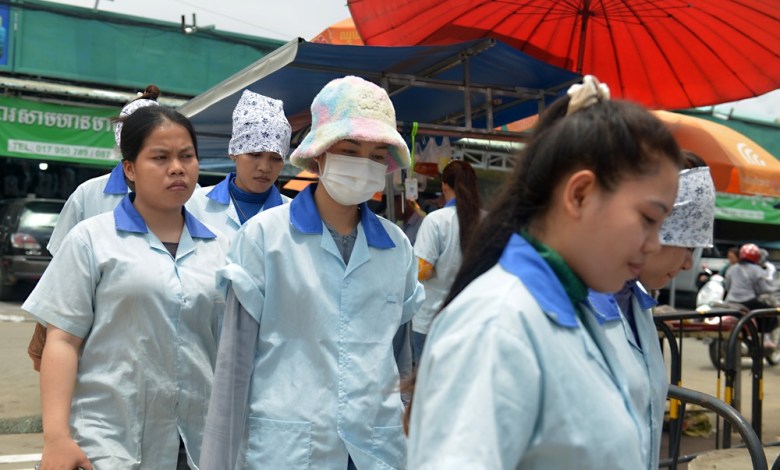
Sarah Krassley, a visiting scholar at Cornell University’s ILR School, was visiting a clothing manufacturer in Cambodia when a question popped into her head. She showed the evaporative cooling “water curtains” that line the factory walls, the exhaust fans circulating cold air across the sewing floors, the refrigerant-powered air conditioning that vibrates heat-sensitive equipment despite summer temperatures that have topped 42 degrees Celsius, or 107.6 degrees Fahrenheit.
“Did a brand help you pay for this? The International Finance Corporation or another development organization?” she asked the female managers of Sabrina Garments, a nearly 78,000-square-foot facility on the western edge of Phnom Penh in Kampong Speu province. “They looked at me like I was crazy. They said, ‘No, we financed this ourselves. Why would we do otherwise?”
Learn more about Sourcing Journal
Krassley was on a research trip to Cambodia and Vietnam in November, where — as she wrote in a report released a few months later by the ILR Global Labor Institute — extreme heat waves intensified by climate change have become not a “transient disturbance” but a “defining operating condition” that can cause physiological heat stress, leading to exhaustion, vision loss, urinary tract infections, and even death.
As the founder of Shimmy Technologies, a gamified AI-powered training platform that helps garment workers upskill in the age of automation, Krassley has long been interested in what happens when large forces collide with workers’ livelihoods. She now wanted to understand how clothing factories were adapting to what she describes as “systemic workforce pressure” from the heat, especially as suppliers with razor-thin margins bear the cost in poorer countries where upgrading aging infrastructure is expensive and codes of conduct from well-meaning buyers rarely translate into financing.
The ILR Global Labor Institute had previously made a business case for climate adaptation in a series of reports, starting with a 2023 analysis with investment firm Schroders that estimated that falling productivity from rising temperatures and flooding could reduce export revenues by $65 billion and put at risk 1 million new jobs in four of the world’s top clothing-producing countries by 2030. Its research also found that Workers had few safety guidelines and even fewer legal recourses when conditions became unbearable.
Importantly, the study concludes that adaptation is not yet integrated into risk planning, as the fashion industry as a whole, as well as the regulators expected to provide oversight, remain focused on mitigation.
“Many people who care about what’s happening in workers’ lives have difficulty grasping the impacts or quantifying them,” said Jason Judd, executive director of the ILR Global Labor Institute and author of many previous studies.
To document concrete examples of largely self-financed heat adaptation measures initiated by factory management, Krassley visited An Giang Samho, a large semi-automated shoe complex in Vietnam’s An Giang province; WorldOn, a cut-and-sew facility located about 90 minutes from Ho Chi Minh City; and the aforementioned Sabrina Garments in Cambodia.
What she discovered were three distinct adaptation pathways: the first introduced gradual changes within an open hangar that relied on natural cross-ventilation; the second viewed cooling as necessary for the precise control of temperature and humidity needed to operate automated technologies such as robotic sewing; and the third made additional investments guided by data and worker feedback. Although their methods differed, one thing united them: all three manufacturers viewed cooling not as a reactive response but as essential to their long-term operational resilience. The result also justified these improvements.
“Factories that have invested proactively are seeing a return on investment that goes beyond just ‘we’re more productive,’” Krassley said. “The results were more important. And it was interesting to see what was important to the workers.”
At Sabrina Garments, for example, absenteeism hovers around 1%, a rarity in the Cambodian clothing sector, according to managers. In addition to competitive wages, subsidized lunches and what she called a “quiet and respectful environment,” workers are demanding jobs at the plant. Employees would also stay at Sabrina Garments for 10 to 15 years in an industry plagued by high turnover, with many returning after family leave.
Krassley also observed that factories didn’t embark on a gigantic, expensive renovation, but instead took a phased approach to accumulating cooling improvements that were easier on their bottom line.
They didn’t have to be expensive, either: An Giang Samho installed ice machines to make and store clean ice after a manager noticed workers hunched over makeshift ice buckets filled with often unsanitary ice from their neighborhood. When workers began using them, supervisors reported fewer heat-related complaints at midday. A union leader Krassley spoke with also described the decision as “significant,” an indication of management’s attention and a “prudent move beyond mitigating a risk of noncompliance.”
At the same time, the plant’s “most significant” climate adaptation, she said, came from a utility-financed solar installation whose financing structure allowed it to adopt renewable energy without upfront capital or downtime. Working as a heat shield that captures heat from the sun before it warms the building, the solar panels helped lower indoor temperatures by 3 degrees Celsius while reducing energy costs by $3,000 per month.
Although WorldOn built part of its factory with air conditioning – a rarity in Vietnam – it also made progressive decisions that alleviated heat discomfort, such as replacing steam ironing systems and fabric-relaxing machines with electric systems that lowered the ambient temperature. Instead of conventional metal ducts, he used fabric-based air dispersion ducts that are easier to clean and distribute air more evenly without creating drafts.
WorldOn also moved from passive ventilation to active environmental management by installing a digital monitoring system that uses sensors to track temperature and humidity throughout the factory, maintaining levels within set parameters during production hours.
For Krassley, these case studies show that there is a “real opportunity” to meaningfully tackle climate adaptation by prioritizing progress over perfection.
“None of these are a completely complete solution to reducing heat,” she said. “But it builds on the next one and builds on the next one and builds on the next one. And in the world we live in right now, that’s the type of action we want to encourage. We don’t want a factory to throw up its hands and say, ‘Well, that’s too expensive. I can’t go all-in on cooling.’ We want them to say, “Okay, what are these things I can do with a goal in mind?” »
Krassley sees a clear parallel between the industry’s response to the Rana Plaza collapse in Bangladesh in 2013 and how it must respond to the worsening heat crisis among workers. After the tragedy, fashion brands and civil society organizations mobilized to assess and repair the safety gaps that threatened similar buildings and their workers, even if doing so required massive capital investments. The heat, she says, must now be greeted with the same sense of urgency.
“If we don’t get the heat situation under control, we’ll end up in the same situation,” Krassley added. “It may not be buildings that are collapsing, but people are already suffering. »


