Liberal justice questions transgender athlete laws during oral arguments


NEWYou can now listen to Fox News articles!
Justice Ketanji Brown Jackson raised concerns during Supreme Court oral arguments Tuesday about how two state laws preventing transgender athletes from competing in women’s sports could discriminate against transgender people.
Jackson asked similar questions of the solicitors general of Idaho and West Virginia, who appeared in court to defend the laws, about whether their states were inappropriately treating transgender athletes who identify as girls differently than biological girls.
“I guess I have a hard time understanding how you can say that this law doesn’t classify on the basis of transgender status,” Jackson told Idaho Solicitor General Alan Hurst. “The law is expressly intended to ensure that transgender women cannot play on women’s sports teams. So why isn’t there a classification based on transgender status?”
CONSERVATIVE JUSTICE IS ABOUT THE DOJ IN THE TRANS SPORTS CASE: “I DON’T THINK YOU ARE A PHD IN THIS PRODUCT”

Justice Ketanji Brown Jackson attends the 2025 ESSENCE Culture Festival presented by Coca-Cola at the Ernest N. Morial Convention Center on July 5, 2025 in New Orleans, Louisiana. (Arturo Holmes/Getty Images for ESSENCE)
Hurst responded that Idaho’s fairness in women’s sports law depends on the gender of the student-athlete, not transgender status.
“The legislature didn’t want to exclude transgender people from sports,” Hurst said. “He wanted women’s sports to be reserved for women and exclude men from women’s sports.”
Jackson continued to press Hurst, asking, “But this treats transgender women differently than cis women, doesn’t it?”
In another case, Jackson asked similar questions of West Virginia Solicitor General Michael Williams about his state’s Save Women’s Sports Act.
The high court heard arguments in both cases on Tuesday and is expected to issue a ruling by the summer that could have far-reaching consequences. A ruling in favor of the states could allow the two states, along with about two dozen others, to block transgender athletes who identify as women and girls from competing in women’s sports from grade school to college. It could also influence other transgender policies across the country, depending on how broad or narrow the court’s rulings are.
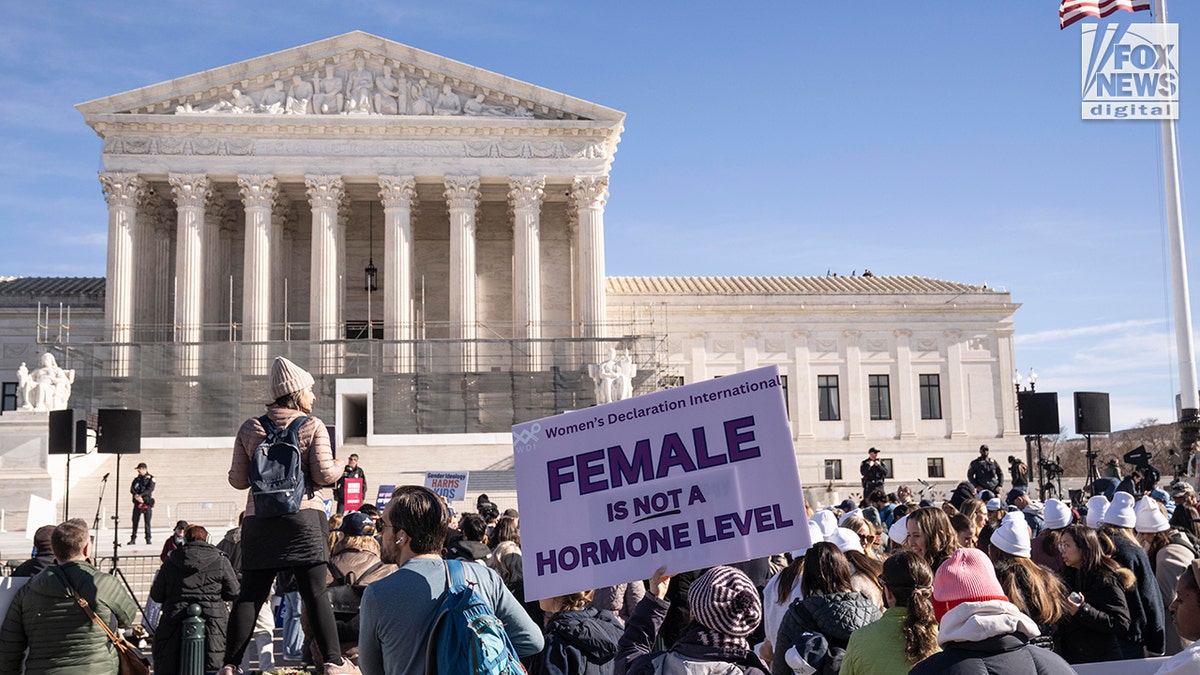
Groups of protesters stand outside the U.S. Supreme Court as justices hear the landmark case to decide whether transgender girls should be allowed to participate in girls’ and women’s sports, Tuesday, Jan. 13, 2026. Credit: Andrew Thomas / CNP (Andrew Thomas/CNP for Fox News Digital)
“It’s like second-order discrimination, right?” Jackson asked Williams. “The first order is to separate men from women. …The second order is to separate transgender women from cisgender women, right? »
In West Virginia, a 15-year-old girl who identifies as transgender and is represented by the American Civil Liberties Union argued that the state law violates Title IX and the Equal Protection Clause of the Constitution.
Williams told Jackson that the high court should only look closely at the law’s requirements that the state distinguish between boys and girls in school sports, not between biological girls and transgender athletes who identify as girls.
Jackson, a Biden appointee, continued to promote the idea that West Virginia’s law not only divided boys and girls, but also divided transgender people and those who identify as their gender at birth.
“There’s the overall classification — everyone has to play on a team that is the same sex at birth — but then you have a definition of gender identity that operates within that, which is a distinction, meaning that for cisgender girls, they can play consistent with their gender identity. For transgender girls, they can’t,” Jackson said.
The judge added that she wanted to look at “the idea that this is really just the definition of who – that we accept that you can separate boys and girls, and we’re now looking at the definition of a girl, and we’re saying that only people who were assigned at birth are eligible.”
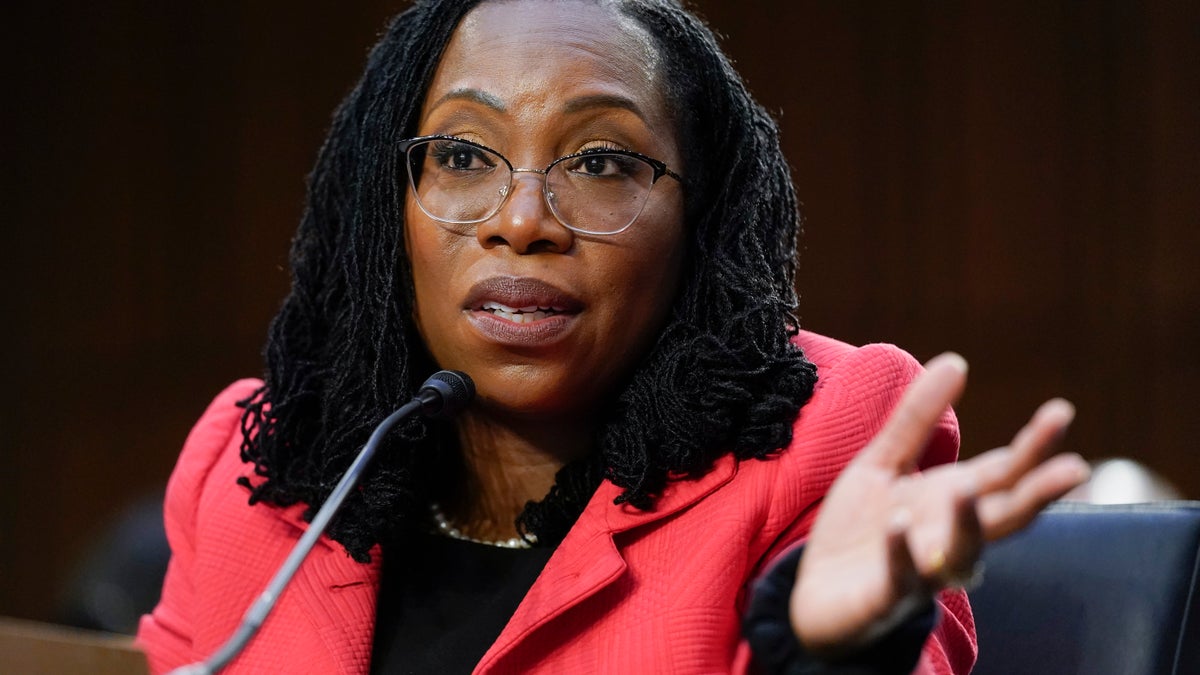
Supreme Court nominee Ketanji Brown Jackson testifies during her Senate Judiciary Committee confirmation hearing on Capitol Hill in Washington, Tuesday, March 22, 2022. (AP Photo/Andrew Harnik) (AP Photo/Andrew Harnik)
Williams argued that once the high court agrees that states are allowed to separate boys and girls in sports, disputes over the definition of “girl” could be reviewed under a less strict legal standard.
“But I don’t think the Court should go that far,” Williams added.
Jackson’s focus on the definition of “girl” echoes a viral moment from his confirmation hearing to become a judge in 2022, when Sen. Marsha Blackburn, R-Tenn., asked Jackson to define “woman.”
CLICK HERE TO GET THE FOX NEWS APP
“I can’t, not in this context. I’m not a biologist,” Jackson replied.
Conservatives have frequently asked the question of transgender rights advocates, who, like Jackson, generally do not offer direct answers to a question that critics have called loaded and designed to attack transgender people.


