Lincolnshire farm uses climate change to grow olives at Long Sutton


Paul MurphyEast Yorkshire and Lincolnshire Climate and Environment Correspondent

 BBC
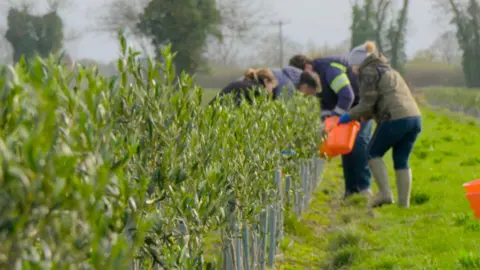
BBCA farmer says climate change has allowed him to grow and harvest what is believed to be Lincolnshire’s first commercial olive crop.
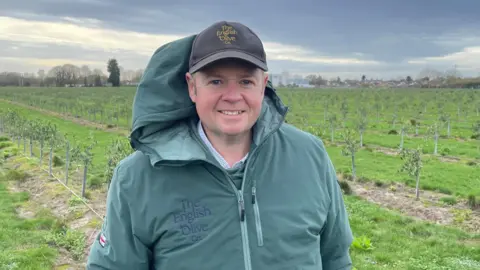
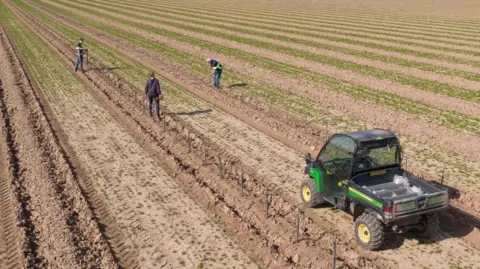
David Hoyles, whose family has farmed the Fens for over 200 years, grew the fruit on 25 acres (10 hectares) of land in Long Sutton.
“We’re seeing that climate change is sometimes making it difficult for some of our conventional crops. We’re having hotter, drier periods,” he said.
The olives were harvested by hand and crushed to extract the oil which was bottled for public sale.
Mr Hoyles’ windswept grove is one of the world’s most northerly commercial olive farms. He has spent the last five years researching the specialized techniques needed for a successful harvest.
“We first looked at grapes, but they weren’t suitable for our soil type. Olives are an extreme choice, but we chose it,” he said.
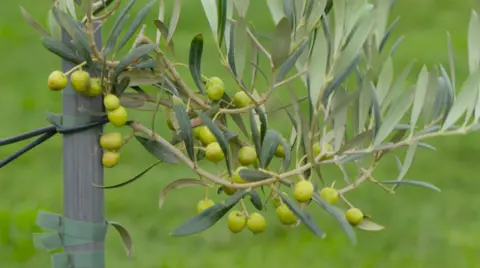
Mr Hoyles planted his olive crop in 2024 after fact-finding trips to Italy, which saw him collaborate with other farmers who said it had been “fantastic”.
Italian farmers helped Mr Hoyles research the different species of olive trees and assess their suitability for cultivation in Lincolnshire.
“They [the Italians] call me ‘the mad Englishman’, but they all agreed to share their knowledge, passion and enthusiasm,” he said.
Mr Hoyles said the decision to plant more than 18,000 olive trees on his farm was driven by “pragmatism” but also because he “likes a challenge”.
 David Hoyles
Mr Hoyles, who grows olives alongside more conventional crops such as wheat, sugar beet, potatoes and peas, said he had installed wind turbines and solar panels to improve energy self-sufficiency.
Additional reservoirs were also built to provide more water to crops during dry periods.
He said: “We are finding that the classic way of growing olives is not the way we do it in the UK; the timings of the seasons are different and we are learning and adapting all the time.”
It has been possible to produce wine from UK-grown grapes for decades and, with the Met Office predicting warmer, wetter winters and hotter, drier summers, Mr Hoyles believes there is an opportunity for farms like his to diversify.
“Taking climate change into account is one of the reasons why we have invested, even if we are at the limit of [olive] the trees will survive,” he said.