‘Living rocks’ suck up a lot of carbon


Among the delicate carnivorous plants, great white shark-killing orcas, and other remarkable flora and fauna that inhabit South Africa, is a remarkable group of “living rocks.” Called microbials, these communities resemble coral reefs and are made up of microbes. These tiny living organisms absorb and release dissolved minerals into more solid, rock-like forms. Microbialites are also some of the oldest evidence of life on Earth and can be found in layered, self-contained communities called microbial mats.
New research recently published in the journal Natural communications also notes that these living rocks do not only survive along the South African coast. They are thriving. The new study shows how microbials capture carbon and transform it into new layers of calcium carbonate. These structures then use photosynthesis (the same way plants use the sun to make food) and other chemical processes to absorb this carbon day and night at the same rate as other microbes living within their microbial community.
According to the study authors, the rate at which they use carbon shows the impressive efficiency of these microbial mats, removing dissolved carbon from their environment and moving it to a stable mineral deposit.
“These ancient formations that textbooks say are almost extinct are alive and, in some cases, thriving in places where organisms would not be expected to survive,” Dr. Rachel Sipler, study co-author and marine biogeochemist at the Bigelow Laboratory for Ocean Sciences in Maine, said in a statement. “Instead of finding ancient, slow-growing fossils, we found that these structures are made up of robust microbial communities, capable of growing rapidly in harsh conditions.”
Scientists have long struggled to understand how such microbial communities interact with their environment. Part of the difficulty is that the data on these interactions comes from fossilized remains of microbials, some of which are billions of years old. Fortunately, living microbials are still widely distributed in salty marine environments around the world.
Sipler and the team also examined the underlying geochemical processes at play. Over several years, they conducted several field expeditions, examining four microbial systems in southeastern South Africa. Here, hard, calcium-rich water escapes from coastal sand dunes.
“The systems here thrive under some of the most challenging and variable conditions,” Sipler said. “They can dry one day and grow the next. They have this incredible resilience that was hard to understand.”
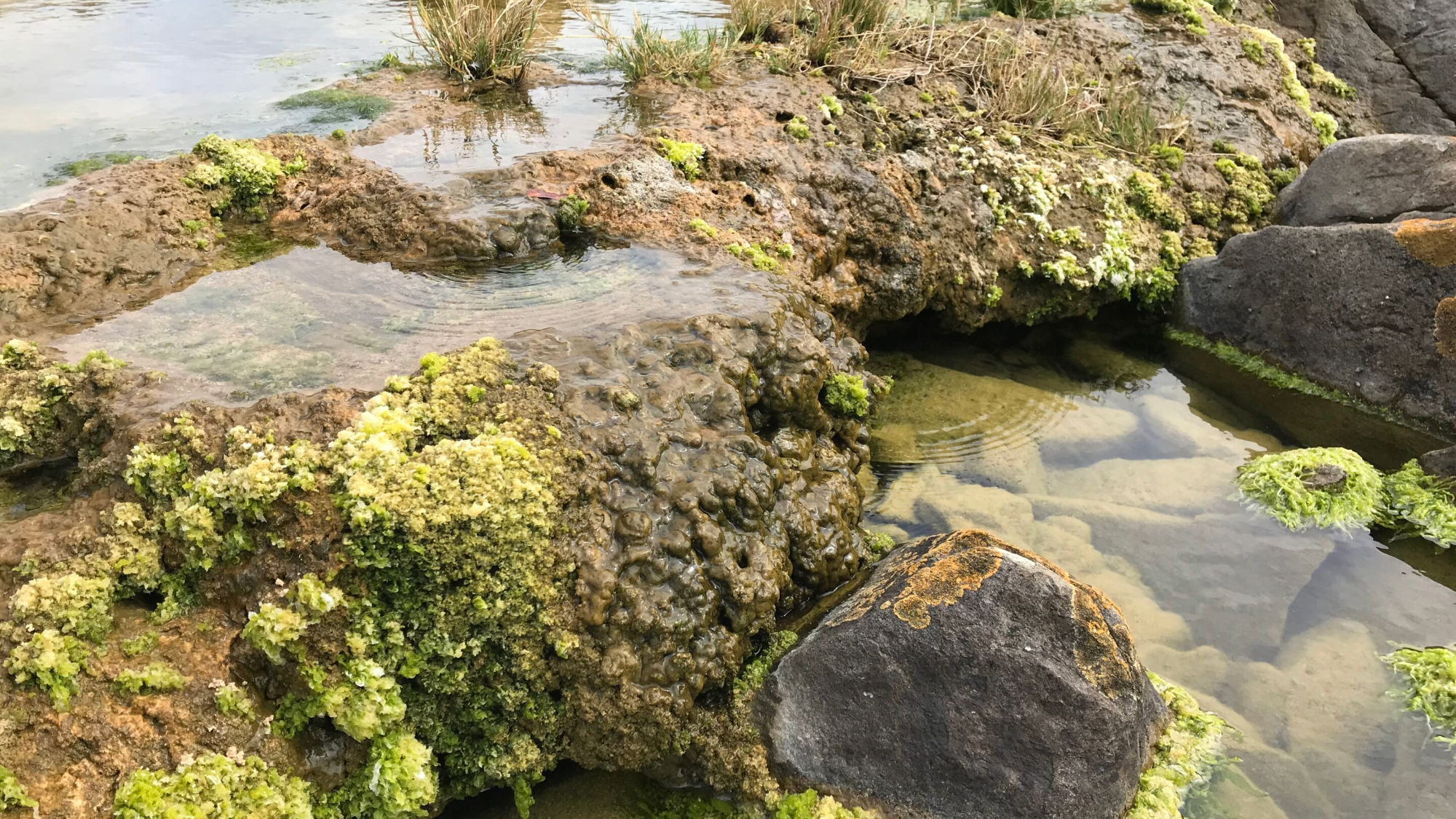
They found that these systems rapidly deposited calcium carbonate, estimating that the structures can grow about two inches vertically each year. Surprisingly, they also found that the amount of carbon absorbed during the day and night was about the same. Since these systems had long been thought to be driven solely by photosynthesis, the team was surprised to find that nighttime absorption rates were as high as during the day. After repeating their experiments several times, the team confirmed that the microbes use metabolic processes other than photosynthesis to absorb all that carbon in the absence of sunlight. This is similar to how microbes living in deep-sea vents are able to survive in near-total darkness.
Based on daily carbon uptake rates, the team estimates that these microbes can absorb the equivalent of about 20 to 25 pounds (nine to 16 kilograms) of carbon dioxide each year per square meter. This would equate to an area the size of a tennis court absorbing as much carbon dioxide as three acres of forest each year. This rate of carbon uptake makes these microbial systems one of the most efficient long-term biological carbon storage mechanisms observed in nature.
“We are so trained to look for what is expected. If we are not careful, we will train ourselves to not see the unique features that lead to a true discovery,” Sipler said. “But we continued to go out and dig into the data to confirm that the finding was not an artifact of the data but an incredible discovery.”
Additionally, coastal marshes are similar to these microbials since they can absorb carbon at a similar rate. However, swamp microbes put all of this energy into organic matter, which can be easily broken down compared to the more stable mineral structures of microbites. Given these differences, the team is studying how environmental factors and microbial variations can influence the fate of carbon in different microbial systems.
“If we had just looked at metabolisms, we would have had part of the story. If we had just looked at carbon uptake rates, we would have had a different story. It was through a combination of different approaches and strong scientific curiosity that we were able to construct this complete story,” Sipler said. “You never know what you’re going to discover when you put people from different backgrounds and different perspectives into a new and interesting environment. »

PopSci Outdoor Gift Guide 2025


