Lockdown could have been avoided and other key findings


Nick Triggle, Jim Reed, Dom Hughes and Michelle Roberts

 Getty Images
The long-awaited independent report into the government’s handling of the Covid pandemic has been published.
The inquiry’s chair, former judge Baroness Hallett, said the UK’s response could be summed up as “too little, too late”.
The report examines whether the lockdowns were timely and reasonable, and what impact rule-breaking within government had on public trust.
Here are some of the key findings.
Containment could have been completely avoided
The report said the lockdown could have been avoided if measures such as social distancing and isolation of people with symptoms as well as their household members had been introduced before mid-March 2020.
But by the time ministers took action, it was already too late and a lockdown was inevitable, he says.
By the end of January 2020, it “should have been clear that the virus posed a serious and immediate threat”, while February 2020 was “a wasted month” and the general lack of urgency on the part of the government was “inexcusable”, the inquiry found.
Voluntary measures were put in place on March 16, 2020, followed by total home confinement seven days later.
But a lockdown a week earlier could have saved thousands of lives
Introducing lockdown a week earlier, on March 16, would have resulted in 23,000 fewer deaths in England during the first wave, modeling suggests. This would have been equivalent to 48% fewer deaths during the first wave.
But the report does not suggest that the total number of deaths from the pandemic – 227,000 in the UK by the time it was declared over in 2023 – would have been reduced by an earlier lockdown.
This is very difficult to say, as it depends on various other factors that could have reduced or increased the number of deaths as the pandemic progressed.
“Chaotic” British government and its key figures criticized
The report describes a “toxic and chaotic” culture at the heart of the UK government during its response to the pandemic, which it says has affected the quality of advice and decision-making.
While claiming a number of senior leaders and advisers have demonstrated poor behaviour, Boris Johnson’s top adviser Dominic Cummings is described as having exerted a “destabilizing influence”.
He claims his actions contributed “significantly to a culture of fear, mutual suspicion and mistrust which has poisoned the atmosphere at 10 Downing Street”.
 Pennsylvania
Johnson, then prime minister, was also criticized for his excessive optimism in the face of the looming pandemic and for his “wavering” on key lockdown decisions.
The report said Johnson “should have understood sooner that this was an emergency that required the Prime Minister’s leadership to inject urgency into the response.”
Instead, he failed to understand the urgency of the situation, “because of his optimism it would come to nothing,” he says.
Meanwhile, her Health Secretary, Matt Hancock, is accused by Baroness Hallett of not being “upfront” enough about the UK’s ability to deal with the virus.
Lockdowns have left “lasting scars”
While the lockdowns of 2020 and 2021 undoubtedly saved lives, they also “left lasting scars on society and the economy, ended ordinary childhood, delayed the diagnosis and treatment of other health problems, and exacerbated societal inequalities,” the report said.
Children have not been given enough priority as ministers have failed to properly consider the consequences of school closures, the report says.
It says the vast majority of children were not at risk of serious direct harm from Covid “but suffered greatly from school closures and being required to stay at home”.
None of the four UK countries was sufficiently prepared for the sudden and enormous task of educating most children at home, the investigation adds.
Rule-breaking politicians have undermined public trust
 PA Media
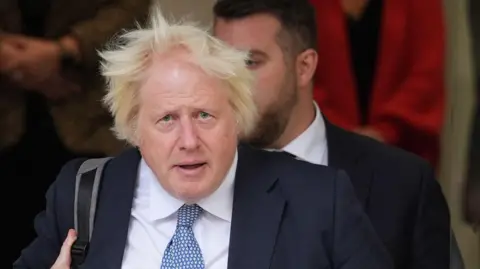
The report says that failure to follow the rules by politicians and their advisers has undermined public confidence in the decision-making process and significantly increased the risk that people will not comply with the measures put in place.
It lists events such as Cummings’ trip to Durham and Barnard Castle in March 2020; two visits to a second home during lockdown by Scotland’s Chief Medical Officer, Dr Catherine Calderwood; and visits to the home of scientific adviser Professor Neil Ferguson by a woman with whom he was in a relationship during lockdown.
As details of parties and social events at Downing Street were revealed in November 2021, there was a “public outcry”, the report said.
Johnson and Rishi Sunak subsequently received fixed penalty notices for their actions.
Devolved governments relied too much on the UK
The four countries were criticized for their planning and decision-making, which the investigation found was hampered by a lack of trust between Boris Johnson and the prime ministers.
The inquiry found that at the start of 2020, while all four countries lacked urgency in their response, the devolved administrations were too reliant on the UK government to lead the response.
The four countries then differed in their strategy for emerging from the first national lockdown, with Scotland, Wales and Northern Ireland taking a more cautious approach – but this strategy was undermined by the lack of restrictions on travel from England, where many restrictions had been eased.
The report reveals that in autumn 2020, Holyrood was the only government to learn from the first lockdown and introduce strict, targeted measures at a local level that avoided the need for a nationwide lockdown.
On the other hand, decision-making in Northern Ireland has been described as “chaotic”, while the Welsh Government’s approach resulted in the highest age-standardized death rate of the four countries between August and December 2020.
How could the UK have done better?
The report gives a long list of recommendations, including:
- Establish structures to improve communication between the four nations in the event of an emergency
- Improve consideration of the impact that decisions can have on people – both due to the illness and the measures taken to respond to it
- Create expert groups to advise on economic and social implications, not just science
- Ensure that decisions – and their implications – are clearly communicated to the public
- Allow greater parliamentary oversight of emergency powers
The government is not obliged to adopt the inquiry’s recommendations, but it must respond to them, which could shape its future policies.
The inquiry has already reported on the UK’s preparedness for the pandemic, concluding that the UK has failed its citizens with faulty plans.


