Looking at Art on Psychedelics



Explore
HDo psychedelics change what we see? Many scientists have tried to answer this question by combining large-scale brain scans with self-assessment of study participants. But few people have examined the mediators of this kingdom: eyes.
So, a team of researchers decided to discover: where is the gaze on psychedelics?
To do this, they went to people with eye monitoring equipment and dried psychedelic mushroom pills (from Psilocybe cubensis). Then they showed people 30 different paintings while they stumbled and looked at what had happened.
The study participants, of course, volunteered for the study and had been assessed first. (They had all taken psilocybins with mushrooms at least twice before – and obtained two different study visits: one in very low doses, such as “active” control, and another in high doses as an experimental condition.)
ADVERTISEMENT
Nautilus members benefit from experience without advertising. Connect or join now.
“What an infinitely significant complexity labyrinth!”
The study of study was not your usual psychedelic aesthetic price. (Not a fractal in sight!) A painting, School youthBy Jean-Séméon Chardin, was painted in the 1730s, and shows in a rococo style in mute, a moment of classic and calm education. Another, Speed+ sound summary By Giocomo Balla of the first half of the 1910s is a futuristic painting which reflects the experience of seeing and hearing a new car, through oil painting, in geometric shapes. The rest of the 30 works were varied to date from the 1400s in the middle of the 20th century.
What happened when scientists analyzed data from eye -monitoring experiences was not what they expected. One of the main theories of this type of psychedelic – known as serotonergic psychedelic, which have an impact scientists presumed that this would lead to more chaotic and wild visuals in works.
Psilocybin at low dose “active control” showed that people were looking around the paintings as expected, for example, focusing on the faces of the two individuals in School youth painting as well as the relationship of the two figures.
ADVERTISEMENT
Nautilus members benefit from experience without advertising. Connect or join now.
But in the high dose of psilocybin, people’s eyes tended to walk less rather than more – instead of locking even more on focal details, such as the faces of this painting. This was also the case in a more visually dispersed paint, as Speed+ sound summary: The visual focus of people has really focused on the most central part of the painting, rather than dancing more widely (as they did on low dose control).
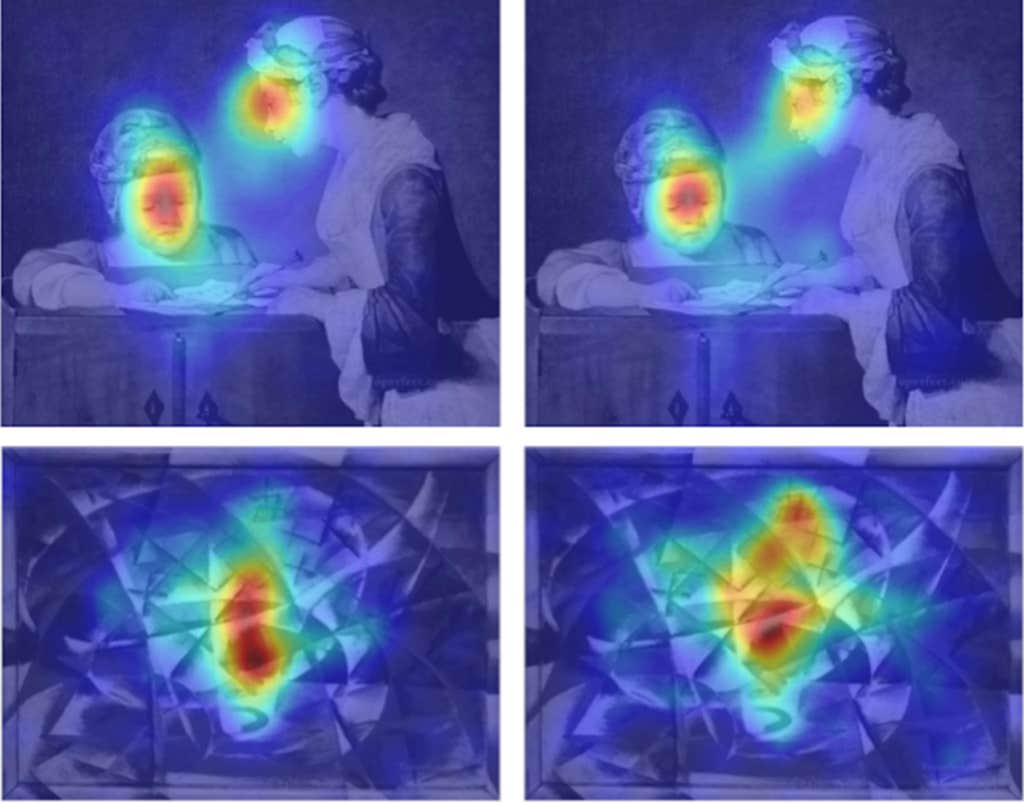
The results may have been a surprise based on scientific literature. But they may not be a surprise based on experience. People on psychedelics often signal the fixing on the visual details of the slightest kind, generally adopted by the spirit of daily perception. Or like the writer and philosopher Aldous Huxley described it in 1954 The doors of perception: “I looked down by chance and I continued to look passionately by the choice, my own legs crossed. These folds in the pants – what an infinitely significant complexity labyrinth! And the texture of the gray flannel – how rich, at what depth, mysteriously sumptuous!” (Credit to study authors for having drawn this quote.)
Although psychedelics seemed to increase the concentration of participants on certain parts of the paintings as well as on the feelings of self -depressed flows, drugs did not seem to make people as The paintings are more than the basic line at very low dose.
ADVERTISEMENT
Nautilus members benefit from experience without advertising. Connect or join now.
Curious to know more? The authors of the study put everything in their article, which was published this summer Scientific relationshipsas well as in additional equipment. But if you want a quick overview of how the experience has taken place, here it is:
The research team met each person in a house for the choice of participants in two different days, one month apart. With them whenever the researchers have brought their eye tracking equipment, a monitor to display the works and a capsule of 0.5 gram of dried psychedelic mushrooms (acting as a kind of basic control) or 3 grams. Neither the participants nor the research team knew at the time when the dose of a participant had received.
About an hour after taking the pill, the participants were shown the famous – but not too famous – art works on the instructor in a random order, for 30 seconds each. Eye follow -up equipment captured where people’s eyes moved and where they rested. By compiling the data and by doing it, the researchers could create a thermal card to see how people’s visual engagement has changed with the higher dose. They were also asked to describe the intensity of their perceptions – things like: “the edges seem distorted”, “I see geometric models”, “my sense of time and space is distorted.”
As a warning, it was a small study – 15 people finished all stages of the study, most of whom were men and in the 80s in the early noon. The researchers recognize that this study was “exploratory” – hence occasional test environments and the small group. But this is an early step to learn how psychedelics change what we see – and how we look.
ADVERTISEMENT
Nautilus members benefit from experience without advertising. Connect or join now.
Image of lead: Nina_susik / Shutterstock


