Lost in translation – How Africa is trying to close the AI language gap

Although Africa is home to a huge proportion of world languages - much over a quarter according to certain estimates – many are lacking in the development of AI.
This is both a problem with an easily available lack of investment and data.
Most AI tools, such as GPT Chat, used today are trained on English as well as other European and Chinese languages.
These have large amounts of online text to be drawn.
But as many African languages are mainly spoken rather than written, there is a lack of text to form AI to make it useful for the speakers of these languages.
For millions through the continent, it means being left out.

“We think in our own languages, dream in them and interpret the world through them. If the technology does not reflect this, an entire group may be left behind” “, source: Vukosi Marivate, Source Description: IT teacher, University of Pretoria, Image: a top plan of Vukosi Marivathe. He has short and lifting hair.
Researchers who tried to solve this problem recently published what is considered the largest set of known data from African languages.
“We think in our own languages, dream in them and interpret the world through them. If technology does not reflect this, an entire group may be left behind,” said Professor Marivate at the University of Pretoria, who worked on the project, told the BBC.
“We are going through this AI revolution, imagining everything that can be done. Imagine now that there is part of the population that simply does not have this access because all the information is in English.”
The Africa Next Voices project brought together linguists and computer scientists to create sets of data ready for AI in 18 African languages.
This is perhaps a small part of the more than 2,000 languages estimated to speak through the continent, but the people involved in the project say they hope to develop in the future.
In two years, the team has recorded 9,000 hours of speeches through Kenya, Nigeria and South Africa, capturing daily scenarios in agriculture, health and education.
The recorded languages included Kikuyu and Dholuo in Kenya, Hausa and Yoruba in Nigeria and Isizulu and Tshivenda in South Africa, some of which are spoken by millions of people.
“You need a base to start and that’s what Africa sees the next voice, then people will rely above this and add their own innovations,” said Professor Marivate, who led research in South Africa.
His Kenyan counterpart, the computer linguist, Lilian Wanzare, says that recording the speech on the continent meant creating data aimed at reflecting the way people live and really speak.
“We have gathered voices from different regions, ages and horizons, so it’s as inclusive as possible. Big Tech cannot always see these nuances,” she said.
The project was made possible by a Gates Foundation subsidy of $ 2.2 million (1.6 million pounds sterling).
The data will be open, allowing developers to create tools that translate, transcribe and respond in African languages.
According to Professor Marivate, there are already small examples of how native languages used in AI can be used to resolve real challenges in Africa.

Kelebogile Mosime has spent the last three years to create a prosperous agricultural business [BBC]
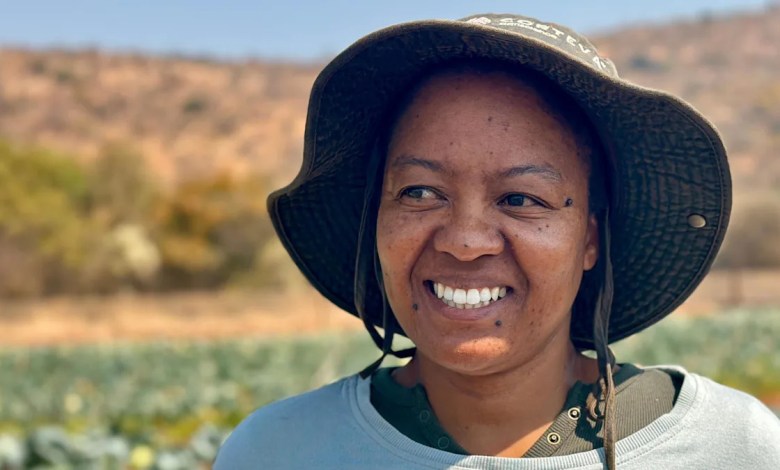
The farmer Kelebogile Mosime manages a 21 hectare site in Rustenburg, in the heart of the platinum region in South Africa.
The 45 -year -old man works with a small team to grow vegetable rows – including beans, spinach, cauliflower and tomatoes.
It started only three years ago, with a cabbage harvest, and to help, it uses an application called Ai-Farmer, which recognizes several South African languages, including Sésotho, Isizulu and Afrikaans, to help solve various problems.
“While someone still learns to cultivate, you are facing a lot of challenges,” said Msime.
“Every day, I see the advantages of being able to use my Home Setswana linguistics on the application when I encounter problems on the farm, I ask for anything and I get a useful response.
“For someone in rural areas like me that is not exposed to technology, it is useful. I can ask questions about insect control options, it has also been useful for diagnosing sick plants,” she radiated under a sun through.

“English is the language of the opportunity. For many South Africans who do not speak, it is not only annoying – it can signify the essential services” “, source: Peleomin Moiloa, Source Description: CEO, Lelapa Ai, Image: a header of Pealomi moiloa. She looks at the camera and wears a black joyer.
Lelapa AI is a young South African company that builds AI tools in African languages for telecommunications banks and companies.
For its CEO Peleomin Moiloa, what is currently available is very restrictive.
“English is the language of opportunity. For many South Africans who do not speak, it is not only annoying-this can mean essential services such as health care, banking services or even government support,” she told BBC.
“Language can be a huge barrier. We say it should not be.”
But it’s more than being business and convenience.
For Professor Marivate, there is also a danger as without African language initiatives, something else could be lost
“Language is access to imagination,” he says.
“These are not only words – it is history, culture, knowledge. If indigenous languages are not included, we lose more than data; we lose ways to see and understand the world.”
You may also be interested:

Go to Bbcafrica.com For more news from the African continent.
Follow us on Twitter @Bbcafricaon facebook at BBC Africa or on Instagram at bbcafrica
BBC Africa Podcasts


