How astronomers plan to detect the signatures of alien life in the atmospheres of distant planets

When you purchase through links on our articles, Future and its syndication partners may earn a commission.

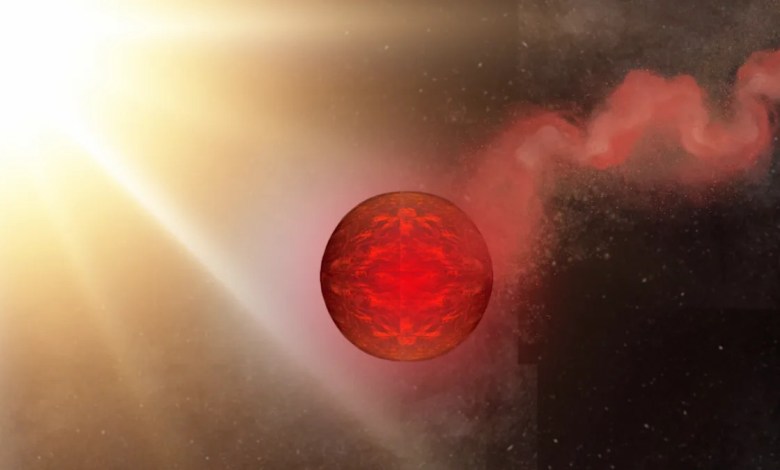
One illustration shows an ultra-short period planet followed by a trail of gas and dust. | Credit: Robert Lea (Created with Canva)
This article was originally published on The conversation. The publication contributed the article to Space.com Expert voices: opinion pieces and perspectives.
We live in very exciting times: the answers to some of the oldest questions humanity has conceived are within our reach. One of them is whether Earth is the only place that supports life.
Over the past 30 years, the question of whether the Sun is the only planet to host a planetary system has been answered resoundingly: we now know of thousands of exoplanets orbiting other stars.
But can we use telescopes to detect whether any of these distant worlds also harbor life? A promising method consists of analyzing the gases present in the atmospheres of these planets.
We now know more 6,000 exoplanets. With so many worlds now cataloged, there are several ways to determine which worlds hold the most promise for biology. For example, using the distance between the planet and its host star, astronomers can determine its likely temperature.
Earth is the only planet in the world solar system with oceans of liquid water on its surface, mild temperatures are therefore a possible requirement for a habitable planet. Whether a planet has the right temperature for liquid water is strongly influenced by the presence and nature of the planet’s atmosphere.
Surprisingly, we can identify molecules present in the atmospheres of exoplanets. Quantum mechanics causes each atmospheric chemical to have its own distinct, barcode-like pattern that it leaves on light passing through it. By collecting starlight filtered through a the atmosphere of an exoplanet, telescopes can see the barcodes of the molecules making up this atmosphere.
To benefit from it, the planet must transit – pass in front – the star from our point of view. This means that it only works for a small fraction of known exoplanets.
The strength of the signal depends on the abundance of the molecule in the atmosphere: stronger for the most abundant molecules and progressively weaker as the abundance decreases. This means that it is generally easier to detect dominant molecules, although this is not always true. Some barcodes are inherently strong, while others are weak.
For example, Earth’s atmosphere is dominated by diatomic nitrogen (N₂), but this molecule has a weak barcode compared to the much less abundant diatomic oxygen (O₂), ozone (O₃), carbon dioxide (CO₂), and water (H₂O).
Molecule detection
THE James Webb Space Telescope (JWST) is a large space telescope that collects light in infrared wavelengths. It has been used to probe the atmosphere of various exoplanets.
Detecting molecular fingerprints in an exoplanet’s atmosphere is not entirely straightforward. Different teams of workers can achieve different results by making slightly different choices in how they process the same data. But despite these difficulties, reproducible and robust detections of molecules have been achieved. Simple molecules with strong barcodes such as methane, carbon dioxide and water were detected.

Artist’s impression of NASA’s Habitable Worlds Observatory in space. | Credit: NASA Goddard Space Flight Center Conceptual Image Lab
Planets larger than Earth but smaller than Neptune – called sub-Neptunes – are the most common type of exoplanet known. It is for one of these planets, K2-18b, that a bold statement of a detection of a biosignature was carried out in 2025. The analysis detected dimethyl sulfide, with less than a 1 in 1,000 chance that this detection was false.
On Earth, dimethyl sulfide is produced by phytoplankton in the oceans, but breaks down quickly in seawater illuminated by sunlight. As K2-18b could be a planet covered entirely by an ocean of water, the detection of dimethyl sulfide in its atmosphere could imply a continuous supply from microbial marine life.
Re-examination of the detection of dimethyl sulfide K2-18b by other researchers casts doubt on this claim. The most important was the 2025 event by Luis Welbanks and colleagues at Arizona State University, the choice of molecular barcodes to include in the analysis dramatically affected the results.
They found that many alternatives, not explored in the original paper, provided equally good or better fits to the measured data.
For Earth-sized, presumably rocky planets, it is quite difficult to detect an atmosphere with JWST. However, the future is bright, as a number of planned missions will allow us to learn much more about planets that could be Earth-like.

An illustration of the exoplanet K2-18b with its host star in the distance. | Credit: ESA/Hubble, M. Kornmesser
Upcoming missions
With a launch planned for 2026, the European Space AgencyIt is Plato Telescope will identify planets much more similar to Earth and suitable for transmission spectroscopy than those we currently know.
from NASA Nancy Grace Roman Space Telescopescheduled for launch in 2029, will pioneer coronagraphic techniques to cancel out starlight so that very dark planets orbiting nearby stars can be studied directly.
The European Space Agency Ariel Telescopescheduled for launch in 2029, is a mission dedicated to transmission spectroscopy, designed to have the capacity to determine the composition of the atmospheres of exoplanets.
from NASA Habitable Worlds Observatory (HWO) is currently in the planning phase. This mission will use a coronagraph to study approximately 25 Earth-like planets, looking for various habitability features.
HWO will have broad wavelength coverage, from ultraviolet to near-infrared. If an Earth twin star were to orbit one of HWO’s nearby target stars, the telescope would collect starlight reflected from the planet. This reflected starlight would include the barcode signatures of diatomic oxygen (O₂) and other gases characteristic of our planet’s atmosphere. It would also reveal a signature of starlight absorbed by photosynthetic plants: the so-called “red edge of vegetation.”
The Earth’s surface is divided into land and oceans, which reflect light differently. HWO would be able to reconstruct a low-resolution map of the surface from changes in reflected light as continents and oceans rotate in and out of view.
The future therefore looks very promising. With the spacecraft expected to launch in the coming years, we could get closer to answering the question of whether Earth is unique in terms of hosting life.


