Children and teenagers share impact of pandemic in new report


Branwen JeffreysEditor And
Erica Witherington

 Bbc
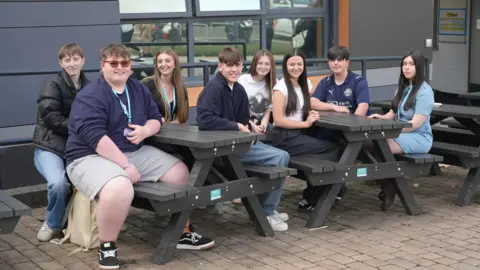
BbcWhen the lock started, the student SAM lived with his mother because his parents were separated.
Then his father died unexpectedly, letting him feel that “something had been stolen”.
His experience is one of the many people highlighted while the COVVI-19 public inquiry is preparing to examine the impact of the pandemic on children and young people.
A new report – given exclusively by the BBC – includes individual accounts of 600 people who were under 18 during the pandemic.
They include happy memories of the time spent with the family, as well as the impact of the disruption of online schools, social isolation and the loss of parents.
The investigation will begin to hear evidence on these issues from Monday, September 29.
‘I lost a relationship’
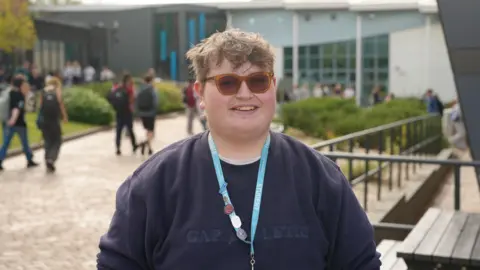
The resident of Wigan Sam was 12 years old during the first locks and said that he had trouble understanding the rules that prevented him from spending more time with his father.
The death of his father left him with the regrets that he had “lost a relationship” because of isolation before the death of his father.
“I feel deeply that something was stolen to me,” he said.
“But I know that the procedures we had to go through were correct. It was a bad situation.”
Today, 17 years old, Sam’s resilience was unfortunately tested after the loss of his mother, who recently died of cancer.
But Sam says that the strength he accumulated during Covid helped to give him “the tools to cope with sorrow alone”.
“ Try to catch up with the lost moments ”
Kate Eisenstein, who is part of the team who heads the investigation, says that the pandemic was a “set of circumstances that changed their life” for the children and the adolescents who lived her.
The impact of the pandemic set out in the testimony is extremely varied and includes happier memories of those who have prospered in secure houses, taking advantage of online learning.
Other accounts capture fears of children in fragile families without escaping mental health problems or domestic violence.
Some describe the sudden devastating loss of parents or grandparents, followed by funeral online or physically distant.
The sorrow for family members lost during the pandemic is an experience shared with some of Sam de Sam’s classmates.
Student Ella told the BBC that the loss of her grandfather during Covid had made her value to spend more time with her grandmother.
It is one of the ways that Ella says she tries to “catch up with the lost moments” that she missed during Covid.
Live online life
An almost universal experience for children living through the pandemic was a large part of life that was moving towards online platforms.
Although this has made it possible to maintain family ties and friendships, Ms. Eisenstein said that some children had darker experiences, passing up to 19 hours a day online, leaving them “really anxious”.
“Some explained to us how they started to compare their body image to online people, how video games and social media have distracted their learning,” she said.
The most worrying, she said, was the accounts revealing an increased risk of adults seeking to exploit young children online, in particular by sending naked images and inappropriate messages.
The remarkable variety of experiences, both positive and stressful, adds to what it describes as “an unprecedented overview of the inner world of children”.
Aaliyah, a student from Winstanley College near Wigan, said that the social isolation she had at the age of 11 led her hours to spend hours looking at social media, who began to change her self -confidence.
“With the content I saw online, I would start looking in the mirror and saying:” I could change that of me “, or” I don’t really like that of me “”, she said.
Sustainable effects
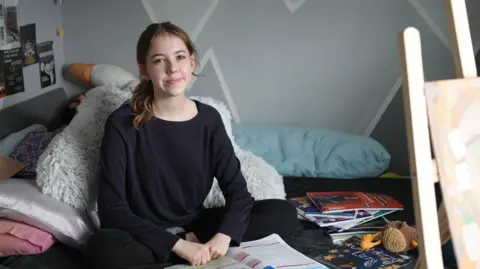
The investigation should also hear about the experiences of children still living with Long Cavid, like Avlyn, now 16, who fell ill with the virus in October 2021.
While schools were starting to return to normal, Avlyn was struggling with deep and debilitating fatigue and finally left school for home education.
It took a year to obtain a formal diagnosis of long and specialized advice.
“I liked to be at school, I liked being social and seeing people, then suddenly it was removed very quickly,” said Avalyn.
Avlyn has long said she was sporty in primary school and appreciated acrobatics.
Like many other children her age, Avlyn has shown determination and resilience to achieve things that would not have been so difficult in other circumstances, and she has now exceeded four GCSE.
“I knew I wanted to do GCSE to prove to myself, especially since I always had the ability to do what everyone did,” she said.
She always goes to a group of performing arts, which allows her to join as much or as little as she can manage.
Avlyn admits “it’s weird to say”, but in some ways, she is “grateful” to have had a long time, because of the things she has done during her long spells at home.
She wrote, illustrated and self-published two children’s books and spent more time on her art.
Although the path to come is not easy, it says it is optimistic to find a way to study and get started at work.
The survey plans to hear evidence on the impact of children and young people in the four weeks from September 29 to October 23.


