MAHA says red meat will make you healthy. The American Heart Association disagrees

In earlier times, the American Heart Assn. and the U.S. federal government were very closely aligned on what the American public should eat and why.
Cardiovascular Research Association Dietary Guidelines widely reflected those published by the U.S. Department of Health and Human Services. American Heart Association. officials advised the government on the science behind its dietary advice.
But as is the case with many public health issues these days, the distance between policies recommended by established medical groups and those endorsed by Department of Health and Human Services Secretary Robert F. Kennedy Jr. appears to be widening.
Tuesday, American Heart Assn. released its update guidelines for a heart-healthy diet. Like the new federal dietary guidelines released in JanuaryThe document warns against processed foods and refined sugars.
But the group has cracked down on some nutritional claims that Kennedy and Make America Healthy Again influencers have touted in public statements and written into federal policy.
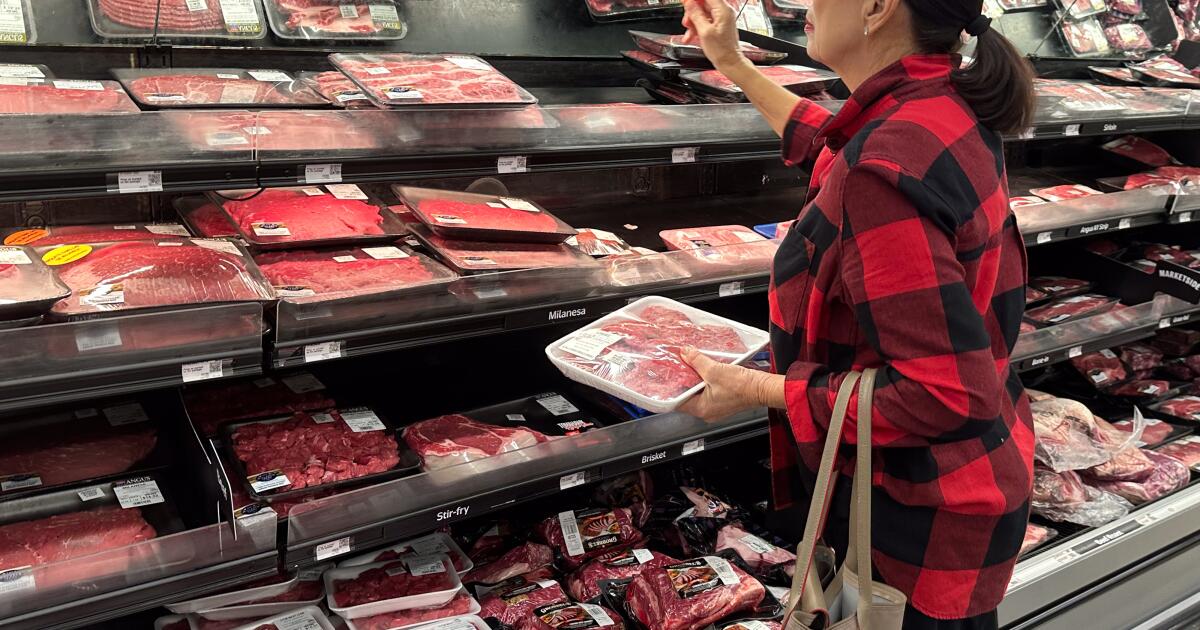
Unlike the new system authorized by the federal government inverted food pyramidwhich stars a huge cut of steak, a platter of ground meat, a hunk of cheese and a carton of whole milk, the American Heart Assn. advocates plant-based proteins over red meat and low-fat or fat-free dairy over whole-fat options.
Contrary to Kennedy’s January declaration that the United States was “ending the war on saturated fat,” the Heart Association continues to recommend unsaturated fat sources over saturated fats for the benefit of cardiovascular health.
The Heart Association also opposes Kennedy’s well-publicized passion for beef tallow as a replacement for seed oils, which he accused (despite fragile evidence) of “poison” the Americans.
“Animal fats (e.g., beef tallow and butter) and tropical oils (e.g., coconut oil, cocoa butter, and palm oil) are relatively high in saturated fats, while nontropical vegetable oils (e.g., soybean, canola, and olive oils) are relatively high in unsaturated fats,” the American Heart Assn. the paper reads. “In summary, as part of a heart-healthy diet, non-tropical plant fat sources should be used in food preparation in place of animal fats and tropical oils.”
In response to questions, the American Heart Assn. and the Department of Health and Human Services emphasized their common goals rather than any differences.
« The American Heart Association program [paper] complies with dietary guidelines on the key issues: eating real foods, avoiding highly processed foods, and limiting refined grains and added sugar,” said Andrew Nixon, a spokesperson for the Department of Health. “We look forward to working collaboratively with the [American Heart Assn.] to evangelize these fundamental principles and reverse the epidemic of diet-related chronic diseases.
The Heart Association and the federal government have different goals when writing their recommendations, said Dr. Simin Liu, director of the UC Irvine Center for Global Cardiometabolic Health and Nutrition and professor at the UC Irvine School of Medicine.
The Heart Association’s guidelines aim to reflect the best available evidence on nutrition and cardiovascular health outcomes, while federal nutrition standards inform the contents of federally funded meals served in schools, hospitals and military restaurants, and help determine which foods are included in assistance plans like the Supplemental Nutrition Assistance Program.
The two sets of guidelines are not completely opposite. The association of the heart applauded government warnings against added sugars, refined grains and processed foods in January, noting that the advice is in line with the organization’s recommendations long-standing recommendations.
“Those of us working in the field have pushed for diet-based dietary recommendations, such as advocating that people eat real foods instead of [processed] food products,” Liu said, but “the focus on consuming animal products is a little off base.”
The administration’s enthusiastic support for animal protein sources surprised many health groups, because a diet high in red meat is strongly associated with poorer cardiovascular health.
An additional report released alongside the federal guidelines noted that several members of the government’s advisory committee had financial ties to meat and dairy industry groupsincluding the National Cattlemen’s Beef Assn., the National Pork Board and the California Dairy Research Foundation.
The Heart Association’s guidelines better reflect the current scientific consensus on the relationship between diet and cardiovascular health, said a spokesperson for the nonprofit Center for Science in the Public Interest, and “will be a valuable resource for anyone who has been confused by the mixed messages” in previous government advice.


