6,300 years ago, dozens of people were murdered in grisly victory celebrations in France


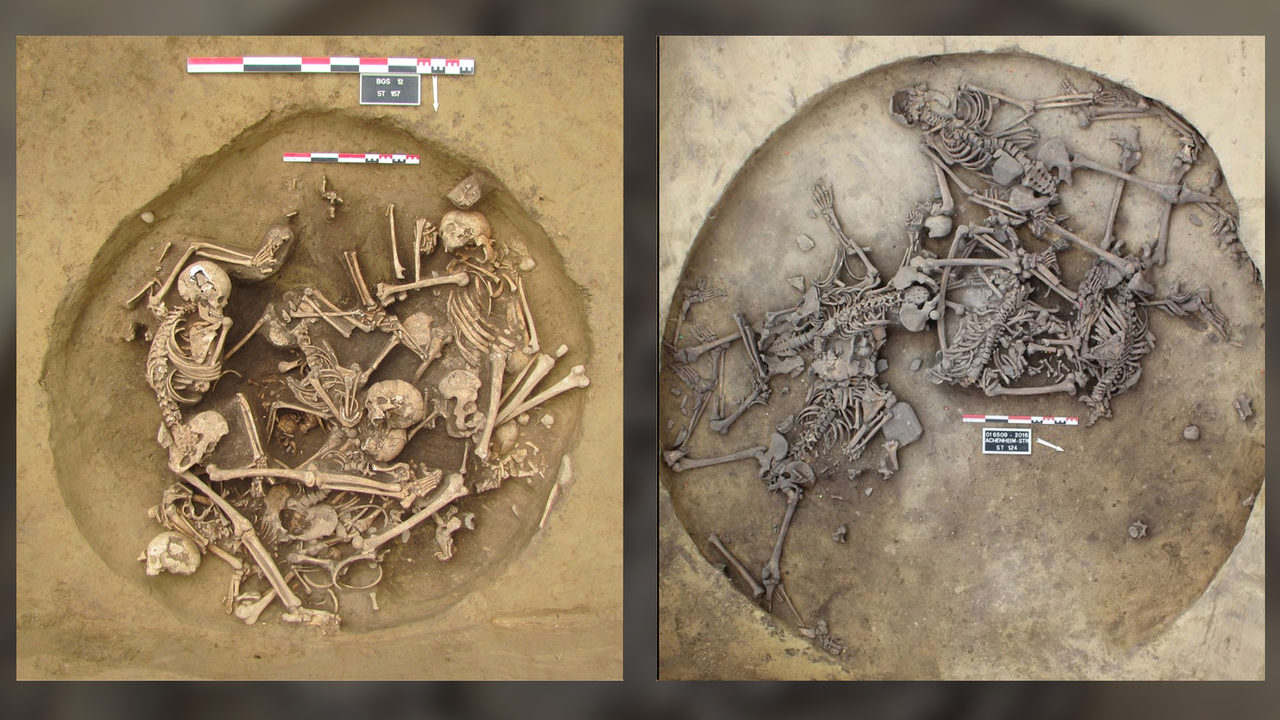
In a series of “victory” celebrations more than 6,000 years ago in northeast France, a group of defenders cut their left arms of their conquered enemies and buried them in pits, found archaeologists.
The discovery gives an overview of an era when war was endemic in the region and when invaders pushed in northeast France from the Paris region.
The “lower limbs were [fractured] In order to prevent the victims from escaping, the whole body shows trauma of blunt force and, what is more, in some skeletons, there are marks – piercing holes – which can indicate that the bodies have been placed on a structure for a public exhibition after having been tortured and killed “,” co -author of the study Teresa Fernánd-CrespoAn osteoarchaeologist at Valladolid University in Spain, Live Science told an email.
In an article published Wednesday (August 20) in the journal Scientific advancesThe researchers analyzed the remains of 82 people buried in pits in northeast France between 4,300 and 4,150 BC, some bodies were mutilated, with their arms and left hands. The bodies that have not been mutilated were buried in different pits.
To determine if the funeral treatments reflected the origins of people, the researchers analyzed the chemical signatures of the teeth and bones, which gave clues to the place where people grew up and the food they consumed. Mutilated people came from outside the region, perhaps around Paris. The chemical signatures also suggested that this group of people ate foods that come from different areas, alluding to what they moved, the researchers wrote in the study.
But chemical analysis has shown that those who were not mutilated were premises. This could mean that they died by defending their territory, suggested the researchers.
In relation: The Stone Age family may have been cannibalized for “ultimate elimination” 5,600 years ago, suggests the study
Some of the invaders were probably captured by the defenders, and their left arms or hands were cut like “trophies” in one of the first well -documented cases of celebration of martial victory in prehistoric Europe, the researchers wrote.
“We believe that they were brutalized in the context of triumph rituals or victory celebrations that followed one or more battles,” said Fernández Crespo. Because the funeral tanks were located in the middle of a colony, this “hardly suggests that the act would have been a public theater of violence intended to dehumanize captive enemies in front of the whole community”.
A time of conflict
There are other evidence of a generalized conflict in this region around 4,500 to 4000 BC
Detlef GronenbornA teacher of archeology at the Leibniz Center for Archaeology in Germany who was not part of the research team, told Live Science in an e-mail that “the period in question is a period of considerable disorders on the level of Europe and is linked to a period of high climate volatility, a period of crisis on a continent level, everything [culminating] About 4100 “BC Ruptures in the occupation of the sites suggest” high mobility high due to a general increase in war, “said Gronenbor [warfare] In the wake of these migrations. “”
Linda FibigerAn osteoarchaeologist at the University of Edinburgh who was not part of the research team, told Live Science in an e-mail that “it is an exciting, well executed and carefully interpreted discovery that gives important information on the varied practice of violence in the Neolithic”.
Chemical analysis “made it possible to achieve something as important as to distinguish captives and attackers in prehistoric contexts of interpersonal violence as far as the Neolithic”, ” Miguel Ángel Moreno-IbáñezAn osteoarchaeologist at the University of Edinburgh who was not part of the research team, told Live Science in an email.
It was a period of war when the inhabitants of the region lived in fortified colonies, and the skeletons frequently reveal proofs of violence. The pottery in the Paris region also appears, and archaeologists believe that people from the Paris region invaded what is now the northeast of France.
“The injuries caused in Neolithic battles generally targeted their heads and very often other parts of the body,” said Fernández-Crespo, but these pits in France reveal “a non-specified[ed] The intensity of violence to the body which can only be understood in a context of torture, mutilation and dehumanization of the victim. “These brutal attacks may have been carried out as an act of revenge, noted researchers in the study.
Stone age quiz: What do you know about the Paleolithic, the Mesolithic and the Neolithic?


