Relief Pitcher of the Year Awards to honor an overlooked position

No role in baseball has undergone any more transformation than that of a emergency launcher. What was in the past something that a launcher became because he was not good enough to be a starter is now a vital role occupied by a succession of the hardest launchers.
Anyone who doubts the importance of a quality enclosure has not paid attention to dodgers lately.
During the weekend, the Writers ‘baseball’ Association of America announced that it had created a relief launcher prize of the year – one in each league – from 2026. It will become the fifth honor distributed by the BBWAA each year, joining the most useful player, Cy Young, recruit of the year and manager of the year.
(Notice of non-responsibility: I am a member of the BBWAA over 20 years old and I voted for the creation of the rewards of the year.
Why did the BBWAA decided to create another price? Well, as Jayson Stark, baseball writer and backbone of the renowned temple wrote, wrote in The Athletic, “It’s time.”
Stark pointed out that from Oakland Athletics, closer Dennis Eckersley won the American League Cy Young and MVP Prize in 1992 when he marked 51 stops, only one lift won a Cy Young Prize and no lift finished even in the Top three of the MVP vote.
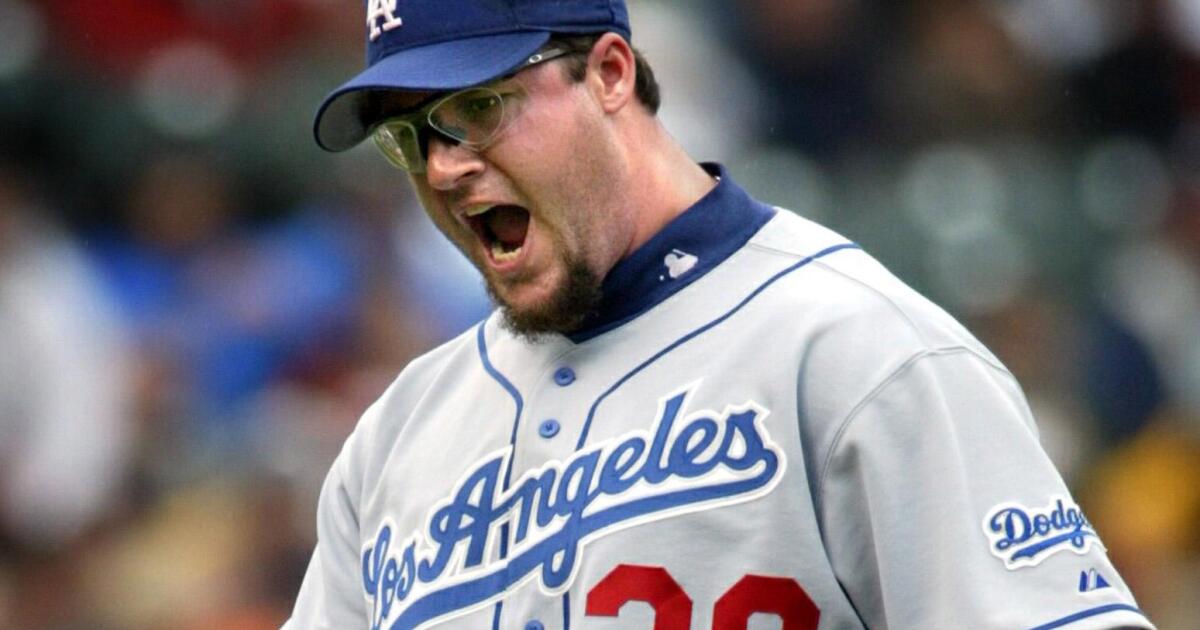
This winner of Cy Young? Dodgers fans can only wish that one is currently as dominant as dominant as Eric Gagne was in 2003 when his performance – certainly illegally improved – resulted in 55 stops and an average made by 1.20.
Otherwise, note Stark: “The voters have decided that the MVP is a price of the position player, the Cy Young is a starting launcher price and” none of the above “is a relief launcher price”.
Laters have never been considered superstars, but for a brief period after the stops were introduced as an official statistical category in 1969, the closings were regularly honored.
The Dodgers, Mike Marshall, became the first relief launcher to win the Cy Young Prize in 1974 when he made 106 amazing appearances and went 15-12 with 21 stops. Three years later, Sparky Lyle of New York Yankees became the first rise in the American League to bring back the honor.
Recognition did not end there. Bruce Sutter won the NL Cy Young Award in 1979 and Rollie Fingers became the first lift to win the Cy Young and MVP awards in 1981. Three years later, Willie Hernández of the World Series Champion Detroit Tigers became the second.
Steve Bedrosian and Mark Davis also won Cy Young awards in the 1980s, but Eckersley won the Cy Young and MVP in 1992 marked the brutal end of the victors of one or the other prize. For what? The backup has become considered an erroneous statistic, and the workload of a closer pale compared to beginners, who then regularly exceeded 200 sleeves per year.
The readers were honored for 50 years from 1960 by The Sporting News with what has become the prize for the firefighter of the year. He coincided with the introduction of a rudimentary version of The Save, created by Longtime Sporting News and the Chicago baseball writer Jerome Holtzman.
Before that, the readers were particularly anonymous. Sometimes we made the headlines for a strange achievement, like Roy Face of the Pittsburgh Pirates displaying an 18-1 file in 57 relief appearances in 1959. Holtzman was particularly upset by the fact that baseball writers were sufficiently impressed to raise the face to the seventh in the MVP NL vote.
Years later, someone returned and determined that 10 of these victories were credited in Games Face exploded the advance, the pirates returning while he was the recorder. Regarding statistics, it turns out that backups could be less imperfect than victories.
It was therefore a romantic relationship between the readers and the writers for decades. Billy Wagner was elected to the fame of fame this year during his 10th and last year on the ballot, the eighth pure lift to be inducted, joining Mariano Rivera, Trevor Hoffman, Lee Smith, Goose Gossage, Hoyt Wilhelm, Fingers and Sutter.
Ecorsley was a starter for 12 seasons before moving to the enclosure of the lifts and scored 390 stops, and John Smoltz started for 12 seasons, then became exceptional for four years before returning to rotation in the last five years of his career at the renowned temple.
Without a BBWAA price, MLB in 2005 created the delivery price of the year, which honored a better lift. Nine years later, MLB created a prize for each league named after Rivera and Hoffman, the only two launchers reach 600 career stops.
The winners each year were closures, generally league leaders in stops. With the growing value of configuration readers at an era when beginners only have 5.3 innings on average, perhaps the new launcher prices of the year will reward more ninth round.
Stark, who chaired the BBWAA Committee which studied the new prices before handing it over to members for a vote, would like to think, making the following reasons. Prices are necessary.
“Because the evolution of sport has led us at that time. Because the debates should be so fun. Because we are fortunate to do something special – and not just to count backups but to “do things correctly”. “


