Maps show where winter storm threatens to bring heavy snow, ice, brutal cold this weekend


More than 200 million people in the United States are bracing for a major winter storm expected to hit this weekend. About 175 million people are under winter warnings or extreme cold, as the system threatens to bring a mix of icy conditions across a 2,000-mile stretch of the country. Meanwhile, about 160 million people are under warnings for snow, sleet and freezing rain, according to the National Weather Service.
The storm is expected to begin in the southern Plains on Friday before moving south and on the east coast. Heavy snow, ice and brutal cold are expected to make the storm a life-threatening weather event for much of the country, 35 states.
From the Rockies to the East Coast, forecasts show that about two-thirds of the United States could be hit by what will likely be the largest winter storm in at least five years. As the system moves east, temperatures are expected to drop to record lows through the weekend in parts of the Southern Plains and Mid-Atlantic regions, with residents around Washington, D.C. and Raleigh, North Carolina potentially experiencing the coldest periods in those regions since 2018.
Maps show what to expect from the winter storm
A low pressure system is expected to develop in the southwest and interact with incoming moisture from the Gulf and cold air from the Arctic. Forecast models indicate that precipitation will begin to decrease on Friday across the Southern Plains.
CBS News 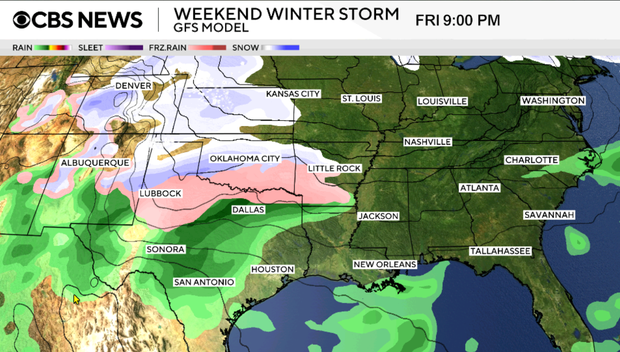
The system is expected to move slowly eastward, bringing snow and accumulating ice. Forecast models continue to change as the event approaches, but it is expected to impact large swaths of the United States, from Arizona to Maine, said National Weather Service meteorologists Rich Otto and Tony Fracasso of the agency’s Weather Prediction Center.
Heavy snowfall is expected across a wide swath of the country, with a foot or more potentially headed to parts of the Texas Panhandle and Ozarks, Otto and Fracasso told CBS News. The heaviest snowfall – perhaps up to 2 feet – could accumulate in the central Appalachians and in the northeastthey said.
According to Parts of New York could see between 6 and 12 inches of snow, according to CBS New York meteorologist Scott Padgett.
CBS News 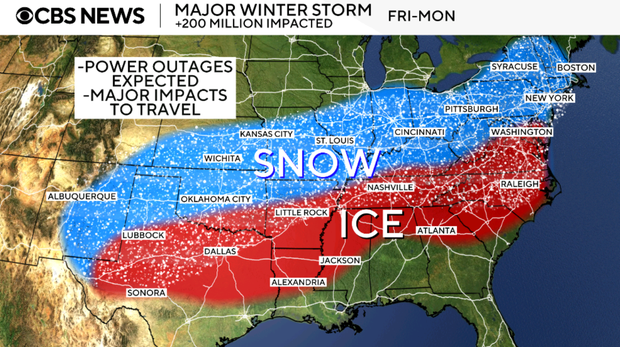
Meanwhile, the polar vortex which is usually located above the North Pole, is expected to plunge across the eastern half of the United States starting Thursday and lasting until the first half of next week.
This will cause temperatures to drop well below average for this time of year and even bring record temperatures to some locations. Frostbite can occur in just 5 to 10 minutes if you are exposed to this dangerous cold. Wind chill temperatures are expected to reach 40 to 50 degrees below zero in parts of the northern United States.
CBS News 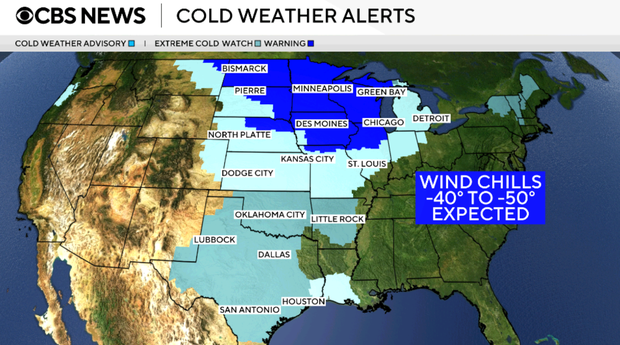
Ice is expected to accumulate along the south side of the storm’s track, but given its slow movement, the amount of accumulation is expected to be between two-tenths of an inch and up to a half-inch. Impacts of this magnitude can bring down power lines. With the severe cold prevailing, power outages could leave people freezing without indoor heat in some communities.
Parts of northeast Texas, northern Mississippi and southwest Tennessee will likely feel the greatest effects from the ice, Otto and Fracasso said. They noted that icy conditions are also expected to have significant impacts across part of the eastern United States, from northern Georgia to the Carolinas.
CBS News 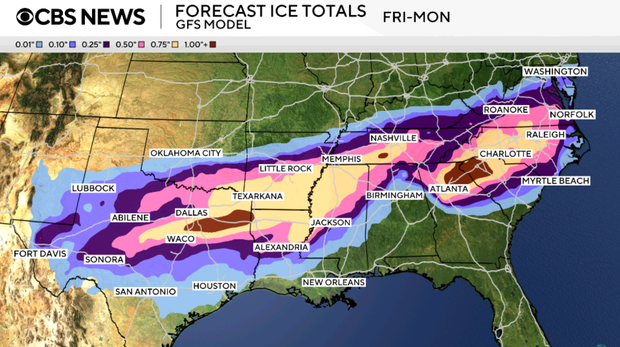
Possible snow amounts still vary by location as forecast models continue to come together. But up to 5 or 10 inches are already expected across the Southern Plains as the system takes shape over the region Friday through Saturday.
CBS News 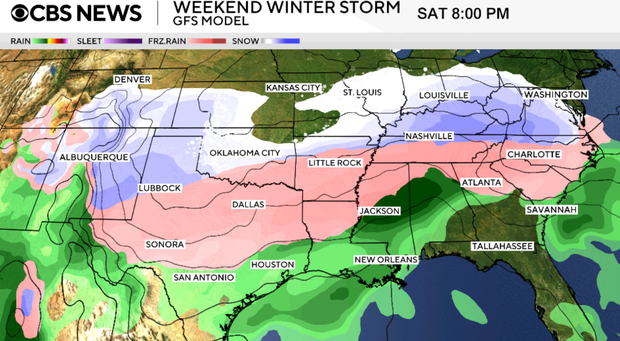
As this system moves east, snow amounts will vary depending on location.
CBS News 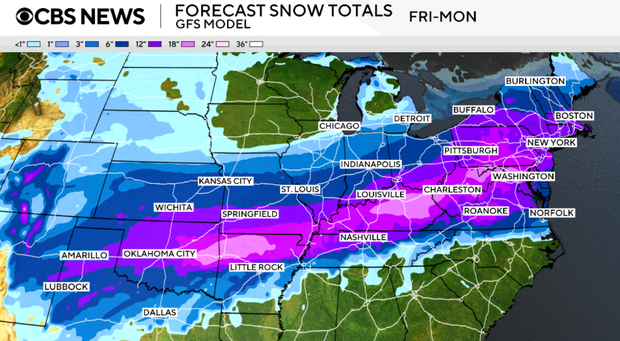
Winter storm could impact travel plans
Travel may be disrupted by weather conditions on roads and at airports. Some southern airports do not have de-icing equipment to allow planes to take off safely, which could lead to widespread cancellations and delays over the weekend.
Some airports that might experience problems are Dallas Fort Worth International Airport; Will Rogers International Airport in Oklahoma City; Clinton National Airport in Little Rock, Arkansas; Memphis and Nashville International Airports in Tennessee, as well as Hartsfield-Jackson Atlanta International Airport.
Major US airlines grant travel waiversand many carriers are issuing travel alerts and allowing customers to change their plans without penalty starting Thursday.
In a news release Thursday evening, Delta Air Lines said flight cancellations would be “necessary” at “select airports in North Texas, Oklahoma, Arkansas, Louisiana and Tennessee.” He did not say how many flights were expected to be affected.
CBS News 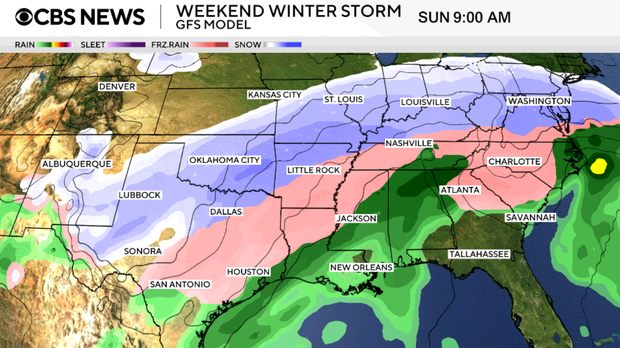
Roads may also become very difficult to navigate, if not impossible, due to slippery conditions on major highways such as I-10, I-20, I-30, I-35, I-40, I-44, I-49 and I-55.
Traveling on the roads is strongly discouraged on weekends, but if absolutely necessary, people are advised to drive with caution.
“Hazardous driving conditions are likely due to accumulating ice and snow. In some areas, travel will become nearly impossible during the peak of the storm,” Otto and Fracasso said. “Extreme cold following the storm will prolong potential impacts, with many areas not going above freezing for much of next week.”
Officials are urging drivers to consider carrying a winter storm protection kit, including items such as jumper cables, a flashlight, a shovel, extra blankets and clothing as well as water, a first aid kit and anything else that might help survive a stranded situation.
Preparations underway
In Texas, heavy ice could weigh down power lines and cause widespread outages. Texas Governor Greg Abbott said At a news conference Thursday, the Electric Reliability Council of Texas, which manages the state’s power grid, “has never been stronger, has never been more prepared and is fully capable of handling this winter storm.”
Texas transportation agencies are working overtime to prepare, with officials hoping to avoid a repeat of the widespread outages caused by a crippling ice storm in 2021, which resulted in the deaths of more than 200 people.
Stores across the South were packed with people stocked with supplies such as generators, flashlights, and batteries. In the Fort Worth area, some shoppers were finding essential items out of stock.
Meanwhile, staff at Rush University Medical Center in Chicago were bracing for a surge in cold-related injuries, with emergency room doctors on standby.
“We’ll see a lot of patients with exposure, frostbite, frostbite, possibly hypothermia,” Rush ER physician Dr. Scott Heinrich told CBS News. “We see our vulnerable populations, those without safe housing, perhaps our elderly without heat.”
Reasons for forecast uncertainty
After weather forecast models showed considerable variation in their winter storm forecasts earlier in the week, uncertainty is decreasing as the storm’s arrival approaches.
The variations seen earlier in the week were not unusual, Otto and Fracasso said, adding that there can be significant differences “between forecast models 3 to 4 days before the onset of a storm.”
Predicting winter storms can have an added layer of uncertainty because freezing temperatures create another variable in the forecast.
“For winter storms, uncertainty is compounded by uncertainty about the total amount of precipitation in addition to the type of precipitation that might fall,” Otto and Fracasso said. When the precipitation type is snow, very slight atmospheric changes, such as temperature swings of just one or two degrees, can significantly change the forecast, they added.


